What Alberta requires of portable fire extinguishers
Every building needs portable fire extinguishers except dwelling units (home-type care occupancies are pulled back in), and fire extinguisher inspection in Edmonton follows NFPA 10-2013, not the newer editions NFPA sells today (NFC(AE) 2023, Division B, 2.1.5.1 and 6.2.1.1). The units have to be selected and installed to NFPA 10, listed to the CAN/ULC performance standard for their type (S504 for dry chemical, for example), rated and identified to CAN/ULC-S508, reachable without undue risk and protected against corrosion where the air is corrosive.
Extinguishers sold, used or serviced in Alberta must also carry metric, bilingual labels showing the CAN/ULC standard and a certification mark (Division C, 2.1.2.7(3) and (4)). A unit labelled for the US market only doesn't qualify, which matters if someone buys cheap online.
The monthly, annual, six-year and hydrostatic schedule
| Task | Interval | Who | What it involves |
|---|---|---|---|
| Inspection | Monthly | The owner, a designated employee or a service provider | A check of each unit, listed below |
| Maintenance | Every year | Qualified personnel at a certified service agency | A closer examination, with the tag updated |
| Six-year maintenance | Every 6 years, on stored-pressure dry chemical units | Certified agency | An internal teardown. The clock restarts after a recharge or hydrostatic test |
| Hydrostatic test | Every 12 years for dry chemical. Every 5 years for CO2, water and wet chemical | Agency with certified test equipment | A pressure test of the cylinder |
| Recharge | Immediately after any use | Certified agency | Refill and a new tag entry |
Halocarbon clean agent units aren't covered by that table, so ask your agency and read the nameplate.
The six-year teardown is the easiest to miss, because it doesn't land on an annual visit's calendar. And don't top up a dry chemical cylinder from whatever is on the shelf. ABC dry chemical is acidic, BC is alkaline, and mixing them can build dangerous pressure (Amerex service manual).
What the monthly check covers
Monthly inspection under NFPA 10 can be done by the owner, an employee the owner designates or a service provider (NFC(AE) 2023, Division C, 2.2.4.2(3)). The Amerex owner's manual, which restates the NFPA 10 items, lists these:
- the unit is in its designated place, and nothing blocks or hides it;
- the gauge reads in the operable range;
- fullness is confirmed by weighing or hefting, where that applies;
- instructions face out;
- safety seals and tamper indicators are intact;
- no visible damage, corrosion, leakage or clogged nozzle.
Monthly entries on the tag are handwritten (Division C, 2.2.1.2(13)). Monthly checks fail the boring way: everyone assumes someone else did them. On a multi-floor site, put named people on named floors.
The Alberta tag, item by item
An extinguisher with a poor tag is easy for an inspector to spot and slow to defend. NFC(AE) 2023, Division C, 2.2.1.2(10), wants a securely attached tag showing the type, size and serial number; the date of the last annual inspection and of the last recharge; and a five-year record of monthly inspections and annual maintenance. It also carries the owner's name, the service agency's name, address and phone, the approved testing agency's certification number, and the printed name and signature of the person who did the work.
Two allowances apply.
Bar-coded tags are fine if the full record is kept at the premises and the tag still carries the key items (2.2.1.2(11)). And weather-exposed extinguishers rated 40B:C or 80B:C on outdoor commercial equipment may use adhesive labels (2.2.1.2(12)).
Who may service extinguishers in Alberta
Technicians need an approved public post-secondary certificate and must own or work for an agency certified annually to CAN/ULC-S532 by a recognized certification body. The agency's facility and equipment are certified annually by an approved fire testing agency, and any high-pressure hydrostatic test equipment is certified by Transport Canada or its appointee (Division C, 2.2.3.2 and 2.2.4.2).
Ask any service company for its S532 certificate and the testing agency certification number that goes on your tags. Sterling supplies Amerex extinguishers, and we'd tell you the same about ours: ask for the paperwork.
Choosing types and ratings
The letters on an extinguisher name the fire class it handles, and the numbers say how big a fire of that class it's rated for. Class A is ordinary combustibles, B is flammable liquids, C is energized electrical equipment and K is cooking oils. The types of fire extinguishers guide covers the classes properly.
The code sets some ratings itself. Tire storage, for one, needs a 4-A:80-B extinguisher every 500 m2 within 25 m of travel (NFC(AE) 2023, 3.2.4.4). Kitchens need Class K units near the cooking line, alongside the hood system covered under special hazard suppression. And cold matters in Alberta. The Amerex dry chemical line is rated to -54°C on some models and -40°C on others, so read the nameplate on any unit that lives on a loading dock, in a parkade or on a truck, and protect it if temperatures leave that range.
Where extinguishers go
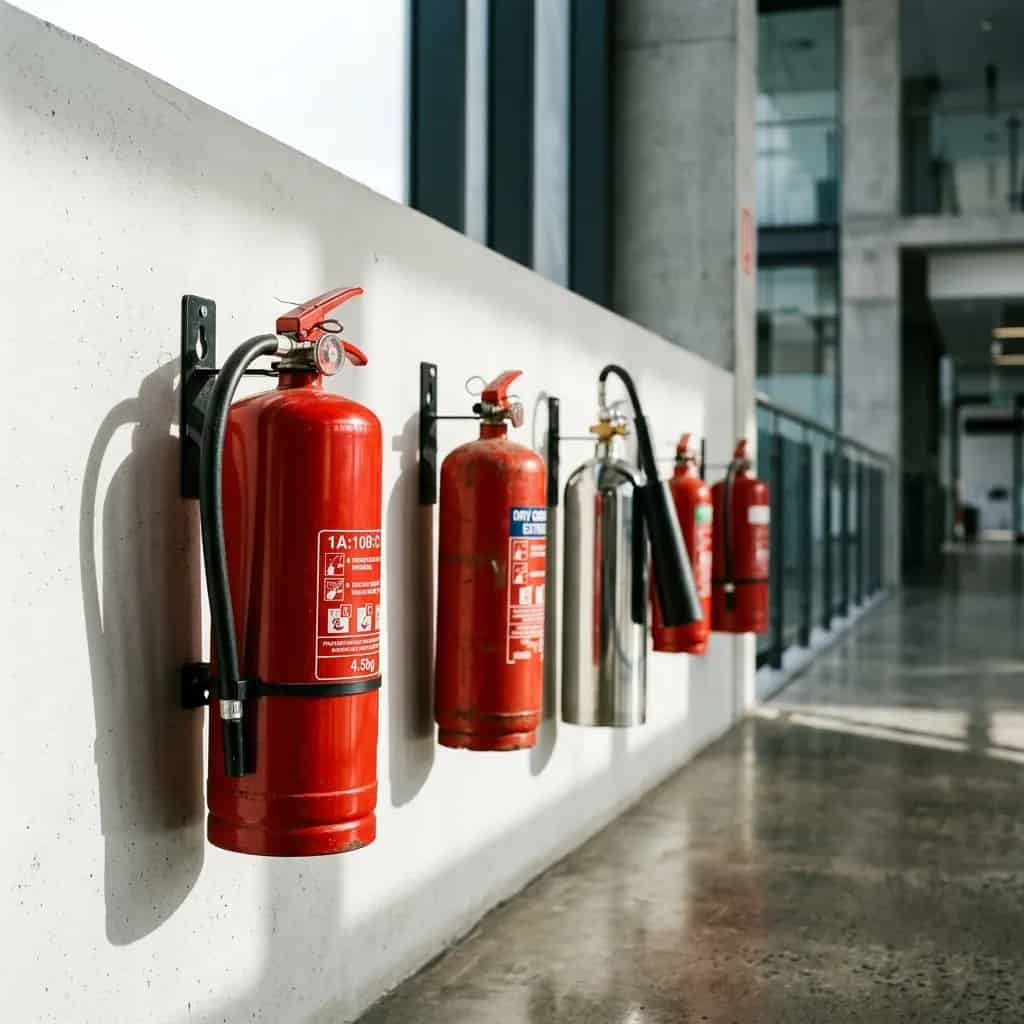
Mount them where people will pass on the way out. Not in the back of a mechanical room. NFPA 10, as the Amerex manual restates it, limits mounting height by weight: a unit under 40 lb (18 kg) gross goes with its top no higher than 5 ft (1.5 m) above the floor, and a heavier one no higher than 3.5 ft (1.1 m).
Travel distance limits depend on class. The NFPA tables most guides summarize allow 75 ft (22.9 m) to a Class A extinguisher, 30 ft (9.1 m) to a Class K, and 30 or 50 ft to a Class B depending on rating and hazard. Treat those as a starting point and confirm them against NFPA 10-2013 and your AHJ, since layout and ratings are settled together at design.
Training, recharging and replacing
Nobody should meet an extinguisher for the first time in a fire. Walk the staff most likely to use one past the nearest units, show them the pin and the gauge, and settle the rule beforehand: small fire, clear exit behind you, otherwise leave and call 911.
Recharge immediately after any use, even a short burst, and have the agency update the tag. Replace rather than recharge when a unit fails hydrostatic testing, is dented or corroded, or when a recharge plus a due hydro test creeps toward the price of a new unit. That last one is judgment, and we'd make the call with you at the annual visit with the age and condition in front of us.
What drives the price: the number and types of units, how many are due for six-year maintenance or a hydrostatic test this year, how easy they are to reach, and whether the tags and records need cleaning up. We quote after a count, not before. Send the building address and a rough unit count through the contact page. Extinguishers also fit into the annual visit described on our fire system inspections page.
Frequently asked questions
How often do fire extinguishers need to be inspected in Alberta?
Monthly by the owner, a designated employee or a service provider, and yearly by qualified personnel at a certified agency (NFC(AE) 2023, Division C, 2.2.4.2). Stored-pressure dry chemical units also need a six-year internal teardown, and every type needs hydrostatic testing at 5 or 12 years depending on the agent.
Can we inspect our own extinguishers?
Yes, the monthly inspection only. Annual maintenance, the six-year teardown, hydrostatic testing and recharging need a certified agency. The monthly and annual entries on the tag must be handwritten, so keep a pen with the log.
What is the six-year maintenance on a fire extinguisher?
A complete internal teardown and examination of a stored-pressure dry chemical extinguisher, done every 6 years. It's tied to the 12-year hydrostatic test, and the six-year clock restarts after a recharge or a hydro test.
When does an extinguisher need a hydrostatic test?
Dry chemical cylinders every 12 years, and CO2, water and wet chemical units every 5 years, tested to the pressure on the nameplate. Halocarbon clean agent units follow their own schedule, so ask your service agency.
Can I buy extinguishers online or at a hardware store?
You can, but Alberta requires metric, bilingual labels with the CAN/ULC standard and a certification mark (Division C, 2.1.2.7(3) and (4)). A US-only label doesn't meet it. The first annual service will also need a certified agency to tag the unit properly.
Does a rental apartment suite need its own extinguisher?
The code exempts dwelling units, but the rest of the building doesn't get a pass (NFC(AE) 2023, Division B, 2.1.5.1). Common areas such as corridors, service rooms and parkades still need extinguishers, placed to NFPA 10's travel-distance rules.
Sources
- National Fire Code 2023 Alberta Edition, National Research Council Canada
- Owner's Service Manual, hand portable dry chemical extinguishers (P/N 05602), Amerex
- The ABCs of Fire Extinguisher Service, Amerex
- Fire codes and standards, Government of Alberta