One fire, seven systems
Follow one fire through a typical commercial building and you'll meet most of the seven systems, each handing off to the next.
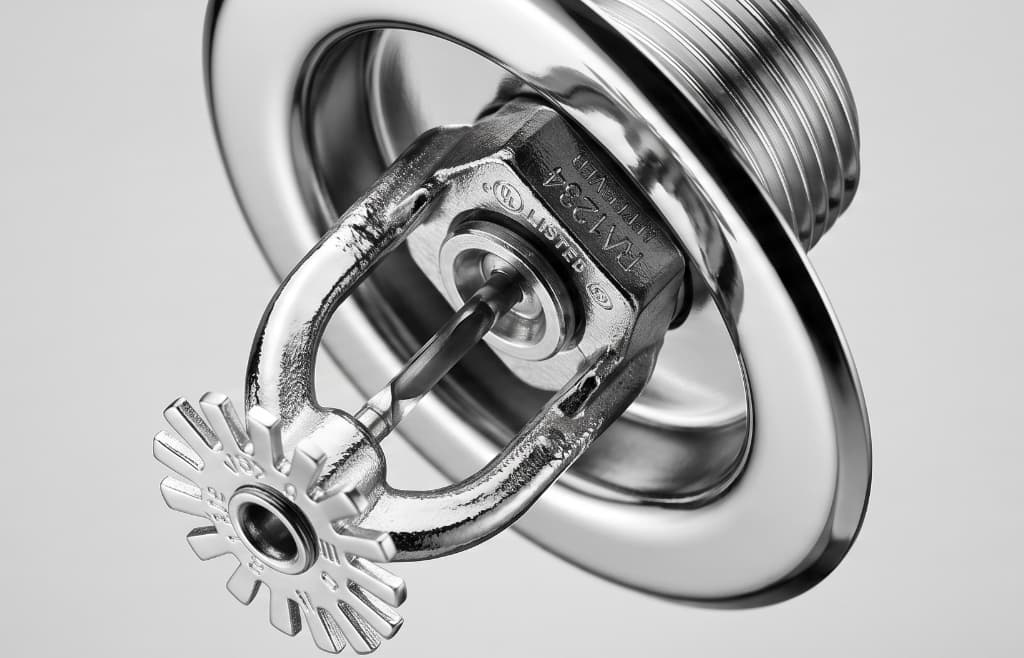
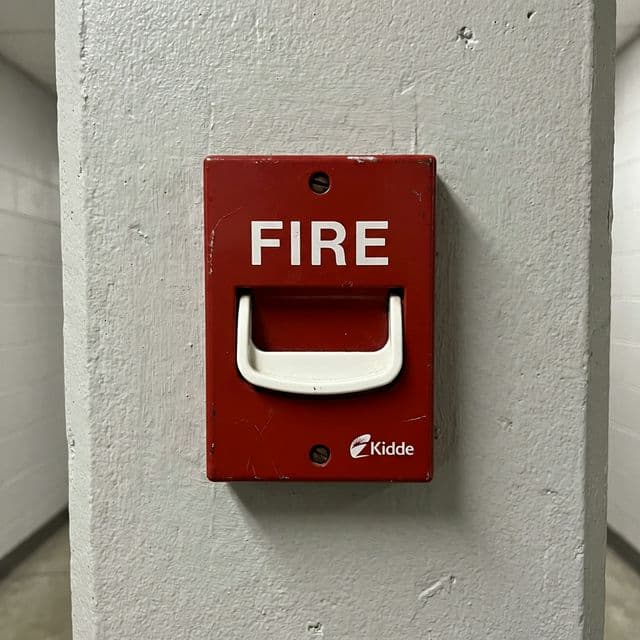
A sprinkler head opens over the fire. Water starts moving in the riser, and the flow switch on that riser tells the fire alarm panel. The panel sounds the horns and sends a signal to a monitoring centre, which calls the fire department. As the sprinklers draw water, system pressure falls, and if the building has a fire pump it starts. All of that water arrives through a backflow assembly. If the power fails, the emergency lights come on for the walk to the exit signs.
That's the sequence on a good day.
Not every fire gets that far. A portable extinguisher deals with the small one. And where water would do more harm than the fire, in a server room, over a kitchen range or in a flammable liquid store, special hazard suppression stands in for the sprinklers or works beside them.
A building doesn't carry all seven by default. Which it needs comes from its occupancy, floor area, height and use under the National Building Code 2023 Alberta Edition (NBC(AE) 2023) and the National Fire Code 2023 Alberta Edition (NFC(AE) 2023). That's a code analysis, not a shopping list.
Which system answers which building problem
| The building problem | The system | What it does |
|---|---|---|
| A fire will grow before the fire department arrives | Fire sprinkler systems | Heads over the heat open and control the fire, and often put it out |
| Nobody in the building knows there's a fire | Fire alarm systems | Detects, warns occupants and signals a monitoring centre |
| Water would ruin the room, or can't put out the fire | Special hazard suppression | Clean agent, CO2, foam or a kitchen wet chemical system, built around one hazard |
| The street main can't deliver what the sprinklers need | Fire pumps and hydrants | A pump, often with a storage tank, plus private hydrants on the site |
| The sprinkler pipe hangs off the public water supply | Backflow prevention | An assembly on the fire line stops water flowing back into the main |
| The power fails and the corridors go dark | Emergency lighting and exit signs | Battery-backed lights and signs that show the way out |
| A small fire, and someone is standing next to it | Portable fire extinguishers | Rated, tagged units within reach |
Sprinklers get the attention, but the supporting pieces are where projects trip. The alarm connection, the water supply and the backflow assembly each involve another trade or a utility, and each has to be finished before the acceptance test can run.
How the systems hand off to each other
Sprinklers talk to the alarm through switches on the riser. The waterflow and supervisory switches are wired into the fire alarm panel, and a fire alarm system that includes waterflow devices must notify the fire department through monitoring to CAN/ULC-S561 (NBC(AE) 2023, 3.2.4.7). That's why the monitoring company gets a call before every sprinkler test.
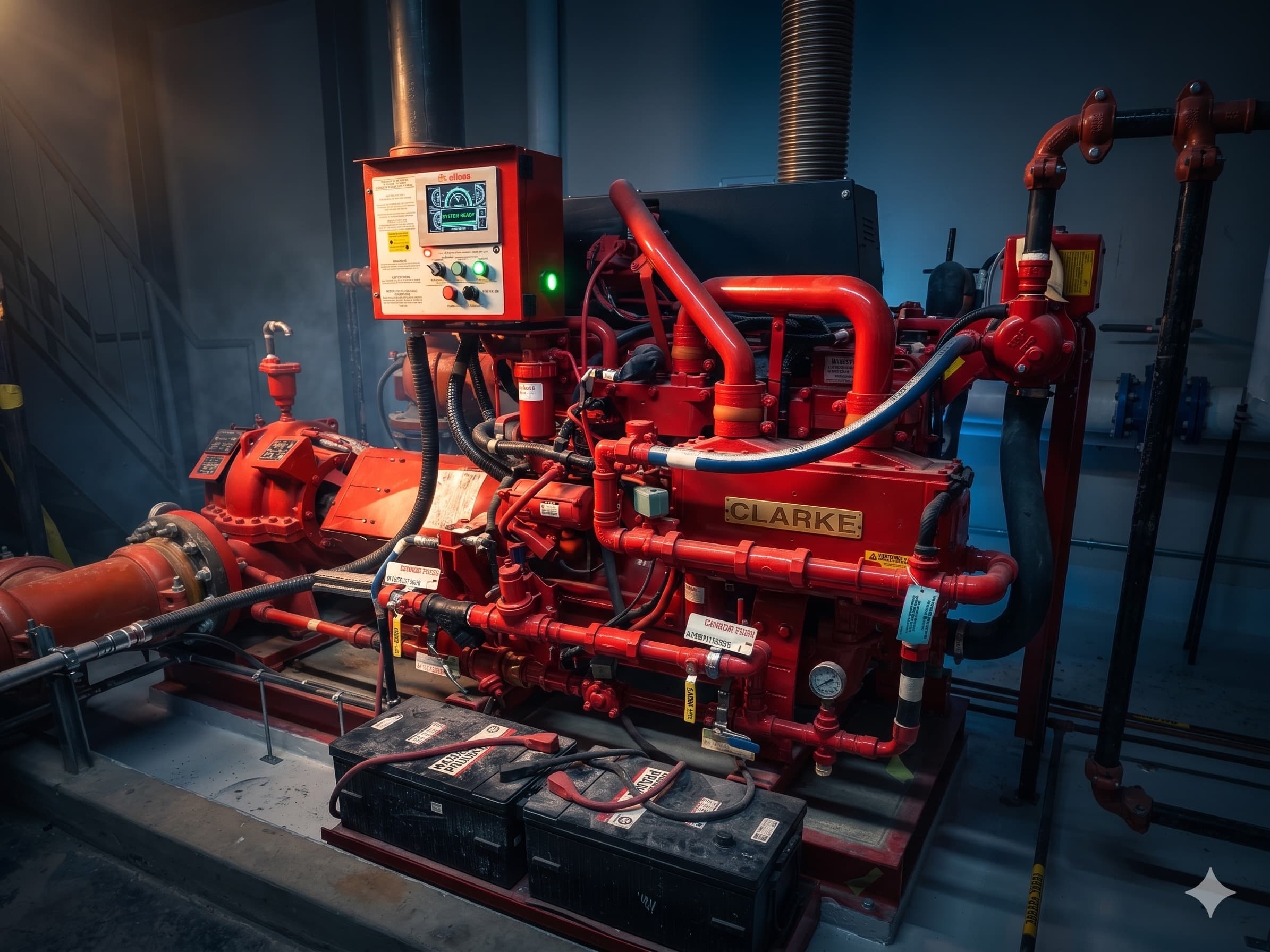
The fire pump exists to make the sprinkler hydraulics work. When system pressure falls, the controller starts the pump, and a small jockey pump holds pressure between events, so a jockey that never stops usually means a leak. NBC(AE) 2023 references NFPA 20-2016 for pumps, older than the NFPA 13-2019 edition used for the sprinklers, which is why out-of-province specifications catch people out.
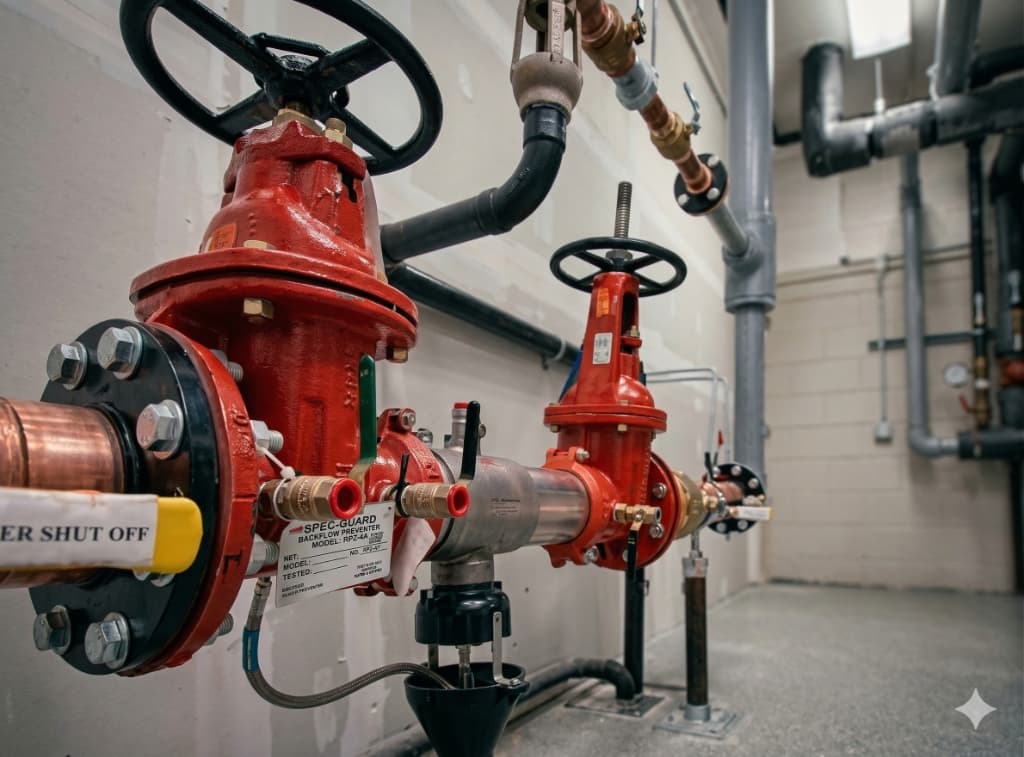
The backflow assembly sits on the fire line ahead of the fire department connection (National Plumbing Code 2020, 2.6.2.4). EPCOR says the annual test takes 1 to 2 hours with a short water shut-off, and on a fire line that shut-off takes the sprinklers with it. Add antifreeze to a loop and the same plumbing code wants a reduced pressure assembly instead of a double check. If an annual test fails, what to do when a backflow test fails in Edmonton sets out the repair and retest steps.
Emergency lighting covers the way out when normal power fails. It has to average at least 10 lx at floor level with no point below 1 lx along exits and the main routes to them, and it runs for 30 minutes in most buildings, 1 hour in care, treatment and detention buildings that aren't high buildings, and 2 hours in high buildings (NBC(AE) 2023, 3.2.7.3 and 3.2.7.4). How the monthly and yearly tests work is in our emergency lighting testing guide.
The alarm also reaches into other systems. On alarm it can recall elevators, stop air handlers and release door hold-opens. The code tests those connections as a group to CAN/ULC-S1001-11 (NFC(AE) 2023, 6.8.1.1), coordinated by a registered engineering professional (Division C, 2.2.4.8).
What happens when one of them is down
Because each system leans on another, shutting one down takes out more than you'd expect. Close the water for a valve repair or a backflow test and the sprinklers are out. Take the alarm panel down and the sprinkler flow signals go nowhere.
If a fire alarm system or part of it is out for more than 2 hours, the owner must notify the fire department and, when directed, provide continuous surveillance until it's restored (NFC(AE) 2023, Division C, 2.2.7.2).
Plan the routine work so the building is impaired once, not three times. Do the sprinkler test, the backflow test and the alarm test in one visit with the monitoring company on the line. The fire system inspections page covers what a visit involves, and the 24/7 emergency repair page covers what to do when something goes down between visits.
Which of the seven your building needs
A warehouse leans on sprinklers and water supply. A hotel leans on the alarm and its voice evacuation. A data hall leans on special hazard suppression. The industry pages show how the mix shifts by sector, and fire code consulting settles the borderline cases before design starts. The fire code compliance guide explains who enforces what.
Sterling works on all seven through five services: design, installation, inspection and maintenance, code consulting and emergency repair. On the kitchen side of special hazards, we work with Amerex kitchen suppression systems. The services overview shows how those fit a project from first drawing to annual test.
Send the address, the use and any drawings through the contact page, or call 780.760.0806. That number is answered at any hour for emergencies.
Sources
- National Fire Code 2023 Alberta Edition, National Research Council Canada
- National Building Code 2023 Alberta Edition, National Research Council Canada
- National Building Code 2023 Alberta Edition, Part 3 code update information, BILD Alberta
- National Plumbing Code of Canada 2020, National Research Council Canada
- Cross Connection Control, EPCOR
- Fire codes and standards, Government of Alberta