What EPCOR requires for backflow prevention in Edmonton
If you own or manage a commercial, industrial, institutional or multi-residential property (five units or more) in Edmonton, you need a backflow preventer on the water service, and a certified tester has to test it every year. The report goes to EPCOR within 5 business days. Fire lines are named in the bylaw.
The legal basis is Bylaw 19626, the EPCOR Water Services Bylaw (consolidated July 7, 2026), Schedule 2, section 5.4. Customers can't allow contaminating cross connections, and must control them by installing, maintaining and testing approved backflow prevention, "including fire lines". EPCOR's cross connection control program keeps a database of assemblies and their test histories, registers certified testers, requires testers' kits to be calibrated every year, and surveys premises. Its own brochure lists fire sprinkler systems first among common cross connections.
These are Edmonton's rules. In another municipality, ask the local water utility what it requires.
Why a fire line gets a backflow assembly
Backflow is water moving the wrong way, from a building's piping back into the public main. It happens when pressure in the main drops, after a main break or heavy hydrant use, or when pressure in the building rises above supply. A sprinkler system is a pipe full of water that may have sat for months. It can hold corrosion inhibitors or antifreeze, and its fire department connection lets a pumper push water of unknown quality into it. So the National Plumbing Code 2020 (2.6.2.4) puts the preventer upstream of that connection, and bars bypass piping that would reduce its effectiveness (2.6.2.12).
DCVA, RP and the fire line
Three devices do most of the work.
- A double check valve assembly (DCVA) is two internally loaded check valves between shutoffs, with test cocks. EPCOR's guide allows it only where the hazard is a pollutant, not a health hazard.
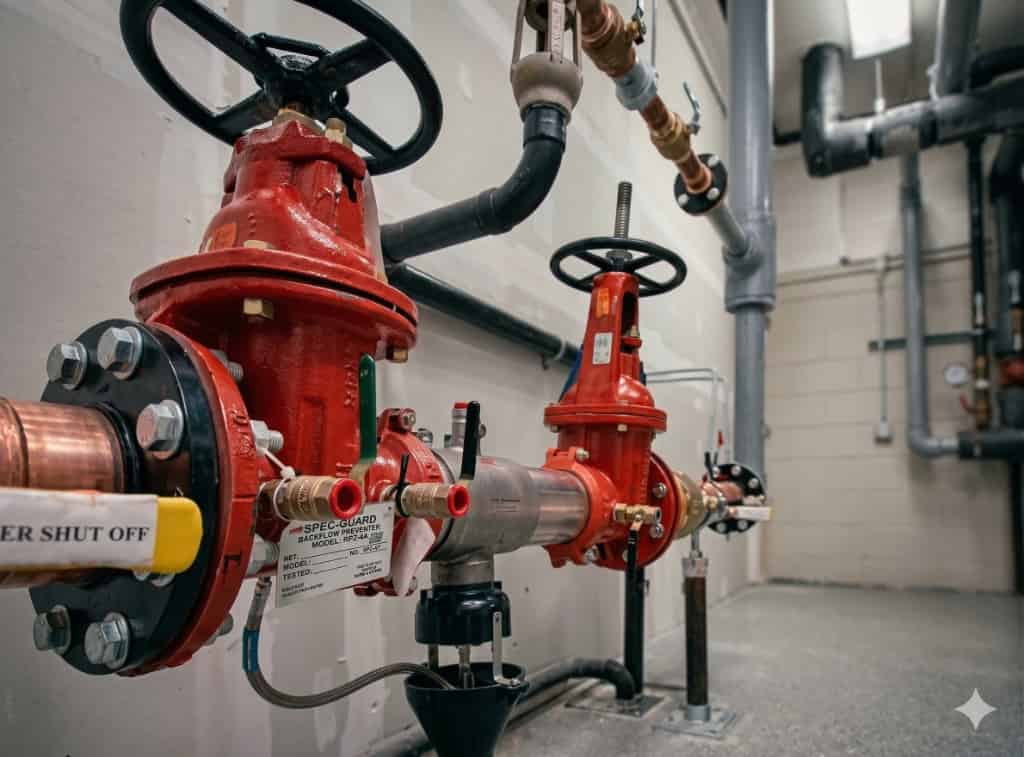
- A reduced pressure principle assembly (RP) adds a hydraulically operated relief valve between two independent checks. If the first check leaks or the supply pressure drops, the relief valve discharges water, so an RP needs a drain that can take that discharge, and room to work.
- A dual check has no test cocks and no relief port. It's the lightest protection, and it isn't a testable assembly.
On fire lines you may also see the detector version of the double check, a DCDA, which adds a small metered bypass so a low flow (a leak, or unauthorized use) shows on a meter. It's still a double check, suited to the same pollutant-level hazards as a DCVA.
EPCOR ties the device to the degree of hazard. Its examples put severe hazards (hospitals, car washes, labs, auto repair, dry cleaners) on an RP, and moderate ones (restaurants, schools, hotels, offices, malls, apartments) on a DCVA. The plumbing code adds its own rule for the sprinkler side. The National Plumbing Code 2020 (2.6.2.4) sorts fire systems into six classes, and the protection rises with the risk:
- residential systems of potable pipe: no preventer for full flow-through, a dual check for partial flow-through;
- Class 1 systems with no additives and potable materials: a single or dual check;
- the rest of Classes 1 to 3 without additives: a double check assembly;
- any Class 1 to 3 system using antifreeze or other additives: an RP on that portion;
- Classes 4 and 5: an RP. Class 6: a DCVA, or an RP where there's a severe health hazard.
Antifreeze is the trap. A designer adds a small antifreeze loop to a dock canopy, and a fire line that was happy with a DCVA now wants an RP on that portion. That should show up in design, not at commissioning. The sprinkler systems page covers freeze options. Have your designer name the assembly before you buy it, and confirm with EPCOR's cross connection office (780.412.7840) that it will be accepted.
What the annual test involves
A backflow assembly gets tested on installation, after it's cleaned, repaired or overhauled, when it's moved, every year, and whenever the regulator asks. Every testable assembly is tested annually. Non-testable devices get a visual inspection.
The tester needs a Western Canada Section AWWA Cross Connection Control Specialist certificate, a registration with EPCOR and a calibration report for the test kit. EPCOR's guide says the certificate can't be older than five years. Testing follows the AWWA Canadian Cross Connection Control Manual. EPCOR's brochure tells owners to hire a certified plumber or fire sprinkler company from its list. We install and test DCVA and RP assemblies, but whoever tests yours, us included, ask to see the certificate and check the tester is on EPCOR's list.
The tester connects a differential pressure kit to the assembly's test cocks and checks that each check valve holds against reverse flow and, on an RP, that the relief valve opens when it should. EPCOR says the annual test takes 1 to 2 hours with a short water shut-off. Installing a new assembly can take a full working day, water off (EPCOR brochure).
On a fire line, that shut-off takes the sprinklers with it. Treat the test window as a planned impairment: tell the monitoring company, tag the valve, and have the system back in service before the tester leaves. The NFC(AE) 2023 treats any interruption, routine testing included, as a temporary shutdown that needs alternative measures (Division B, 6.1.1.4 and its explanatory note), and the fire system inspections page explains how impairments are handled, and our impairment checklist lists the steps for a planned one.
Reporting is online now. Testers submit results through SwiftComply within 5 business days, and EPCOR no longer takes email or fax. New testing companies and testers have to register there first. EPCOR only accepts reports for premises isolation assemblies. Reports for internal zone or fixture assemblies stay with the building owner, and a copy of every test report stays on site. EPCOR sends a reminder when the annual test is due.
Two tests, two audiences
Owners tend to confuse the EPCOR test with the sprinkler side, which has its own rules under NFPA 25-2017.
| EPCOR backflow test | NFPA 25 forward flow test | |
|---|---|---|
| Proves | The check valves hold, and an RP's relief valve works | The assembly passes enough water to the system |
| How often | Annually | Annually (13.7.2) |
| Done by | A certified tester on EPCOR's list | An inspector qualified under NFC(AE) Division C, 2.2.4.4 |
| Record goes to | EPCOR through SwiftComply, plus a copy on site | Your fire inspection records |
NFPA 25 also has RP assemblies inspected weekly or monthly (13.7.1), and it moves the main drain test from annual to quarterly where the sprinklers' only supply runs through a backflow preventer (13.2.5), per Siemens's chart of NFPA 25-2017. A backflow assembly quietly changes your fire inspection schedule. Booking both tests into one visit saves a second shut-off. The fire pump page covers the other equipment on that supply.
When the test fails
EPCOR gives a failed assembly 5 business days to be repaired or replaced and retested, and the owner pays. If you don't, EPCOR can shut off the water, apply bylaw penalties and inform Alberta Health Services. Bylaw 19626 lists penalties item by item, and they change, so read the current schedule. A water shut-off on a sprinklered building is an impairment you never scheduled. Don't let a failed report sit, and if the supply is impaired, call us or read the 24/7 emergency repair page.
Failures are ordinary. Rust scale and grit from a fire line get under a check seat, rubber seats wear or tear, and an RP's relief valve leaks or opens at the wrong differential. A dirty or worn assembly can usually be rebuilt and retested. A cracked body can't.
Freeze protection for assemblies
The assembly sits at the service entrance, often in a mechanical room, a vault or a small heated enclosure. NBC(AE) 2023, 3.2.5.17, requires fire protection equipment in unheated areas to be protected from freezing. Edmonton's January design temperature is -30°C (2.5%) and -33°C (1%), and the airport has recorded -45.9°C, on January 12, 2024. An assembly in a cold corner at that temperature is a cracked body waiting. The heater, its thermostat and a low-temperature alarm belong in the installation, and a heated room is only as good as its heater. Check it in October.
New assemblies on a construction project
For a general contractor, three things cause trouble. The assembly's size, clearance and drain need to be on the drawings early, since an RP's relief port must never sit where water can submerge it, which rules out a pit that floods. The contractor pulls the City permits before installing. And the assembly has to be tested at commissioning, with the report going to EPCOR, so the owner's water shut-off has to be booked. Where the assembly sits also affects the sprinkler design, because it takes pressure out of the supply. See fire system installation for sequencing. Our guide to sprinkler submittals and permits covers the wider submittal sequence.
If a test has failed or the report is overdue, call 780.760.0806 or use the contact page.
Frequently asked questions
How often does a backflow preventer need to be tested in Edmonton?
Every year, by a certified tester, and also on installation, after any cleaning, repair or overhaul, and when the assembly is relocated. EPCOR requires testable assemblies on premises isolation to be tested annually under Bylaw 19626. Non-testable devices get a visual inspection instead.
Who can test a backflow preventer in Edmonton?
A tester with a Western Canada Section AWWA Cross Connection Control Specialist certificate who is registered with EPCOR and has a calibrated test kit. EPCOR keeps a certified tester list, and its brochure suggests hiring a certified plumber or fire sprinkler company from it.
Where does the backflow test report go, and how fast?
To EPCOR's Cross Connection Control office within 5 business days of the test, submitted online through SwiftComply. Email and fax aren't accepted. Keep a copy of every report on site. Reports on internal zone or fixture assemblies go to the building owner, not EPCOR.
Will my sprinklers be out of service during a backflow test?
For a short time, yes. EPCOR says the annual test takes 1 to 2 hours with a brief water shut-off. On a fire line that shut-off takes the sprinkler supply with it, so plan it as an impairment: tell the monitoring company and have the water back on before the tester leaves.
Do I need an RP or a DCVA on my fire line?
It depends on the hazard and the system. EPCOR puts moderate hazards such as offices, hotels and apartments on a DCVA, and severe hazards on an RP. The National Plumbing Code 2020 (2.6.2.4) requires an RP on the portion of a Class 1 to 3 fire system that uses antifreeze or other additives, and on Class 4 and 5 systems. Confirm with EPCOR before you buy.
What happens if I don't get my backflow preventer tested?
EPCOR can apply penalties under the bylaw, shut off the water and notify Alberta Health Services. A failed test has its own clock: repair or replace within 5 business days, then retest. The bigger problem is a building with no water.
Related reading
- What to do when a backflow test fails in Edmonton. A failed backflow test starts a clock.
Sources
- Cross Connection Control, EPCOR
- Cross Connection Control Procedure Guide, EPCOR, February 26, 2024
- Cross Connection Control brochure, EPCOR
- Bylaw 19626, EPCOR Water Services Bylaw, City of Edmonton
- National Plumbing Code of Canada 2020, National Research Council Canada
- National Building Code 2023 Alberta Edition, National Research Council Canada
- NFPA 25-2017 frequency tables, Siemens