
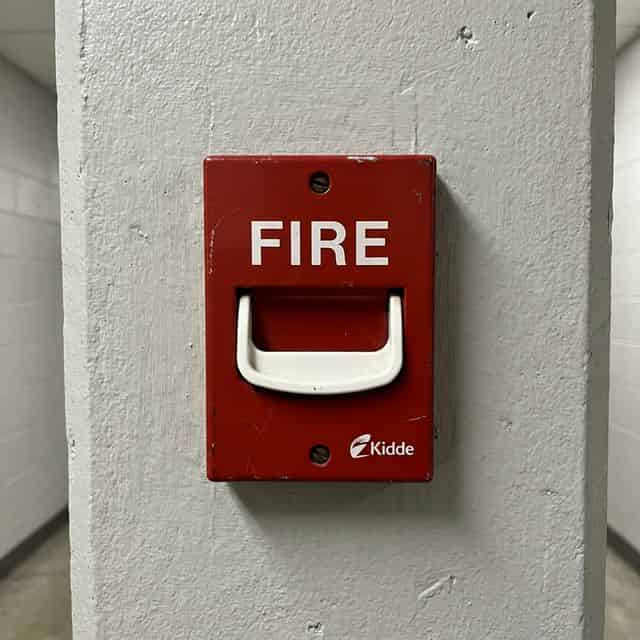
What Alberta's code requires of a fire alarm system
Fire alarm system installation in Edmonton is done to CAN/ULC-S524:2019, verified to CAN/ULC-S537:2019, then inspected and tested every year to CAN/ULC-S536:2019. NFPA 72 isn't Alberta's standard. The building code mentions it only in an explanatory note on voice intelligibility. The National Building Code 2023 Alberta Edition (NBC(AE) 2023) names S524 and S537 (Division B, 3.2.4.5). The National Fire Code 2023 Alberta Edition (NFC(AE) 2023) names S536 (6.3.1.2) and requires the system to be operable at all times (6.3.1.1).
But whether a building needs a system at all is a code-analysis question. For a building that isn't sprinklered throughout, NBC(AE) 2023, Sentence 3.2.4.1(4), lists the triggers, as shown in BILD Alberta's code update comparison: more than 3 storeys, a total occupant load over 300, more than 150 people above or below the first storey, a school or child care facility over 40 people, a licensed beverage establishment or licensed restaurant over 150, and a few more. Check the official code text for the full list. Sprinklers, occupancy and change of use all move the answer, so have your design professional settle it before the ceilings close. An existing system must be upgraded if a change of use creates a hazard beyond its design (NFC(AE) 2023, Division B, 2.1.3.1).
Conventional or addressable panels
Conventional panels tell you which zone is in alarm. Addressable panels tell you which device.
That decides how long a fault takes to find. On a conventional system a zone can be a whole floor, so every alarm or trouble sends someone walking every detector in it. An addressable loop gives each detector, pull station and monitor module an identity.
We'd specify addressable on almost any new commercial build. Chasing faults through conventional zones costs labour every time, and an addressable panel can be reprogrammed when tenants move walls. A small building with a short life ahead can live with conventional. On older panels the catch is parts, so ask whether the manufacturer still supports yours.
Detectors, notification and voice evacuation
Detector type follows the room.
- Spot smoke detectors cover most offices, corridors and suites.
- Heat detectors go where smoke detectors would cry wolf, such as boiler rooms and unheated garages.
- Duct detectors sit in air handler ducts and stop the fans so smoke isn't carried around the building. The S536 record logs their pressure differential, because a duct detector with no air moving across it detects nothing.
- Beam detectors span atria and warehouses, where ceilings are too high for spot detectors.
- Aspirating (air-sampling, VESDA-type) detectors draw air down a pipe network to a central unit. They earn their cost in server rooms and cold rooms.
Horns and strobes do the notifying. Voice evacuation goes further and lets the building say "use the stairs" instead of just making noise. An unsupervised voice or PA system that forms part of the evacuation plan is tested at least monthly, for audibility throughout the building and two-way communication from each floor (NFC(AE) 2023, 6.3.1.4). We install addressable panels, voice evacuation and air-sampling detection, and connect them to ULC monitoring.
What the alarm talks to
A fire alarm rarely works alone. On alarm it can recall elevators, stop air handlers, release door hold-opens and magnetic locks, and take signals from sprinkler flow and tamper switches. Each connection lands on another trade's equipment, and each is a way for the system to fail quietly.
The code tests them as a group. NFC(AE) 2023, 6.8.1.1, points to CAN/ULC-S1001-11, and the coordinator has to be a registered engineering professional (Division C, 2.2.4.8). For a GC that's a scheduling knot: the elevator, mechanical, security and sprinkler trades must all be finished and powered before the integrated test can run (see fire system installation). If the alarm controls sit behind a locked panel, the fire department also needs a key box (Division C, 2.2.10.1), on the exterior wall near the principal entrance when the system signals the fire department.
Monitoring and the Fire Protective Signalling Certificate
Monitoring means an alarm signal reaches a fire signal receiving centre, which calls the fire department. The building code requires it for single-stage systems in assembly occupancies over 300, for any system with waterflow devices and for any two-stage system (NBC(AE) 2023, 3.2.4.7), with the centre maintained to CAN/ULC-S561 (NFC(AE) 2023, 6.3.1.3). A building whose sprinkler flow switches feed the alarm panel is monitored. That isn't optional.
The paperwork is a Fire Protective Signalling Certificate. The owner gives the AHJ one from a certified listing agency, naming the address, the listed installer and the listed monitoring company (NBC(AE) 2023, Division C, 2.2.3.4). Both companies need a listing. So ask each for proof before you sign. Call the monitoring company before any test, so a test signal doesn't send a fire truck.
Who may install, verify and test in Alberta
| Job | Who the fire code accepts (NFC(AE) 2023, Division C, 2.2.4.3) |
|---|---|
| Install | An Alberta journeyperson electrician (certificate dated September 1, 1991 or later), or an earlier Alberta or Red Seal electrician plus a fire alarm course recognized by the Provincial Fire Administrator |
| Make operational, inspect, test, maintain and sign documentation | An approved public post-secondary certificate (including those electrician routes) or a current Canadian Fire Alarm Association (CFAA) Fire Alarm Technician certification |
| Assist at the panel during verification or annual testing | The same qualifications, or supervised apprentices and CFAA students |
| Daily and monthly checks | The owner or their representative, once trained by the manufacturer or a service provider |
The old routes are gone. The code's explanatory note says NAIT and SAIT Fire Alarm Technician certificates, Alberta "P" cards and Alberta Fire Safety Association cards were recognized only until December 31, 2025. In 2026 a P card on its own isn't enough. Ask to see the certificate or the CFAA number, ours included.
Permits, drawings and verification on a new build
In Edmonton, installing or altering a fire signalling system needs a building permit on top of the electrical permit, and every fire alarm system needs the electrical one (City of Edmonton). Scaled plans go in with the application to build, authenticated by a registered professional unless the AHJ treats the job as a minor alteration (NBC(AE) 2023, Division C, 2.2.3.3). Above the small-building exemptions, the owner must show before construction that a registered professional is retained to design the system, review it in the field and witness the verification (2.4.1.3 and 2.4.1.4). The design service is where those drawings start.
The City's Professional Involvement Standards (29 November 2024) extend this to existing buildings: any change or addition to a fire alarm, voice communication or emergency power system needs professional involvement. Read plainly, a tenant fit-out that moves devices is in scope, so ask the City before assuming it isn't.
Before final inspection the City may ask for Schedule C-1 (the AHJ must have it before issuing an occupancy permit), the Integrated Systems Testing letter (COE-SCPI-FORM-0013) and a Fire Alarm Verification Letter of Confirmation (COE-SCPI-FORM-0014). On Form 0014 the verifier confirms their qualifications under S536, that testing followed S537, and that the S537 report is attached. Later modifications void the letter, so stop adding devices once it's signed. Our fire protection closeout guide for general contractors covers the other letters and reports to collect before occupancy.
The annual test and what Edmonton wants in the report
Every device gets tested every year. The annual inspection to CAN/ULC-S536:2019 covers the panel and its power supplies, plus every device on the loop, on top of the routine checks trained staff can do. The record opens with a documentation check (reset and silence instructions, zone descriptions, sequence of operation, as-built plans). Then come the control unit's alarm, trouble and ground-fault functions, and the batteries, with a capacity test expecting at least 85 percent of rated capacity afterwards. Every field device gets its own line: smoke detector sensitivity and cleaning date, duct detector pressure differential, heat and CO detectors, sounder bases and wireless battery dates (S536:2019 form).
Edmonton is strict about the paper. The Fire Marshal Bulletin of July 2026 says S536-19's reporting format became mandatory with NFC(AE) 2023. Every section of an S536 or S537 report must be completed in the standard's tabular format, with "N/A" where it doesn't apply, and partial reports aren't accepted. Smoke detector sensitivity and battery testing are mandatory, and the STANDATA that let sensitivity testing slide wasn't renewed.
Since September 8, 2026, EFRS has taken third-party ITM reports, alarm reports included, through its Life Safety Inspection Vault (LIV), and expects them within 14 days of the initial inspection. The City's pages disagree on whether every report must go in: deficient reports must, and EFRS recommends uploading all. The inspections page explains LIV, and our post on fire alarm verification and ULC monitoring covers verification versus the annual test.
If you've inherited a panel with no verification report, or you're not sure the people testing it qualify, send the address, the panel make and model and last year's report through the contact page.
Troubles, false alarms and downtime
A trouble signal is the panel telling you it can't promise the alarm will work: a ground fault, an open circuit, a failing battery, a lost link to the monitoring station. Silencing the buzzer clears the noise, not the fault.
Downtime runs on a clock. If a fire alarm system or part of it is out of service for more than 2 hours, for any reason, the owner must notify the fire department and, when directed, provide continuous surveillance until it's restored, with a procedure acceptable to the fire department for warning occupants meanwhile (NFC(AE) 2023, Division C, 2.2.7.2). EFRS also expects deficiencies that affect a system's operation to be reported within 24 hours. If you're planning a shutdown, fire watch requirements in Alberta explains where the code names a fire watch, and our impairment checklist covers the sprinkler side.
Most nuisance alarms have a physical cause. Construction dust and steam from a shower or kitchen are common culprits, and so are detectors that have drifted out of their sensitivity range. Contractors sometimes bag detectors to keep dust out and forget the bags, which swaps a nuisance alarm for an impairment (Division B, 6.1.1.4). Fix the cause instead of muting the device.
If a panel is in trouble at any hour, call 780.760.0806. The 24/7 emergency repair page covers what to do before help arrives.
Smoke alarms and CO alarms
Smoke alarms and CO alarms are a separate track from a commercial fire alarm system. NFC(AE) 2023 requires smoke alarms to CAN/ULC-S531 in each dwelling unit and each sleeping room outside one (with exceptions), installed to CAN/ULC-S553 (Division B, 2.1.3.3). Smoke alarms are maintained to CAN/ULC-S552 and CO alarms per the manufacturer's instructions (6.7.1.1). Where CO alarms are required in a new building is a question for your AHJ or design professional. Our posts on CO detector installation mistakes and CO alarm options for homes cover the practical side. CO detectors wired to a commercial system are tested in the annual S536 record like any other device.
Frequently asked questions
Does Alberta use NFPA 72 for fire alarm systems?
No. The building code requires installation to CAN/ULC-S524:2019 and verification to CAN/ULC-S537:2019, and the fire code requires inspection and testing to CAN/ULC-S536:2019. NFPA 72 appears in the building code only in an explanatory note about voice intelligibility. If a quote or report cites it as the governing standard, ask why.
How often does a fire alarm system have to be tested in Alberta?
Every device and panel function is inspected and tested once a year to CAN/ULC-S536:2019, plus the routine staff checks. Unsupervised voice or PA systems in the evacuation plan are tested at least monthly.
Who can test a fire alarm system in Alberta?
Someone holding an approved public post-secondary certificate, including the journeyperson electrician routes, or a current CFAA Fire Alarm Technician certification, plus supervised apprentices and CFAA students (NFC(AE) 2023, Division C, 2.2.4.3). Building staff can do only the daily and monthly checks, after training. P cards and NAIT or SAIT technician certificates stopped being recognized after December 31, 2025.
What is a Fire Protective Signalling Certificate?
It's the document an owner gives the AHJ when the building code requires the alarm to notify the fire department. A certified listing agency issues it, and it names the address, the listed installation company and the listed monitoring company (NBC(AE) 2023, Division C, 2.2.3.4).
Related reading
- Edmonton fire inspection reports and the LIV portal explained. Since September 8, 2026, Edmonton Fire Rescue expects fire system inspection reports through the LIV portal.
Sources
- National Fire Code 2023 Alberta Edition, National Research Council Canada
- National Building Code 2023 Alberta Edition, Part 3 code update information, BILD Alberta
- Fire Marshal Bulletin on fire alarm reporting, Edmonton Fire Rescue Services
- Fire Inspection Report Submission, City of Edmonton
- Electrical Permits - Commercial, City of Edmonton
- Professional Involvement Standards for Building Permits, City of Edmonton
- CAN/ULC-S536:2019 annual test and inspection record, firetechs.net (reproduction of the standard's forms)
- Fire codes and standards, Government of Alberta