
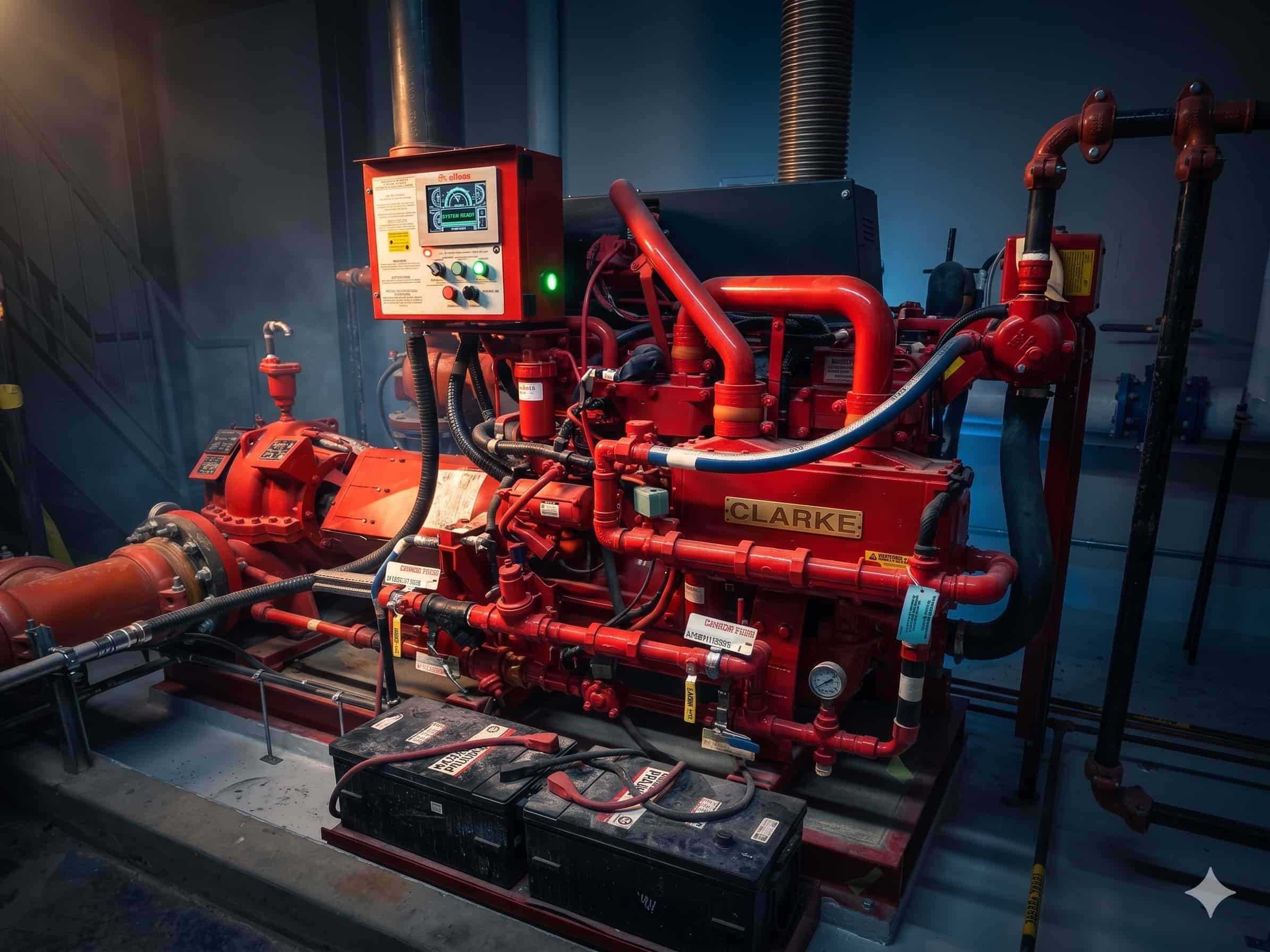
When a building needs a fire pump
A building needs a fire pump when the water supply can't deliver the flow and pressure the sprinkler design calls for. That's the whole test. The designer sets the supply, measured by a flow test, against the demand from the hydraulic calculation. Where the supply falls short, something makes up the gap: a bigger service, a storage tank with a pump, or a pump boosting the city main.
The usual triggers are tall buildings, storage protected by high-demand heads (one insurer's guideline notes ESFR pressures can top 75 psi at the base of the riser, per AXA XL), and sites where the main is weak or missing. It's a design decision, made with the sprinkler layout. The fire protection design page covers what the designer needs from you.
The National Building Code 2023 Alberta Edition (NBC(AE) 2023, Division B, 3.2.5.18) puts fire pumps under NFPA 20, and the edition it references is 2016. That's older than the NFPA 13 edition Alberta uses, which surprises people, so don't let an out-of-province spec sheet quote a newer one. Per a Consulting-Specifying Engineer summary, a listed centrifugal pump has to deliver 100% of its rated flow at rated pressure, at least 65% of rated pressure at 150% of rated flow, and no more than 140% of rated pressure at churn. That article quotes the 2013 edition, but NFPA 20 has carried these limits for decades, and they didn't change in 2016. Churn is the pump running against a closed discharge, moving no water.
Electric or diesel
| Electric motor | Diesel engine | |
|---|---|---|
| Chosen when | The electrical service has the capacity. More compact, fewer moving parts. | Electrical capacity isn't adequate. |
| What comes with it | A reliable feed, often a generator and a transfer switch. Soft-start controllers can shrink the generator. | A fuel tank and dike, batteries, a muffler and a bigger room. |
| Routine run | No-flow run weekly or monthly, depending on the pump | No-flow run weekly |
| Winter | Heated pump room | Heated pump room, and NFPA 25 sets a higher minimum for a diesel without engine heaters |
We'd take electric wherever the building's power can carry it. Fewer parts means fewer weekly surprises. But a diesel that runs when the grid is down has saved more than one design review, and if the AHJ won't accept the electrical feed, the argument's over.
The controller starts the pump when system pressure falls. Whether it may also stop on its own after a minimum run time, or only by hand at the controller, is set in the design under NFPA 20 and what your AHJ accepts, so don't assume either. A small jockey pump holds the system's pressure so the main pump isn't starting every time a valve weeps. If a jockey pump keeps cycling on and off, something's usually leaking.
What gets checked, and how often
The NFC(AE) 2023 requires fire pumps to be inspected, tested and maintained to NFPA 25 (Division B, 6.4.1.1), and the edition Alberta references is 2017. Headline tasks, per NFPA 25-2017 Table 8.1.1.2 as revised by TIA 1287:
| Task | How often |
|---|---|
| Pump house, pump, engine or motor and controller inspected | Weekly |
| No-flow (churn) run | Weekly for diesel. Weekly or monthly for electric |
| Casing relief and pressure relief valves inspected | Weekly |
| Full flow test | Annually |
| Circulation relief and pressure relief valves tested | Annually |
| Power transfer switch, batteries, electrical connections, gauges and sensors | Annually |
| Diesel engine oil and filter | Annually, or every 50 operating hours |
| Controller and motor | Per the manufacturer |
The no-flow run is a diesel weekly for at least 30 minutes, and most electric pumps monthly for at least 10, per Koorsen's summary. Electric pumps go weekly when they serve buildings beyond the fire department's pumping capacity, use limited-service controllers, are vertical turbine pumps, or draw from low-pressure suction like a ground-level tank. The run doesn't test output. It tests that the pump starts, the controller behaves, the engine cools and the packing glands drip only slightly, as they're meant to.
The annual flow test
The annual test runs the pump at churn, at rated flow and at 150% of rated capacity (NFPA 25-2017, 8.3.3.1). Each point has to reach at least 95% of the flow and pressure on the original acceptance curve or nameplate (8.3.7.2.3), according to QRFS. The water can go through hose streams, which the standard wants at least every third year, through a bypass flowmeter to a drain or the suction reservoir (allowed two years out of three), or through closed-loop metering.
A test day, roughly:
- Tell the building and the monitoring company. Pumps are loud, hose streams put water on the yard, and the controller's alarm signals go to the fire alarm panel.
- Record the churn readings first, with the discharge closed.
- Open the test connection and step up to rated flow, then to 150%, recording flow, suction and discharge pressure and the motor or engine readings at each step.
- Plot every point against the original curve. Anything under 95% is a failed test, not a note.
- Watch the pump while it works: bearings, packing, cooling, controller start and stop. Then put everything back, with the controller on automatic and monitoring off test.
Edmonton adds a wrinkle. Flowing 150% of rated capacity through hoses at -25°C puts sheet ice across a yard, so we'd rather test in the shoulder seasons than in January. Book it before the cold, not because the report is due.
Pumps rarely fail in a dramatic way. The failures are dull: a diesel with dead batteries or old fuel (both annual items in the NFPA 25 table), a controller left off automatic, a closed valve on the suction side, a pump room colder than the standard allows. The weekly check exists to catch those. When it's skipped, the annual test is where you find out.
Private hydrants
A private hydrant is on your property, on your private fire main, and it's yours to maintain. NBC(AE) 2023 references NFPA 24-2013 for private fire service mains (3.2.5.7), and NFPA 25 Chapter 7 sets the upkeep. Hydrants are inspected annually and after each operation. Each one is flow tested annually: opened fully and flowed until foreign material clears, and not less than 1 minute. Underground and exposed mains are flow tested at intervals of no more than 5 years, and hydrants are lubricated yearly (NFPA 25 Chapter 7 reference tables; NFSA).
In Edmonton, the drain time is the whole game. After a dry-barrel hydrant is used, NFPA 25 allows no more than 60 minutes for the barrel to drain. If it won't, because of soil or a high groundwater level, the drain gets plugged and the barrel pumped out after every use, and the hydrant has to be marked as needing pumping. Water left in a barrel through a -30°C night can crack it. You find out in spring, or when the fire department opens it.
Three more points from the fire code:
- Outlets that take 65 mm hose use Alberta Mutual Aid (AMA) thread (NFC(AE) 2023, Division C, 2.2.6.1). Specify it correctly or the fire department can't connect.
- Altering, repairing or shutting down a hydrant, or any impairment, needs fire department notification and approval, and the hydrant has to be marked (Division C, 2.2.7.2(5)).
- Fire protection equipment must be unobstructed and accessible at all times (Division C, 2.1.2.7). A hydrant under plowed snow isn't.
Water storage tanks
Where the supply is inadequate or missing, a tank feeds the pump. The winter items are the ones that matter. As NFPA 25's tank table reads in the 2014 edition (the edition in the linked reproduction; Alberta references 2017, so have your inspector confirm against it), the heating system is inspected daily in cold weather, or weekly where a low-temperature alarm is supervised, and tested every year before the heating season. Low water temperature alarms and high temperature limit switches are tested monthly in cold weather, and interiors are inspected every 5 years, or every 3 where the tank has no corrosion protection (table reproduced here). A frozen tank isn't a leak. It's a building with no water supply. The October winterization checklist covers the wider set of freeze checks for an Edmonton building.
Getting ready for an Edmonton winter
The code's January design temperature for Edmonton is -30°C (2.5%), and St. Albert and Leduc use -32°C (NBC(AE) 2023, Appendix C). The airport area has logged -45.9°C, on January 12, 2024. Do this in October:
- test the pump room heater and its thermostat, and the engine heaters and batteries on a diesel;
- test the tank heater and low-temperature alarm before heating season;
- walk every private hydrant, check the drains and flag any that need pumping;
- mark where the plow puts snow, and keep it off the hydrants.
Who may service pumps and hydrants
Only qualified people. In Alberta, installing water-based systems including fire pumps is for journeyperson sprinkler systems installers. Inspection, testing, maintenance and repair go to journeypersons as well, while a holder of an approved NFPA 25 certificate can inspect, test and maintain but not repair (NFC(AE) 2023, Division C, 2.2.4.6). For hydrants, the AHJ can also accept a municipal bylaw appointee or a certified water and wastewater operator.
A dead pump can leave a sprinkler system that looks fine and has no water to draw on. Any planned shutdown needs a notification procedure the fire department accepts (Division C, 2.2.7.2) and alternative measures while it lasts (Division B, 6.1.1.4). If you find a pump down at night, call 780.760.0806; the 24/7 emergency repair page covers the first steps. The assembly on the incoming line has its own annual test, covered under backflow prevention. The routine visit schedule is in fire system inspections, and the pump feeds the sprinkler systems it's there to protect. Buildings with big storage or process loads, like industrial manufacturing and warehousing and logistics, lean on pumps most.
Frequently asked questions
How often does a fire pump have to be run?
Weekly for a diesel pump, at least 30 minutes. Most electric pumps run monthly for at least 10 minutes, with weekly runs for some types, such as vertical turbine pumps and those on low-pressure suction. NFPA 25-2017 lists the weekly walk-through inspection for every pump. A full flow test follows once a year.
What's the difference between a churn test and a flow test?
A churn test runs the pump with the discharge closed. It proves the pump starts and the controller and driver work. A flow test moves water through a test header or bypass at churn, rated flow and 150% of rated capacity, and compares the results to the original curve. Only the flow test shows whether the pump still delivers.
Who can service a fire pump in Alberta?
A journeyperson sprinkler systems installer, for inspection, testing, maintenance and repair. A holder of an approved NFPA 25 certificate can inspect, test and maintain, but not repair (NFC(AE) 2023, Division C, 2.2.4.6). Ask for the certificate. The AHJ can request qualified persons to show a transcript or certificate.
Who is responsible for a private hydrant, and how often is it tested?
The owner, as with any fire protection equipment (Division C, 2.2.1.1). NFPA 25 has private hydrants inspected annually and flow tested annually, with the underground main flow tested at least every 5 years. Keep hydrants clear of snow, and keep a record of each test on site.
What happens if a fire pump fails its annual flow test?
NFPA 25 wants each test point at 95% or more of the original curve, so a shortfall means finding the cause and fixing it. If the pump can't meet the sprinkler demand in the meantime, or has to come out of service for the repair, treat it as an impairment: notify the fire department, arrange alternative measures, and tell your insurer and monitoring company. Call us if you'd like the report read by someone who'll say what it means. The steps are in our impairment checklist.
Sources
- National Building Code 2023 Alberta Edition, National Research Council Canada
- National Fire Code 2023 Alberta Edition, National Research Council Canada
- NFPA 25-2017 TIA 1287, fire pump table, NFPA
- NFPA 20: Fire pump design, Consulting-Specifying Engineer
- The Fire Pump Flow Test: NFPA 25 Requirements, Part 1, QRFS
- Fire Pump Testing and Inspection Requirements, Koorsen
- Reference materials from NFPA 25 Chapter 7, City of Pocatello
- Hydrant Flow Testing, National Fire Sprinkler Association
- Water Storage Tanks Used for Fire Protection, NFPA 25 table reproduced by American Pipe and Tank
- Estimating Fire Protection Water Demands (PRC.14.1.1.0), AXA XL Risk Consulting