
What a sprinkler system does and who has to have one
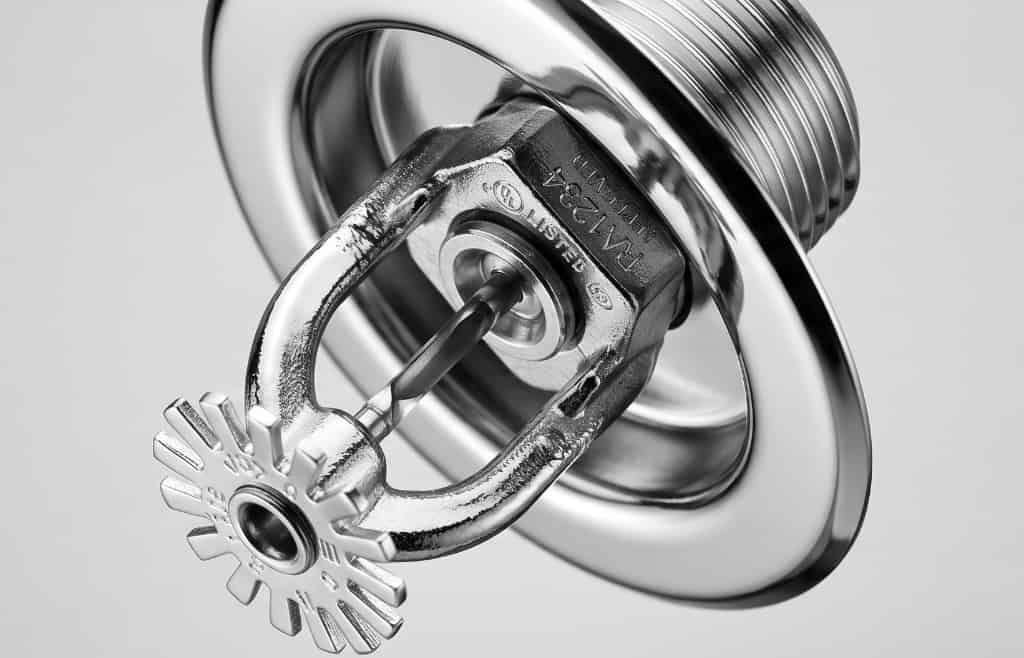
A sprinkler system controls a fire until the fire department arrives, and often puts it out. Only the heads over the heat open. The rest stay shut, which is why a small fire doesn't soak a whole floor. Most designs promise control, not a spotless building. ESFR, below, is the exception: it aims to suppress.
In Alberta, the National Building Code 2023 Alberta Edition (NBC(AE) 2023, Division B, 3.2.5.12) says sprinklers are designed, installed and tested to NFPA 13, in the 2019 edition it references. NFPA 13R-2019 and 13D-2016 are allowed for defined residential and small care buildings. Whether your building needs sprinklers at all turns on its occupancy, size and height under Part 3 of the code. That's the architect's code analysis, and borderline cases are fire code consulting work. Small jobs get one break: fewer than nine sprinklers may run off the domestic water system if it can meet the demand (3.2.5.12(4)).
Which type of sprinkler system fits the building
Most buildings get wet pipe. The other types exist because of freezing, accidental discharge, or a fire a standard head can't handle.
| Type | How it works | Where it's chosen | The catch |
|---|---|---|---|
| Wet pipe | Pipe stays full. Each head opens on its own heat. | Anywhere above freezing: offices, retail, apartments, heated warehouses. | It freezes, and a damaged head is a water leak. |
| Dry pipe | Pipe holds compressed air or nitrogen. An open head drops the pressure, the dry valve trips and water floods in. | Unheated buildings, loading docks, parking structures, freezers. | Water arrives late. Past 500 gal of pipe volume (750 with a quick-opening device), NFPA 13-2019 makes the design prove delivery time. Trapped water and corrosion are steady chores. |
| Preaction, single interlock | Closed heads on air-filled pipe plus a separate detection system. Detection opens the valve. A head opening alone lets no water in. | Data rooms, museums, electrical rooms, coolers. | Needs working detection, and supervised air above 20 sprinklers. Storage gets a bigger design area. |
| Preaction, double interlock | Needs detection and a head opening before water flows. | Freezers and spaces where accidental water is the bigger worry. | The slowest type, with design-area and delivery-time penalties. An AHJ can restrict it. |
| Deluge | Open nozzles. Separate detection releases water to all of them at once. | Hangars, transformers, other special hazards. | The whole zone floods, so drainage and water demand are big. |
| ESFR | Ceiling-only heads meant to suppress a storage fire. | High-piled storage. | High pressure, strict obstruction rules, and height limits that depend on the head's listing. |
| CMSA (large drop) | Large-drop heads that control a storage fire with a set number of heads at a set pressure. | Storage protected by control, not suppression. | Pressure-hungry, so the supply decides feasibility. |
| In-rack | Extra heads inside the racks, hydraulically balanced with the ceiling heads. | High rack storage where ceiling heads alone won't do it. | Racks move and forklifts hit pipe, so every layout change needs a sprinkler review. |
| 13R and 13D | Smaller systems: 13R for low-rise residential, 13D for one- and two-family homes. | Apartments and houses within the standards' limits. | Not for larger occupancies. |
Double interlock has a reputation as the cautious choice. It's cautious about water damage and slow about fire, so if someone proposes it, ask why single interlock won't do. Most owners really choose between two types, and that comparison is in wet vs dry sprinklers in Alberta winters. Warehouse storage has its own piece: ESFR sprinklers in Edmonton warehouses.
Heads, temperature ratings and K-factor
A standard sprinkler is a nozzle held shut by a glass bulb of fluid that expands and shatters at its rated temperature. The bulb colour gives the rating: orange 57°C, red 68°C, yellow 79°C, green 93°C, blue 141°C, per Tyco's TY-B data sheet. Higher ratings go near skylights and unit heaters so a head doesn't trip on a July afternoon.
The K-factor is how much water a head passes: flow equals K times the square root of pressure. A K-5.6 head, the common standard-spray size, passes about 25 gpm at 20 psi and about 18 gpm at 10 psi. A design is a set of heads at a set pressure, so a supply that comes up short means every head delivers less than the design asked for.
Never paint, plate, coat or alter a head. Replace any that leak, look corroded, have a cracked bulb, or have been dropped or struck. Painting is the classic way to ruin one, usually by a finishing trade nobody warned. Heads also age out. NFPA 25-2017 has standard-response heads tested or replaced at 50 years, then every 10; fast-response heads at 20 years; dry-type at 10; and heads in harsh environments every 5 (per a chart of Table 5.1.1.2).
Hazard classification and what you store
NFPA 13 sorts occupancies into light, ordinary and extra hazard (the last two each split into groups 1 and 2), then picks a design density over a design area. Light hazard is designed around 0.10 gpm per square foot over the most remote 1,500 sq ft (MeyerFire). Higher classes want more water over larger areas, which drives pipe size and cost.
Storage is where classification goes wrong. The National Fire Code 2023 Alberta Edition (NFC(AE) 2023) sorts commodities into Class I to IV by how much combustible packaging and plastic they carry (Division B, Note A-3.2.1.1(1)(a)). Class I is essentially noncombustible product in ordinary cartons. Class IV carries an appreciable amount of Group A plastics such as polyethylene or polystyrene. The limits follow. In a sprinklered building, an individual storage area of Class I or II can run to 1,500 m² and 9.0 m high, while Group A plastics stop at 500 m² and 6.1 m (Table 3.2.3.2).
Picture a 40,000 sq ft distribution building near Nisku, sprinklered for canned goods on pallets. The tenant changes, and the new one stocks polyethylene totes on the same racks. Same heads, different fire. The fire code treats that as a change of use raising the hazard beyond the design basis, and it requires an upgrade (NFC(AE) 2023, Division B, 2.1.3.1(2)). It gets missed at lease signing.
Find the hydraulic design information sign at the riser. It states what the system was built to protect, and NFPA 25 has it checked yearly. Operators should read our pages on warehousing and logistics and cold storage and refrigeration.
Water supply and the flow test
Sprinkler design is only as good as the water behind it, and a flow test is how you find out. Static pressure is the pressure in the main with nothing moving. Residual is the pressure while a hydrant flows. With the measured flow, they let the designer project what the main can deliver at the pressure the system needs.
The data can't be stale. NFPA 13-2019 (4.6.1.1) wants the test within 12 months of the working plan submittal unless the AHJ accepts another period (Sprinkler Age). A test taken while the building was still a concept can be out of date by the time the plans go in. Book it when design starts and check the date before submittal.
When the numbers fall short, the fixes are a bigger service, a storage tank or a fire pump. One insurer's guideline notes ESFR discharge pressures can exceed 75 psi at the base of the riser (AXA XL). A commercial fire line in Edmonton also carries a backflow assembly, which takes pressure out of the supply and belongs in the calculation.
Freeze protection in an Edmonton winter
NBC(AE) 2023 3.2.5.17 requires fire protection equipment in unheated areas to be protected from freezing. How is the designer's call. The code's January design temperatures for Edmonton are -30°C (2.5%) and -33°C (1%), and St. Albert, Sherwood Park and Leduc use -32°C and -35°C (NBC(AE) 2023, Appendix C). Those are design values, not the worst night. Environment Canada's extremes record has the airport area at -45.9°C on January 12, 2024.
Pipe doesn't read the design table.
The realistic options:
- Wet pipe in a space you can keep above freezing, with a plan for when the heat fails. The usual freeze failures are wet pipe in dock canopies, parking garages and attics, air leaking around wall penetrations, and one heater with no backup (Risk Logic).
- Dry pipe or preaction for what can't be heated. Dry doesn't mean freeze-proof: water sitting at a low point still freezes, so drain the low points before cold weather and keep the valve room warm. NFPA 25-2017 has those enclosures checked daily in cold weather, or weekly where a low-temperature alarm is supervised.
- Listed heat tracing on short runs. It can't stand in for a heated enclosure around a dry or preaction valve (QRFS).
- Antifreeze loops, with care. By September 30, 2022, NFPA 25 required existing antifreeze systems to use listed antifreeze (evaluated to ANSI/CAN/UL 2901), tested yearly (NFSA). Limits for new systems are tight in the 2022 edition of NFPA 13, and Alberta references 2019, so have your designer confirm what applies. Antifreeze also changes the backflow assembly: the National Plumbing Code 2020 (2.6.2.4) wants an RP on that portion.
Then there's the construction winter. Pipe charged with water in a shell with no heat freezes as well as it does in a finished building, so the GC's heat schedule and the fill dates have to agree. Fire system installation covers the sequencing.
Sprinklers in occupied buildings and retrofits
Retrofit work is mostly about interruptions. Shutting a riser to tie in leaves part of a building unprotected. The code counts that as a shutdown: the fire department needs a notification procedure before repairs or alterations (NFC(AE) 2023, Division C, 2.2.7.2), and alternative measures cover the gap (Division B, 6.1.1.4). Good jobs run as several short outages in known areas, not one long one. Our impairment checklist covers how to plan and tag those outages.
Edmonton adds a design step. Under the City's Professional Involvement Standards (29 November 2024), any change to a sprinkler, standpipe and hose, or fire pump system in an existing commercial building needs professional involvement (City of Edmonton). Even a modest change gets a registered professional.
Fit-outs deserve a warning. When a partition moves, the heads move too, and a ceiling contractor or electrician relocating a head is doing sprinkler work that only a qualified person may do.
Who may install or alter sprinklers in Alberta
The fire code allows only qualified persons to install, alter, test, maintain or repair automatic sprinkler systems (NFC(AE) 2023, Division C, 2.2.4.4). For NFPA 13, 13R and 13D installation and alteration, that means a journeyperson certificate as a sprinkler system installer recognized in Alberta. Apprentices can do the work if they're competent and directly supervised by a journeyperson. Residential 13D systems that flow through the domestic plumbing go to a journeyperson plumber.
Note what the rule isn't. Sprinkler system installer is a designated trade with optional certification in Alberta (Tradesecrets). The fire code is what narrows installation and alteration to journeypersons and supervised apprentices. So ask any sprinkler contractor to show the certificates.
Design, permits and sign-off in Edmonton
Plans come first. Before a sprinkler system is installed or altered, scaled plans with full details go in with the application to build (NBC(AE) 2023, Division C, 2.2.3.2). Where a building needs professional involvement, the owner must show before construction that a registered professional has been retained to design the system, review the installation in the field and witness the testing (Division C, 2.4.1.3). That means an architect, a registered engineering professional or a licensed interior designer.
Then the paper. Schedules A and B go in at permit, and Schedules C-1, C-2 and C-3 after substantial completion. The AHJ must have C-1 before it issues an occupancy permit (Division C, 2.4.2). The City may also want a Fire Suppression System Test Letter of Confirmation (COE-SCPI-FORM-0015), where the verifier confirms they meet the qualification rule in 2.2.4.4 and names the standard used, such as NFPA 13-2019. The code puts the witnessing on your registered professional, and the City collects the letters. General contractors can find the full closeout list in our guide to fire protection closeout, and the submittal side in sprinkler submittals and permits.
The City's plumbing and gas permit page says those permits include sprinkler systems, so ask which permit your scope needs before you submit. The drawing set itself is covered under fire protection design.
Coordinating with the other trades
Sprinkler pipe is sized by hydraulics, so it can't shrink to suit a duct that arrived late. Get the sprinkler contractor into the coordination model before the ceiling trades lock their levels. Heads have clearance rules from obstructions, ESFR is the fussiest, and a light fixture or cable tray added after the heads are placed can mean re-hanging pipe.
Three tie-ins get missed:
- The waterflow and supervisory switches on the riser are wired to the fire alarm. A system with waterflow devices must notify the fire department through a monitoring station (NBC(AE) 2023, 3.2.4.7). See fire alarm systems.
- The fire department connection sits within 45 m of a hydrant and 3 m to 15 m from the principal entrance (3.2.5.15). That's a site plan decision.
- If the main control valve sits in a locked room, the code calls for a fire department key box, usually by the principal entrance (Division C, 2.2.10.1). It's the closeout item that gets forgotten.
Keeping the system working after handover
The NFC(AE) 2023 requires water-based systems to be inspected, tested and maintained to NFPA 25 (Division B, 6.4.1.1), and Alberta references the 2017 edition. The routine runs from weekly checks of sealed control valves to quarterly gauges and alarm devices, an annual main drain test, and an internal pipe assessment every 5 years (NFSA). A holder of an approved NFPA 25 certificate can inspect and test but not repair (Division C, 2.2.4.4 and 2.2.4.6).
The full frequency table is on fire system inspections, with the long-interval items in the NFPA 25 frequency guide. If a system is out of service or a head has operated, call 780.760.0806 at any hour. The 24/7 emergency repair page covers the first few minutes.
Frequently asked questions
Does my building in Edmonton need sprinklers?
It depends on occupancy, size and height under Part 3 of the NBC(AE) 2023, and only a code analysis of your building can say. Article 3.2.5.12 governs how sprinklers are designed and installed once they're in the picture. Heavier storage or a new occupancy can also force an upgrade to the system you already have (NFC(AE) 2023, Division B, 2.1.3.1(2)).
Which edition of NFPA 13 applies in Alberta?
NFPA 13-2019, as referenced by the NBC(AE) 2023. Residential systems use NFPA 13R-2019 or NFPA 13D-2016. Newer editions, including 2022 and 2025, aren't Alberta requirements unless your AHJ or a contract asks for them.
Should an unheated building get a wet or a dry system?
If you can heat the space reliably, heat it and use wet pipe. It's simpler and faster to respond. If you can't, dry pipe is the usual answer, and preaction fits where accidental water is also a worry. Dry costs more to maintain. Sometimes it's the only sane option.
How much does a sprinkler system cost?
We don't publish a flat price, because the number comes from things a floor plan can't show yet: hazard class, storage, ceiling heights, water supply, whether a pump or tank is needed, and the schedule (winter work, occupied building). Send the drawings and intended use through the contact page and we'll price from those.
Related reading
- How to winterize sprinkler and alarm systems in Edmonton. An October checklist for Edmonton building owners covering unheated spaces, dry valve rooms, heat trace, backflow assemblies, pump rooms, hydrants and alarm batteries, with the checks you can do yourself.
- The 5-year internal sprinkler pipe inspection in Alberta. What NFPA 25's five-year internal pipe assessment is, how it's done, what it finds, how sampling works and how to plan it around an occupied building in Edmonton.
- What drives fire sprinkler inspection cost in Edmonton. No honest contractor can price a sprinkler inspection from a postal code.
Sources
- National Building Code 2023 Alberta Edition, National Research Council Canada
- National Fire Code 2023 Alberta Edition, National Research Council Canada
- Sprinkler Systems Installer trade profile, Government of Alberta
- Professional Involvement Standards for Building Permits, City of Edmonton
- Tyco TFP151 Series TY-B sprinkler data sheet, Johnson Controls
- Hazard Class vs Design Criteria, MeyerFire University
- AFSA Technical Challenges, Sprinkler Age
- Estimating Fire Protection Water Demands (PRC.14.1.1.0), AXA XL Risk Consulting
- Preventing Freeze Damage in Fire Protection Systems, Risk Logic
- Heat Tracing Fire Sprinkler Systems, QRFS
- Listed Antifreeze and the Sunset Date, National Fire Sprinkler Association
- Assessing the Internals, National Fire Sprinkler Association
- NFPA 25 inspection frequency chart, Falcon Fire Sprinkler
- Long-term climate extremes, temperature, Environment and Climate Change Canada