
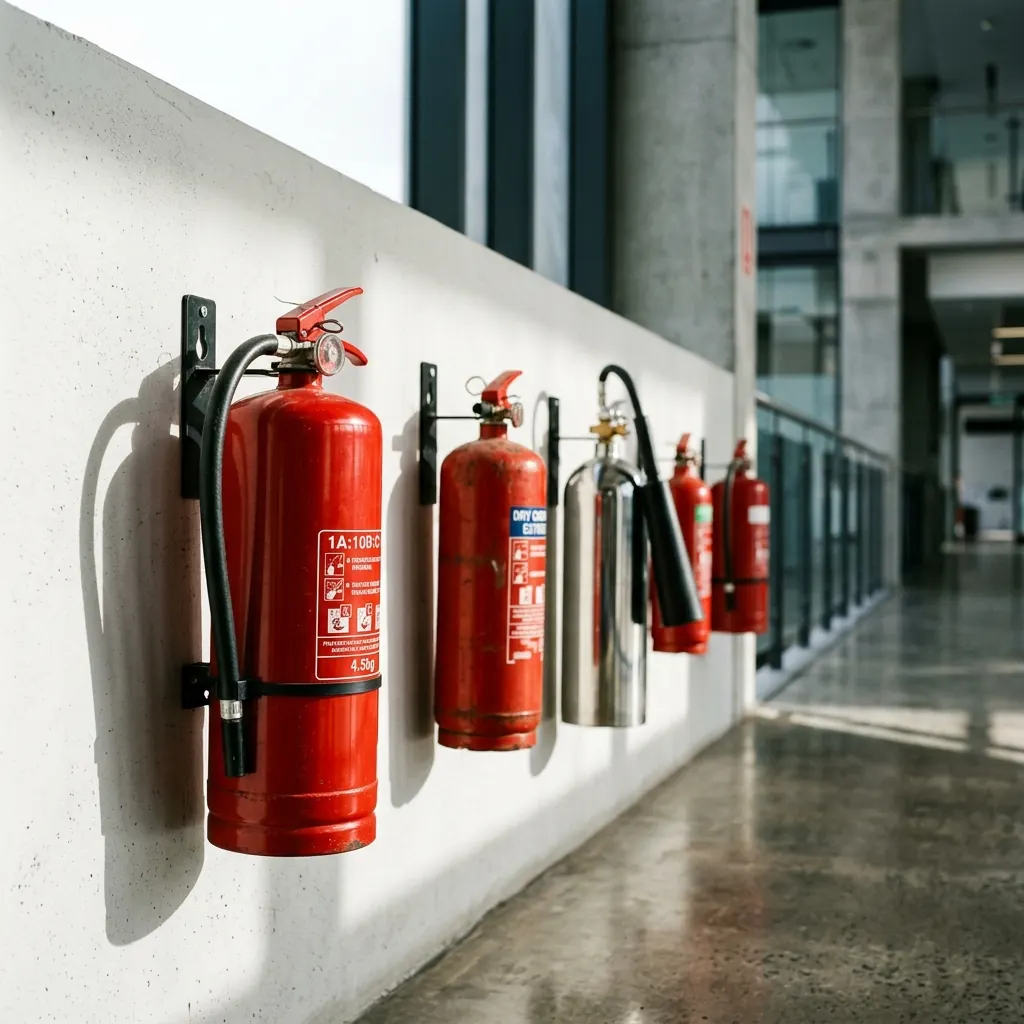
Why the wrong extinguisher makes it worse
Most building owners know they need fire extinguishers. Fewer know that selecting the wrong type does not simply fail to put out the fire. It can accelerate it. Throw water on a deep fryer and the oil flashes to steam instantly, launching a fireball. Use a standard dry chemical on a burning lithium battery and you can intensify a reaction the agent was never designed to handle. The classification system exists because different fuels burn differently, and the chemistry that suppresses one can feed another.
Under the National Fire Code (2023 Alberta Edition) and NFPA 10, building owners carry the legal responsibility for ensuring the right extinguisher types are installed in the right locations, properly maintained, and accessible. This is not a discretionary decision left to intuition. The code specifies it, your AHJ enforces it, and your insurance provider expects it.
Class A, ordinary combustibles
Wood, paper, cardboard, cloth, rubber, many plastics. The fuel is solid and it leaves ash when it burns. That is the mnemonic: A for Ash. These are the fires you are most likely to encounter in offices, schools, retail spaces, and storage rooms. They are common enough that most people underestimate them.
Suitable agents include water, aqueous film-forming foam (AFFF), and multipurpose dry chemical. In practice, most Alberta commercial buildings rely on ABC multipurpose dry chemical units for Class A coverage because the same extinguisher handles B and C hazards as well. That convenience is legitimate. But in spaces with sensitive electronics or archival materials, dry chemical residue is destructive. The choice of agent matters beyond just suppressing the flame.
- Fuel: Wood, paper, cardboard, textiles, rubber, many plastics, ordinary waste
- Symbol: Green triangle labelled A
- Agents: Water, foam (AFFF), multipurpose dry chemical (ammonium phosphate)
- Common locations: Offices, classrooms, retail, storage rooms, common areas
Class B, flammable liquids and gases
Gasoline, diesel, solvents, paint, alcohol, propane. Liquids that ignite and spread. The mnemonic is B for Barrel. These fires move fast because the fuel flows, carrying the flame with it.
Garages, mechanical rooms, paint shops, and laboratories are the typical Class B environments. In industrial settings, the hazard assessment matters more than the default. A building with a large solvent storage area needs a different coverage plan than one with incidental fuel storage near a loading dock.
- Fuel: Gasoline, diesel, oil, paint, solvents, alcohol, propane, natural gas
- Symbol: Red square labelled B
- Agents: CO₂, dry chemical, foam (AFFF), clean agents (FM-200, Novec 1230)
- Common locations: Garages, workshops, paint booths, mechanical rooms, labs
Class C, energized electrical equipment
Class C is about the current, not the material. The moment you de-energize the equipment, the fire reclassifies. It becomes whatever is physically burning, which is usually Class A or B. The extinguisher must be non-conductive while the circuit is live. That is the only firm requirement.
CO₂ is the cleaner option for server rooms and data centres. It suppresses the fire without leaving powder residue that corrodes circuit boards. Dry chemical agents rated for Class C work, but the cleanup cost and equipment damage often exceed the fire damage. In sensitive electrical environments, the choice of agent is also an infrastructure decision.
- Fuel: Energized electrical equipment (computers, panels, motors, transformers)
- Symbol: Blue circle labelled C
- Agents: CO₂ (preferred for electronics), non-conductive dry chemical
- Common locations: Server rooms, electrical closets, data centres, control rooms
Class D, combustible metals
Rare in most buildings. Critical in the ones where it applies. Magnesium, lithium, titanium, sodium, potassium: these metals burn at temperatures that defeat standard suppression entirely, and they react violently with water and CO₂. A Class D fire is not something to approach with the extinguisher already on the wall.
The agent is a specialized dry powder formulated for the specific metal involved. Met-L-X, Lith-X, and sodium chloride-based agents are not interchangeable. If your facility handles combustible metals, the hazard assessment determines which agent is required. A general-purpose Class D unit does not exist. Aerospace manufacturing, machine shops, battery storage facilities, and research labs are where this matters.
Class K, cooking oils and fats
Class K exists because standard Class B agents consistently failed in commercial kitchens. Modern vegetable oils have auto-ignition temperatures high enough that a knocked-down fire re-ignites once the suppressing agent disperses. Wet chemical agents, specifically potassium acetate-based formulations, work differently. They cool the oil and form a soapy foam barrier across the surface that prevents re-ignition. That saponification layer is what distinguishes Class K suppression from everything else.
The Alberta Fire Code requires Class K extinguishers in commercial kitchens using cooking oils or fats. This is separate from and in addition to any installed hood suppression system. The portable extinguisher covers scenarios the hood system does not reach, and inspectors treat the two as distinct requirements.
- Fuel: Vegetable oils, animal fats, lard, cooking grease, deep fryer oil
- Symbol: Black hexagon labelled K
- Agent: Wet chemical (potassium acetate). Cools the oil and creates a saponification layer that prevents re-ignition
- Common locations: Commercial kitchens, restaurants, cafeterias, food processing
Quick Reference, all five classes
The table below is a reference, not a substitute for a proper site hazard assessment. Buildings often contain mixed occupancies and multiple fire classes across different areas.
| Class | Fuel | Agent | Symbol | Do Not Use On |
|---|---|---|---|---|
| A | Wood, paper, cloth, plastic | Water, foam, dry chemical | Green Triangle | Electrical equipment, metal fires, grease |
| B | Flammable liquids and gases | CO₂, dry chemical, foam | Red Square | Never water. It spreads burning liquid |
| C | Energized electrical | CO₂, non-conductive dry chemical | Blue Circle | Conductive agents while circuit is live |
| D | Combustible metals | Specialized dry powder (metal-specific) | Yellow Star | Water, CO₂, standard dry chem. All cause violent reactions |
| K | Cooking oils and fats | Wet chemical (potassium acetate) | Black Hexagon | Water. Causes a violent steam flash and spreads burning oil |
Reading the rating label
The rating on an extinguisher label tells you the capacity of the unit, not just the class. A label reading 2A:10B:C breaks down as follows.
The number before A is a water equivalency measure. Each unit equals 1.25 gallons. A 2A rating means the extinguisher performs comparably to 2.5 gallons of water on a Class A fire. The number before B represents the square footage of flammable liquid fire the extinguisher is tested to handle. A 10B unit covers approximately 10 square feet. C carries no number. It only signals that the agent is non-conductive.
The rating is a capacity measure tested under controlled laboratory conditions. It does not account for wind, heat, proximity to the fire, or whether the person using it has ever operated one before. Training matters as much as specification.
Placement, where the code gets specific
NFPA 10 defines maximum travel distances to an extinguisher. For Class A, that is 75 feet (23 m). For Class B, 50 feet (15 m). These distances are measured as walking paths, not straight lines. Mounting height matters too: the handle should sit between 3.5 and 5 feet off the floor for units under 40 pounds.
Placement violations are among the most common findings during inspections: extinguishers blocked by shelving, removed during renovations and never replaced, or placed in locations that no one would check in a real emergency. The unit needs to be where someone can reach it in the first thirty seconds, under stress, in smoke. That is the actual design constraint.
- Class A: Maximum 75-foot travel distance from any point in the building
- Class B: Maximum 50-foot travel distance from the hazard area
- Mounting: Handle no higher than 5 feet off the floor (units under 40 lbs)
- Visibility: Signage required where the location is not immediately obvious
- Access: Must not be blocked, stored behind, or obstructing an egress path
Inspection and Maintenance, the legal obligations
Under NFPA 10 and the Alberta Fire Code, the building owner holds the maintenance obligation. Monthly visual checks can be done in-house. Everything else requires a certified technician. The certification tag attached after each annual inspection is the record an inspector will check first. An expired tag is an immediate violation.
| Frequency | What Happens | Who Does It |
|---|---|---|
| Monthly | Visual check: location, gauge in green zone, pin and tamper seal intact, no physical damage | Building owner or designee |
| Annual | Full inspection of all components, documented and tagged | Certified fire protection technician |
| 6 Years | Internal examination: stored-pressure units are emptied, internally inspected, and recharged | Certified technician |
| 12 Years | Hydrostatic pressure test on the cylinder itself | Certified testing facility |
These intervals are minimums, not targets. A unit in a harsh environment (dusty warehouse, cold storage, chemical exposure) may need more frequent attention. The code sets the floor. Professional judgment sets the actual schedule.
How Alberta Enforces This
The National Fire Code (2023 Alberta Edition) has been in force since May 1, 2024. It replaced the 2019 edition and carries the enforcement authority of the Safety Codes Act. That statute sets first-offense fines at up to $100,000 and subsequent offenses at up to $500,000. Those numbers tend to get attention.
Your AHJ, typically your local fire department, can require types and placements beyond what the code minimum specifies based on the specific hazards in your building. STANDATA documents from Alberta Municipal Affairs also provide province-specific interpretations that can affect compliance decisions. The code is the starting point, not the ceiling.
When to Bring in a Contractor
Annual inspections require a certified technician. The 6-year internal examination and 12-year hydrostatic test require a facility with the right equipment. Monthly checks you can handle in-house with a simple log. Everything else is outside the scope of building management staff, and attempting to self-certify creates liability without saving much.
If your building has not had a fire extinguisher assessment recently, or if you are not certain which classes are required in which areas, that is worth sorting out before an inspection finds it for you. Sterling provides site assessments, supply, inspection, and testing for portable fire extinguishers across Edmonton and Alberta. Call 780-760-0806 or reach us through rssterling.ca/contact.