
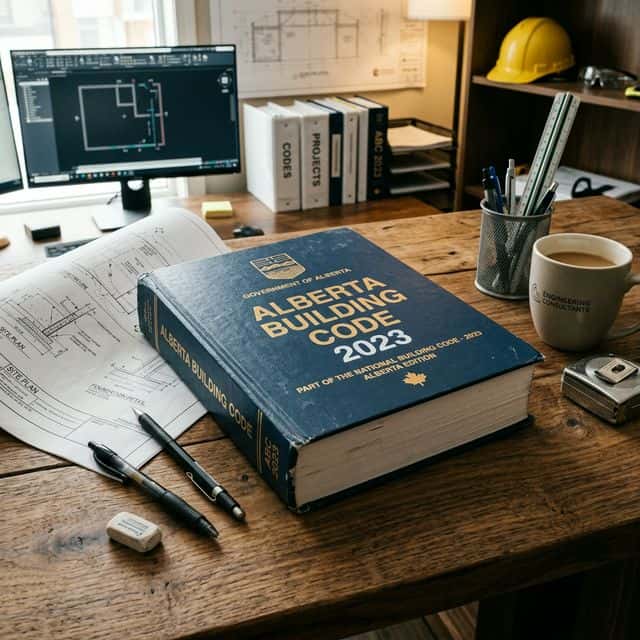
What fire code consulting covers, and where we stop
A fire code consultant works out which requirements apply to a building, where the building falls short, and what the cheapest defensible fix is. Our version is a contractor's version: code analysis, occupancy classification, alternative solutions, representation at audits and inspections, and resolving orders and deficiencies. It sits next to fire protection design and inspections, and it usually starts with somebody holding a piece of paper.
Now the limit. Sterling is a fire protection contractor. The schedules under the National Building Code 2023 Alberta Edition (NBC(AE) 2023) are signed by registered professionals, meaning architects, engineers and licensed interior designers. We tell you when your project needs one and work alongside them. We don't stand in for them, and consulting from a contractor isn't legal advice either.
Which code applies, NBC(AE) or NFC(AE)
Alberta has two codes that matter here, and both current editions have been in force since May 1, 2024. The NBC(AE) 2023 governs design and construction, and it's where sprinkler, alarm and standpipe requirements for a building are set. The National Fire Code 2023 Alberta Edition (NFC(AE) 2023) governs what happens once a building is in use: maintenance, records, impairments, and fire safety during construction and demolition. The two meet in places. The NFC says that where sprinklers, standpipes and alarms are provided they're designed and installed to the NBC, and must be upgraded if a change of use creates a hazard beyond their design (Division B, 2.1.3.1).
Both are adopted under the Safety Codes Act. Municipalities can't pass bylaws regulating matters the Act regulates, so no city has its own fire code that overrides the NFC(AE). The authority having jurisdiction (AHJ) is a safety codes officer in the fire discipline. In Edmonton, that's an inspector with Edmonton Fire Rescue Services (EFRS) Fire Prevention. Building and trade permits sit with the City's Safety Codes, Permits and Inspections. Elsewhere it's your municipality's fire department or its accredited safety codes agency. The Alberta fire code compliance guide has the full framework.
Occupancy classification and change of use
Classification comes first, because almost everything else hangs on it. The NBC sorts buildings into major occupancy groups: assembly (A), care, treatment or detention (B), residential (C), business and personal services (D), mercantile (E) and industrial (F). The group drives whether sprinklers and alarms are required, and the thresholds for professional involvement depend on occupancy, storeys and building area.
That's how a change of use turns into a code project. Picture a warehouse unit leased to a business that will hold classes and small events (a hypothetical). Nobody poured concrete. But the occupancy may be different, and with it the sprinkler design basis, the alarm requirement, the exits and the level of professional involvement. In Edmonton the City's standards make professional involvement mandatory for any change to sprinkler, standpipe or fire pump systems in an existing commercial building. Ask before the lease is signed, not after the tenant is in.
Alternative solutions and variances
An alternative solution is a different way of meeting the code's intent than the prescriptive route in Division B. The NFC(AE) requires it to be documented, with a code analysis and any special maintenance or commissioning it needs, and the documentation must be kept on the premises (Division C, 2.3.1.1 and 2.3.1.2).
Three points people get wrong:
- An accredited authority can't waive the code. It can accept an alternative solution, and that acceptance is registered with the Safety Codes Council as a variance.
- Variances come in two sizes. The Provincial Fire Administrator issues province-wide ones, which aren't project-specific. A safety codes officer can issue a project-specific one that sets no precedent (Division C, 2.2.2.2 and its note).
- Anyone can ask the Provincial Fire Administrator in writing for a code interpretation, and the answer applies across the province (2.2.2.1).
Alberta publishes these as STANDATA: interpretations, province-wide variances, bulletins and errata developed by Municipal Affairs and the Safety Codes Council. STANDATA can expire. EFRS's July 2026 fire marshal bulletin, for instance, says the STANDATA that allowed delayed smoke detector sensitivity testing wasn't renewed, so annual fire alarm reports now have to record it, on addressable and conventional systems alike.
So when is one worth the trouble? On a heritage building, an odd geometry, or an existing building where a strict reading of a rule would cost more than it protects. They take time, and the AHJ can say no. One Alberta municipal guideline notes that the AHJ can require professional involvement on a complex project of any size. We prepare the fire protection side of the case (what the sprinklers, alarm or suppression system will and won't do). Whether the analysis behind it needs a registered professional's signature depends on the building and the AHJ, and we'll say so early.
When the code requires a registered professional
For buildings outside the small-building exemptions in NBC(AE) 2023 Division C, 2.4.1.1(1), drawings are authenticated by registered professionals. If a sprinkler or fire alarm system goes into such a building, the owner has to show before construction that a registered professional has been retained to design it, do field reviews and witness the testing or verification (2.4.1.3 and 2.4.1.4). The details, and what the schedules look like, are on the fire protection design page. The NFC(AE) explanatory note says fire alarm verification is generally the responsibility of a licensed engineering professional and, in Alberta, the registered professional who completes the Schedule C. It's a note, not a requirement, but it tells you which way an AHJ will lean.
Orders and deficiencies, and what the law lets you do
An order is the Safety Codes Act's formal instrument. A safety codes officer can issue one on reasonable grounds that the Act is contravened or that there's a danger of serious injury or damage (s. 49). It can go to the owner, occupier, contractor, designer or service provider, and it has to say what must be done or stopped and give a reasonable time to do it.
| Step | Deadline | Who decides |
|---|---|---|
| Ask for a review of the order | 14 days from service, in writing | The Administrator, who may revoke or vary it within 21 days of service |
| Appeal the order | 35 days from service, whether or not you asked for a review | Safety Codes Council, which can confirm, revoke or vary it and may issue a variance |
| Appeal a refusal to issue a written variance | 30 days | Safety Codes Council |
| Appeal a Council decision | 30 days, on a question of law or jurisdiction only | Court of King's Bench |
Count from the date of service, not the date you got around to reading it. Ignoring an order is an offence, and each day is a separate offence. For a first offence the Act allows a fine of up to $100,000 plus up to $1,000 a day while it continues, or up to 6 months in jail, or both (ss. 67 and 68).
Edmonton's day-to-day process is quieter than an order. When a contractor reports a deficiency, EFRS sends the owner a notice with a correction timeline based on the category of deficiency, and if it isn't corrected, a Fire Safety Codes Officer may inspect. We couldn't find the category timelines published, so read the notice itself. If you're holding one, how to close out a fire marshal deficiency in Edmonton walks through the response. If it carries real money or a deadline you can't meet, get legal advice before the 14-day and 35-day windows close.
Audits and inspection prep
Audit representation means being in the room when the inspector walks the building, with the records and someone who can answer technical questions. Most of the preparation is paper:
- ITM records on site, none destroyed within five years of being prepared, and initial verification and test reports kept for the life of the system (NFC(AE) 2023 Division C, 2.2.1.2);
- the fire alarm verification. If it never had one, the AHJ can require an audit to CAN/ULC-S536 unless it's satisfied the system has been maintained and works (2.2.9.2);
- a current fire safety plan with any impairment arrangements recorded;
- a fire department key box where the code calls for one, such as when alarm controls sit behind a locked panel or a sprinkler main valve is in a locked room (2.2.10.1);
- open deficiency lists, with dates and who closed each item.
What to bring to a first call
- the building address, its use, and its storeys and area;
- the order, notice or report that started this, and the date it was served;
- the last inspection reports and any verification reports;
- drawings, permits and schedules, if the building is new or recently altered;
- what's changing: use, layout, storage, tenants;
- the deadline you're working to.
Send those through the contact page or call 780.760.0806.
Frequently asked questions
What is an alternative solution under the Alberta Fire Code?
It's a different way of meeting the code's intent than the prescriptive route in Division B. The NFC(AE) 2023 requires documentation with a code analysis and any special maintenance or commissioning needs, kept on the premises (Division C, 2.3.1.1 and 2.3.1.2). Accredited authorities accept alternative solutions and register them as variances.
How long do I have to appeal a fire order in Alberta?
You can ask the Administrator for a written review within 14 days of service. You can appeal to the Safety Codes Council within 35 days of service, whether or not you asked for a review. It's 35 days to the Council, not 30. A Council decision can go to the Court of King's Bench within 30 days, on a question of law or jurisdiction only.
Who is the authority having jurisdiction in Edmonton?
For the fire code, EFRS Fire Prevention, whose inspectors are Fire Safety Codes Officers. Building and trade permits and inspections are handled separately by the City's Safety Codes, Permits and Inspections. In surrounding municipalities it's the local fire department or its accredited agency.
Can a city waive a fire code requirement?
No. An accredited authority can't waive the code, though it can accept an alternative solution, which is registered as a variance with the Safety Codes Council. Municipalities also can't pass bylaws regulating matters the Safety Codes Act regulates.
What is the difference between an interpretation and a variance?
An interpretation says what a code requirement means, and once the Provincial Fire Administrator issues one it applies province-wide. A variance permits something different from what the code says. The Administrator issues province-wide variances, and a safety codes officer can issue a project-specific one.
Do I need an engineer for a change of use in Edmonton?
The City's Professional Involvement Standards require professional involvement for any change to sprinkler, standpipe, fire pump, fire alarm, voice communication or emergency power systems in an existing commercial building. One Alberta municipal guideline says an AHJ can also require it on a complex project of any size. Confirm the specifics with the City.
Related reading
- Fire safety plans in Edmonton, who needs one and what goes in it. Under Alberta's fire code, every building that must have a fire alarm needs a fire safety plan.
- Construction site fire safety plans in Alberta, step by step. What Alberta's fire code requires in a construction site fire safety plan, who has to accept it, how hot work and impairments are handled, and what Edmonton expects from contractors.
Sources
- National Fire Code 2023 Alberta Edition, National Research Council Canada
- Safety Codes Act, Alberta King's Printer
- Fire codes and standards, Government of Alberta
- STANDATA overview, Government of Alberta
- Fire Marshal Bulletin on fire alarm reporting, Edmonton Fire Rescue Services
- Professional Involvement Standards for building permits, City of Edmonton
- Professional Involvement and Schedules guideline, City of Medicine Hat
- Fire Rescue Services fees and permits, City of Edmonton