
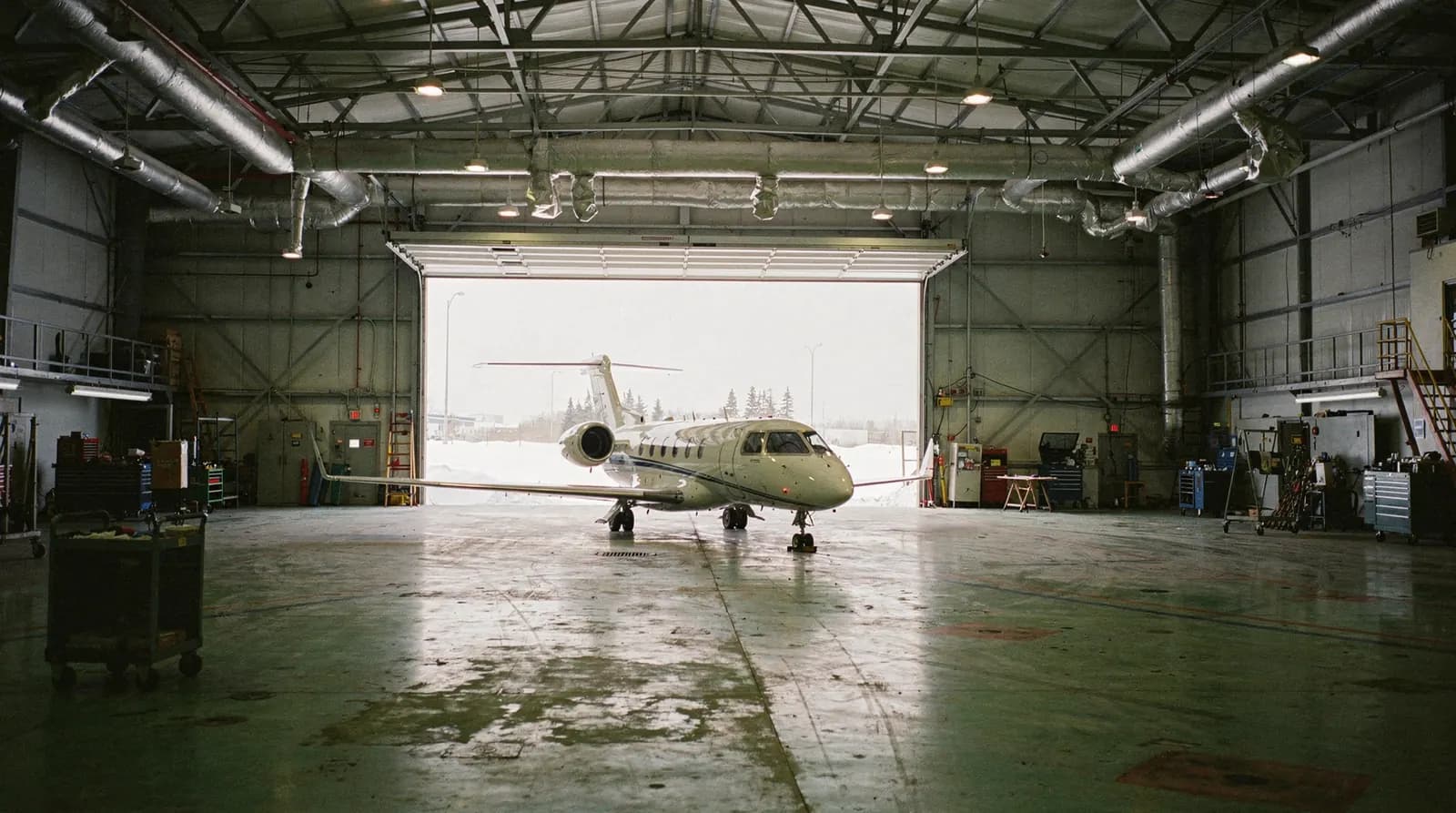
Why a hangar isn't a warehouse with a tall door
A hangar puts a fuelled aircraft, an open floor and a very high roof in one room, and that combination breaks the usual sprinkler assumptions. The fire you plan for starts at floor level, in a fuel spill or under a wing. The heads that would normally control it sit far above the tail, where the heat takes a while to arrive. And water alone is a poor answer to a spill. Jet fuel floats, so a stream can push a burning pool across the floor instead of smothering it.
That's why hangars get their own standard. In the National Building Code an aircraft hangar is Group F-2, and a light-aircraft hangar used only for storage is Group F-3, a lower-hazard class (both are named as examples in the NBC 2020 appendix note; NBC(AE) 2023 is built on that edition). Most of what follows, the foam, the pumps, the drainage, comes from how big the hangar is and what parks in it.
How NFPA 409 sorts hangars
NFPA 409 puts every hangar in one of four groups by door height, fire area and construction. It's written in feet. A 28 ft door is about 8.5 m, and 40,000 sq ft is about 3,700 m².
| Group | What puts a hangar there | Protection the standard describes |
|---|---|---|
| I | Door taller than 28 ft, a single fire area over 40,000 sq ft, or aircraft with a tail taller than 28 ft | Roof-level foam-water deluge (plus monitors for large aircraft), or roof sprinklers with low-level low-expansion foam, or roof sprinklers with low-level high-expansion foam |
| II | Door 28 ft or less, fire area from 5,001 to 40,000 sq ft depending on construction | Foam-water deluge or sprinklers with foam in older editions. The 2022 edition dropped the foam requirement for most Group II hangars |
| III | Door 28 ft or less, fire area up to 30,000 sq ft depending on construction | Group II level protection where hazardous operations take place |
| IV | Membrane-covered rigid steel frame | Low- or high-expansion foam for areas over 12,000 sq ft |
The Group III and IV rows follow a 2022 industry summary of the standard, so check them against the text your project uses.
Here's the Alberta catch. NFPA 409 isn't in the referenced-documents table of the National Fire Code 2023 Alberta Edition, so it doesn't bind a hangar by name. It reaches a project through the AHJ, the owner's insurer or the design brief, and NFPA now lists a 2026 edition alongside the 2022 one. Settle which edition governs before the first drawing. Getting that in writing costs an email. Changing a foam system after the pipe is up costs a great deal more.
Fuel spills at floor level and where the discharge goes
Start below the aircraft. NFPA 409 calls for trench drainage parallel to the hangar doors and flanking the aircraft bays, so spilled fuel drains away before it spreads to the next aircraft. The same trenches take the foam and water after a discharge, and a big discharge is a lot of liquid.
That makes drainage a coordination item before it's a fire protection item. Slab slopes, trench locations and the tie to site drainage get fixed early, and the fire protection design supplies the flow figures. If the designer isn't in the room when the slab is being sloped, somebody ends up coring a trench into a finished floor.
Detecting a flame in a very big room
Heat takes too long to climb to a roof that high, so hangar systems commonly rely on optical flame detectors (UV, UV/IR or triple IR) that see a fire's radiant signature across the room and release the deluge. Designers often ask for two detectors in alarm before release, because an accidental foam discharge over an aircraft is an expensive mistake.
Smoke and heat detection still cover the offices, stores and shop mezzanines. Alberta installs and tests alarms to CAN/ULC-S524:2019 and CAN/ULC-S536:2019, not NFPA 72, and the flame detection panel has to talk to the building's fire alarm system as well as to the release valve.
Foam, water, or both
Sprinklers cool and control. Foam smothers fuel. A Group I hangar needs some of each, which is why the options in the table pair roof water with a foam layer.
A deluge valve holds water back until detection opens it, and then every nozzle flows together. In a hangar that's the point: you want the whole bay covered before the fire gets under the wing, not one head at a time.
Group II is where the standard moved. After risk-analysis studies, NFPA dropped the foam requirement for most Group II hangars in 2022 (industry summaries tie the remaining cases to hazardous operations in the hangar) and allowed alternatives, such as an ignitable-liquid floor drainage assembly, with the AHJ's approval. Read that as flexibility, not permission. Someone still has to show the AHJ the alternative works. In the code, the route for anything the prescriptive text doesn't cover is an alternative solution, and newer approaches like compressed air foam would go through the same door. That's fire code consulting territory.
One practical question belongs on every foam spec. Older foam concentrates contained PFAS, and the industry has been moving to fluorine-free products, so ask what concentrate the design assumes, how much the tank holds, and how a discharge test will be contained. Special hazard suppression covers the systems themselves.
Water supply, pumps and January
Group I hangars need at least two fire pumps. Alberta's NBC(AE) 2023 points to NFPA 20-2016 for fire pumps, an older edition than the one NFPA sells today, and the water supply test is what decides whether a pump and a tank are needed at all. Foam-water flows are big enough that a municipal main rarely settles the question by itself. Our fire pumps and hydrants page covers what a pump room needs.
Then there's the cold. NBC(AE) 3.2.5.17 requires fire protection equipment in unheated areas to be protected from freezing, and Edmonton's code design temperatures are -30 C (2.5% January) and -33 C (1%). Hangar doors open and close all winter. A deluge system's piping is dry until it operates, which helps, but the deluge valve, the pump room and the foam concentrate tank still have to stay above freezing. The October winterization checklist covers the wider freeze checks for an Edmonton building.
The shop next door
An aircraft hangar rarely stands alone. The buildings around it bring their own rules, and most of them are ordinary Alberta fire code:
- spray finishing, covered by NFPA 33-2018, which the NFC(AE) 2023 references;
- flammable and combustible liquid storage, under NFC(AE) Part 4 and NFPA 30-2018;
- hot work, which needs at least one portable extinguisher in the area and a fire safety plan where required (NFC(AE) 5.2.3.6 and 5.2.3.7);
- electronics and avionics test rooms, where water is the wrong answer and a clean agent system designed to NFPA 2001-2018 is one of the options NFC(AE) 2.1.3.5 lists.
Who else has a say
On an airport site, don't assume the reviewer is the one you'd deal with downtown. The Safety Codes Act puts the AHJ in an accredited municipality or agency, and land that's federal or run by an airport authority may add its own requirements on top. We haven't confirmed how that works on any specific Alberta airport. Ask the owner on the first call who reviews the drawings, and ask their insurer what they expect.
Testing and upkeep
NFPA 25-2017 is the inspection standard Alberta cites for water-based systems, so the deluge valve, the pumps and the piping fall under it. The foam side follows the manufacturer's instructions and the design standard. Keep the reports: no inspection record may be destroyed within five years, and they stay on site (NFC(AE) 2023, Division C 2.2.1.2). Detectors, the trench drains and the concentrate tank belong on the inspection schedule too, because a plugged drain is invisible until the day you need it.
What Sterling can do for a hangar or aircraft shop
We can design the sprinkler and deluge layout (hydraulic calculations, AutoCAD and HydraCAD drawings, BIM coordination with the roof steel, lighting and ventilation competing for the same space), install sprinklers, fire alarms, high-expansion foam, fire pumps and water storage, and inspect and maintain them afterwards. Code analysis and alternative-solution work sits with our fire code consulting service, and the 24/7 emergency line covers a tripped valve or an alarm trouble.
One honest limit. Low-expansion foam-water systems aren't among the systems we list, so if your design calls for one, confirm scope with us at the start. To open a conversation, call 780.760.0806 or use the contact page.
Frequently asked questions
Do all aircraft hangars need foam?
No. Group I hangars are the strictest, and the standard pairs roof water with a foam layer there. Since the 2022 edition, foam is no longer required in most Group II hangars, and alternatives can be accepted with AHJ approval. Which group you're in depends on door height, fire area and construction. Your designer and the AHJ confirm the rest.
Does Alberta require NFPA 409?
Not by name. NFPA 409 isn't in the NFC(AE) 2023 referenced-documents table. It applies through the AHJ, the owner's insurer or the design brief, so ask which edition they expect. NFPA lists 2022 and 2026 editions, and they differ.
Is a small storage hangar for light aircraft treated the same way?
Not exactly. The code puts a light-aircraft hangar used only for storage in Group F-3, a lower-hazard class than a maintenance hangar. Whether it needs sprinklers depends on its size, construction and the AHJ. We wouldn't guess without the drawings.
Sources
- National Fire Code 2023 Alberta Edition, National Research Council Canada
- Protection of Aircraft Hangars, Risk Logic
- Understanding NFPA 409: Fire Suppression for Aircraft Hangars, Pye-Barker Fire & Safety