
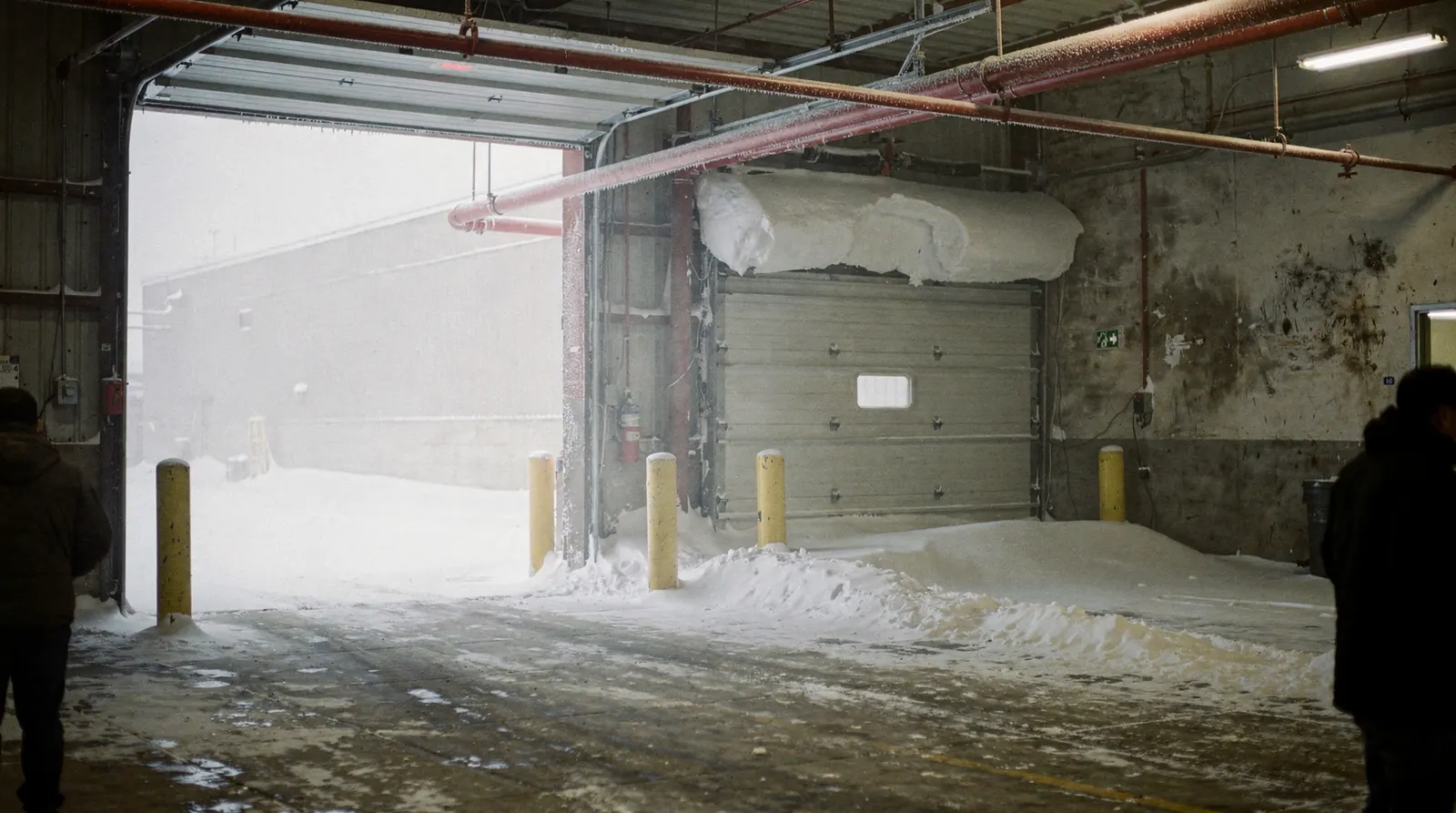
Do the winter check in October, not the week it hits minus 30
To winterize a fire sprinkler system in Edmonton, confirm that every pipe holding water stays above 4°C (40°F), that every dry system holds air and has empty low points, and that nothing you can't see (a stuck heater, an open dock door) is about to change either. Then confirm the alarm side is ready to run on battery when the cold cuts power. Do it in October. A frozen pipe in January gets found by a flood.
Edmonton's own numbers say why. The National Building Code 2023 Alberta Edition lists January design temperatures of -30°C at the 2.5 percent level and -33°C at 1 percent (Appendix C, Table C-2). Hourly readings fall below the first value about 19 hours in an average January and below the second about 8. Those are design values for sizing systems, and they aren't the worst night. Extreme lows are a different thing (the Edmonton International Airport area hit -45.9°C on January 12, 2024, and its record since 1959 is -48.3°C), and no code treats them as a design temperature. What they tell you is that a building can go past its design conditions.
The airport's 1981 to 2010 normals average about 99 days a year below -10°C, about 37 below -20°C and about 10 below -30°C, and mean first fall frost lands around mid-September. So the window is short. The code hook is NBC(AE) 3.2.5.17: fire protection equipment that freezing could affect, in unheated areas, has to be protected from freezing. Once the building is occupied, keeping systems operating is the owner's job under the National Fire Code 2023 Alberta Edition (NFC(AE) 2023, Division B, 6.1.1.2).
What you can check yourself and what needs a contractor
A lot of winterizing is looking and reading. Some of it isn't, and Alberta's fire code limits who can do it (NFC(AE) 2023, Division C, 2.2.4.4). Testing and repairing sprinkler systems is work for a journeyperson sprinkler systems installer, or, for testing and maintenance only, a holder of an approved NFPA 25 certificate. Owners and their staff can do the visual checks. They shouldn't be opening valves or draining systems.
| Task | Owner or staff | Contractor |
|---|---|---|
| Walk unheated areas and confirm heat is on | Yes | |
| Read the temperature in valve rooms and pump rooms | Yes | |
| Check that control valves are open and sealed or locked | Yes, as an inspection | Operate and test them |
| Read gauges on dry systems and note air pressure | Yes | Investigate a drop |
| Look at heat trace and insulation | Yes, visually | Test the circuit and controller |
| Clear snow and ice from hydrants and fire department connections | Yes | |
| Drain dry system low points and confirm no trapped water | Yes | |
| Trip test dry and preaction valves | Yes | |
| Test antifreeze concentration | Yes | |
| Battery and panel testing on the fire alarm | Owner may do daily and monthly checks if trained | Annual test |
| Backflow assembly test | Certified tester |
Wet pipe in unheated spaces is where most freeze-ups start
Wet pipe freezes where the building's heat doesn't reach. The usual list is loading dock canopies, parkades, attics, concealed ceiling spaces, vestibules, exterior walls and any room with a broken heater or a door that stays propped open. Those come from freeze failure summaries by risk engineers (Risk Logic), and they match what any Edmonton facility manager could name from memory.
The test is simple. Walk the building on a cold day with a thermometer. Look at pipe near exterior walls, roof lines and penetrations, because a small air leak next to a pipe drops its temperature well below the room's. Check that the space stays above the 4°C floor commonly used for water-filled pipe, and that the heat doesn't depend on a single unit with no backup.
If a space can't hold that temperature, the answer isn't a heat lamp. It's a design change. Dry pipe, preaction, a listed antifreeze loop or dry-type heads all work, and each has upkeep. That decision is covered in wet vs dry sprinklers in Alberta winters.
Dry and preaction systems need air, dry pipe and empty low points
Dry systems don't freeze the way wet ones do, but they do fail in winter, and the failures are dull. Trapped water in a low point. A compressor that stopped. A valve room that dropped below freezing so the water in the dry pipe valve itself iced up.
Four checks matter before the cold.
- Valve room temperature. The enclosure around a dry or preaction valve is inspected daily in cold weather, or weekly where a low-temperature alarm is supervised (NFPA 25-2017, per charts of Table 13.1.1.2). Decide who does that and write it down. A daily check that nobody owns doesn't happen.
- Air or nitrogen pressure. Read the gauge and compare it with the last report. A system losing pressure is telling you there's a leak, and a low-air alarm at 2 a.m. in January isn't the time to find the compressor is undersized.
- Low-point drains. Water left in pipe after a trip test or a maintenance visit freezes and can split a fitting. Later NFPA 25 editions state that low-point drains get drained before freezing weather and through the heating season (NFPA 25-2023, 13.4.5.3.3). Alberta references the 2017 edition, but the practice is sound whatever the edition.
- Priming water, the low-air alarm and the compressor. The first two are quarterly items in the tables. Check all three before, not after, the first cold snap.
If you're due a full-flow trip test on a dry system, do it in September or October. A trip floods the piping and leaves water at every low point. It's much easier to dry out a system in a warm week. That's why we'd book the three-year test early in the season as part of your inspection visits.
Antifreeze loops and heat trace
Antifreeze systems have to use a listed antifreeze. NFPA 25 set September 30, 2022 as the date for existing systems to move to listed products (later editions let some tested legacy mixes stay, but they can't be topped up with legacy fluid), and "listed" means evaluated to ANSI/CAN/UL 2901 (NFSA on the sunset date). The mix's concentration is tested annually, and the right time is before freezing weather, so you know the loop protects to the temperatures you expect. If a sample fails, the system gets drained and refilled with a listed product, or it's converted to dry pipe. Antifreeze also affects backflow protection, which comes up below.
Heat trace is the third answer for a short run of exposed pipe. It has to be listed for use on sprinkler piping, it keeps the pipe between 4°C and about 49°C (40°F to 120°F), and it depends on insulation to work at all. It can't replace a heated enclosure around a dry pipe or preaction valve. NFPA 25-2017's table sets inspection "per manufacturer's requirements", so ask for the manufacturer's test steps. And ask whether the controller sends an alarm to the fire panel. A heat trace circuit that trips silently is a freeze waiting to happen. Look at it now, while the weather still allows.
Valve rooms, fire department connections and hydrants
A riser room is a fire protection system's front door and the easiest place to check. Put a thermometer in it. Confirm the heater works, the louvres or door to the outside seal, and nothing is stacked against the riser. Sprinkler risers in a mechanical room with a rooftop unit can see a big temperature swing if a damper sticks open.
Fire department connections (FDCs) are inspected quarterly under the NFPA 25-2017 tables. Before winter, check that caps are on, clear of snow and ice, and drain properly, and that the sign is legible. Alberta specifies its hose threads (65 mm couplings use Alberta Mutual Aid thread, NFC(AE) 2023, Division C, 2.2.6.1), so a missing or wrong cap gets replaced with the right one. Nobody wants to discover in a fire that the connection is buried under a plough windrow.
Private hydrants need the same clear access. Plan snow clearing so the plough doesn't pile onto the hydrant. If a hydrant has to be shut down, repaired or altered, the fire department has to be notified and approve it, and the hydrant has to be marked (NFC(AE) 2023, Division C, 2.2.7.2(5)). Our fire pumps and hydrants page covers annual flushing and flow tests.
Fire pump rooms and tanks
A fire pump room has to stay warm enough that the pump, the fuel system and the piping work on demand. NFPA 25-2017 sets minimum room temperatures, and they differ for electric pumps, diesels with engine heaters and diesels without. Ask your tester for the figures that apply to your pump, and confirm the room's heater and thermostat have a backup. Diesel pumps also need fresh, conditioned fuel and charged batteries before winter. The routine no-flow runs (weekly for diesels, monthly or weekly for electric pumps depending on the installation) continue all winter; a pump that hasn't been run since October may not start in January.
Backflow assemblies outside
A backflow assembly on a fire line that sits outdoors or in an unheated vault can freeze and crack. Most are in heated rooms, but the ones on a yard connection often aren't. Check that any enclosure is heated and closed, and that a reduced pressure (RP) assembly has a way to drain its relief port that won't ice over. In Edmonton, EPCOR's program requires annual testing of premises isolation assemblies by a certified tester registered with it, and a failed assembly repaired or replaced within 5 business days (see our backflow prevention page).
Antifreeze or additives on a sprinkler system move the required assembly toward the RP type under the National Plumbing Code 2020 (2.6.2.4). If you add antifreeze to a loop, tell whoever looks after your backflow assembly. It changes what's required.
Remember the tie to your main drain test. NFPA 25-2017 has that quarterly, not annually, when the only water supply passes through a backflow preventer.
Fire alarm panels, batteries and monitoring in the cold
A fire alarm system has to work when the building loses power, and the cold makes the batteries do it harder. Battery capacity drops as temperature drops, and Edmonton's fire marshal bulletin lists battery testing as mandatory in the annual report. So look at the batteries before winter. Check dates on the labels, look for swelling or corrosion, and note whether the panel is in a room that stays heated.
Panels and devices in unheated spaces, such as a parkade or outbuilding, need to be listed for the temperature range they see. Read the label, or ask your alarm contractor. Then test the path out: put the account on test with your monitoring company, trip a device and confirm the station receives the alarm, supervisory and trouble signals. Our fire alarm systems page shows what the annual test covers, and fire alarm verification and ULC monitoring explains the monitoring link.
Daily and monthly alarm checks may be done by the owner or a representative trained by the manufacturer or a service provider (NFC(AE) 2023, Division C, 2.2.4.3). Emergency lighting units use batteries too, and cold rooms shorten their life. Our emergency lighting and exit signs page has the monthly and yearly routine.
If something freezes or you can't keep it warm
A frozen sprinkler pipe is an emergency and a fire protection impairment. Don't close the main valve without a plan. Call a contractor first, then tag the impairment, notify your insurer and the fire department under your notification procedure, and arrange alternative measures such as a fire watch while the system is down (NFC(AE) 2023, Division B, 6.1.1.3 and 6.1.1.4; Division C, 2.2.7.2). Our 24/7 emergency repair page explains the first steps. The number is 780.760.0806.
Better still, get ahead of it. If you know a space won't hold heat this winter, tell your contractor now. We can walk your building before the cold arrives, flag the risks and book the tests that need a qualified person. Send the address and details through the contact page.
Frequently asked questions
When should I winterize my sprinkler system in Edmonton?
Do it in October. Edmonton's mean first fall frost falls around mid-September, and the airport has about 99 days a year below -10°C. Confirm heat in every space with water-filled pipe, drain dry system low points, and test antifreeze concentrations before the first hard freeze.
What temperature keeps a wet sprinkler system from freezing?
Freeze-protection guidance commonly uses 4°C (40°F) as the floor for water-filled pipe. Below that, the space needs freeze protection: dry pipe, preaction, a listed antifreeze loop or dry-type heads. Edmonton's design temperature is -30°C at the 2.5 percent level, but a room only has to lose its heat to be at risk, whatever the outdoor number is.
Do dry sprinkler systems need winter maintenance?
Yes. Dry and preaction valve rooms are checked daily in cold weather (weekly with a supervised low-temperature alarm), air pressure is monitored, and low-point drains are emptied so no water sits in the pipe. A full-flow trip test is better done in warm weather.
Can I put antifreeze in my sprinkler system?
Only a listed antifreeze (ANSI/CAN/UL 2901) may be used to refill, and concentration is tested annually. Antifreeze also pushes the backflow assembly toward the RP type under the National Plumbing Code. Ask a designer before adding it.
Sources
- National Building Code 2023 Alberta Edition, National Research Council Canada
- National Fire Code 2023 Alberta Edition, National Research Council Canada
- Climate normals and long-term extremes for the Edmonton area, Environment and Climate Change Canada
- Listed Antifreeze and the Sunset Date, National Fire Sprinkler Association
- NFPA 25-2017 inspection frequencies chart, Falcon Fire Sprinkler
- Preventing Freeze Damage in Fire Protection Systems, Risk Logic
- National Plumbing Code of Canada 2020, National Research Council Canada
- Cross Connection Control, EPCOR Water Services