
What EPCOR expects after a failed backflow test
A failed backflow test in Edmonton has to be fixed fast. EPCOR's procedure guide says that when an assembly fails a test, the customer must have it repaired or replaced within 5 business days, then tested again to show it complies, and that results go to EPCOR's Cross Connection Control Department within five days of the test date. Reports go in online through SwiftComply. EPCOR no longer accepts them by email or fax.
Read those numbers as the working rule. They come from EPCOR's own guide (section B.4) and its program page. Bylaw 19626 has a penalty table with different thresholds, and the guide has a typo in a nearby clause that says "thirty (5) days." If your situation is close to the line, call EPCOR's Cross Connection Control office at 780.412.7840 and get the answer in writing.
The owner pays for inspection, testing and repair. EPCOR can shut off water service, apply bylaw penalties and inform Alberta Health Services if an assembly stays out of compliance. The penalty schedule is in the bylaw and it changes, so read the current version rather than trusting a figure in an article.
So the clock is short, and it starts on test day, not the day the report lands in your inbox. Here's how the repair path runs.
- The certified tester reports the failure to you on site, with the readings.
- You approve a repair or a replacement, and the work is scheduled inside the 5 business days.
- The assembly is repaired or replaced, then retested by a certified tester.
- The passing retest report goes to EPCOR through SwiftComply, within 5 business days of that test.
- You keep a copy on site. The bylaw requires test records to be retained at the premises.
What "failed" means on an RP and a DCVA
Both types have check valves, and the tester measures whether the checks hold. Definitions come from EPCOR's guide. A reduced pressure principle assembly (RP) has two independently acting check valves and a hydraulically operated pressure differential relief valve between them, with test cocks. A double check valve assembly (DCVA) has two internally loaded check valves between shutoffs, with test cocks, and it's only used where the hazard is a pollutant rather than a health hazard.
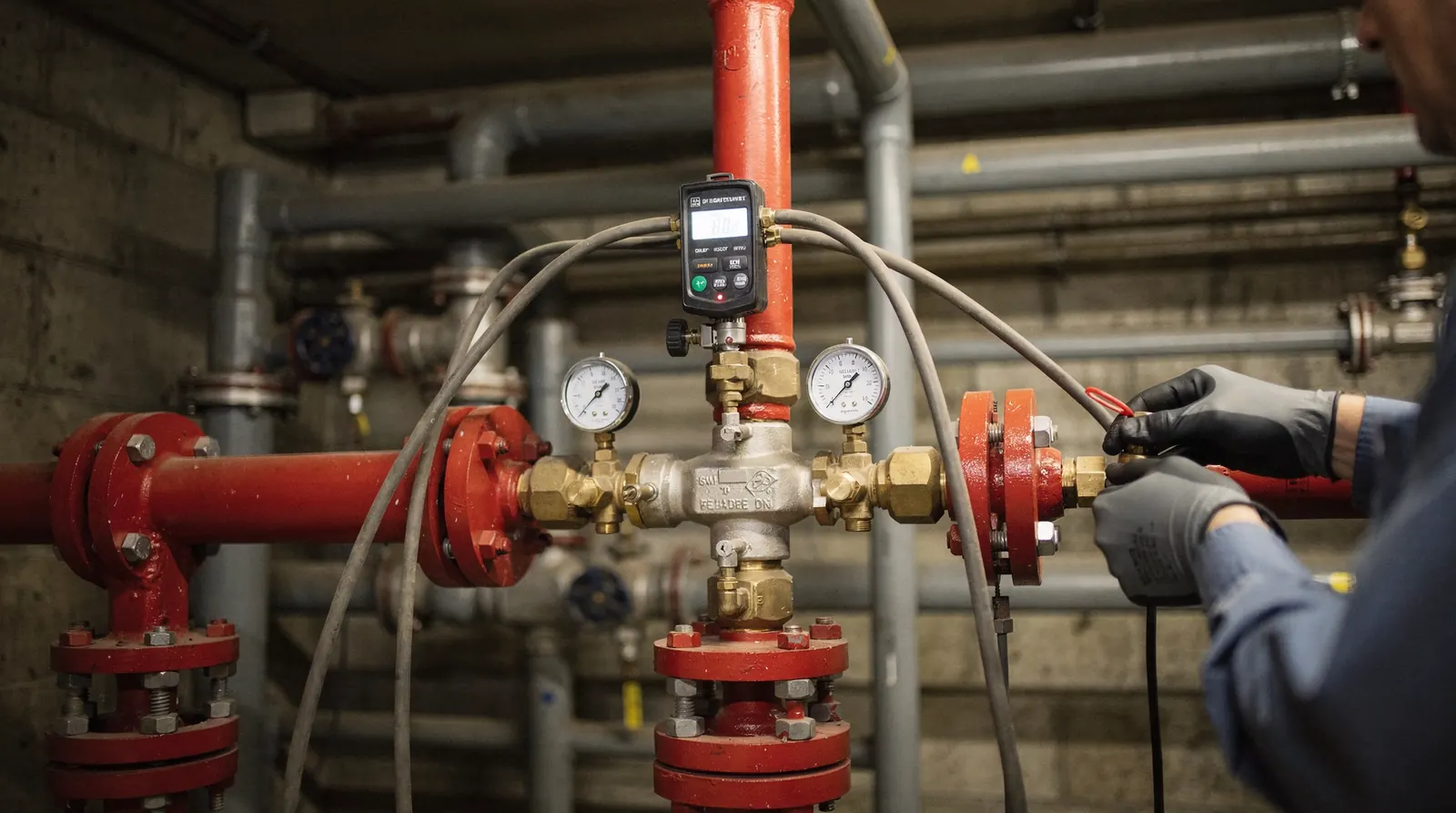
A tester connects a calibrated differential gauge to the test cocks, then works through a sequence of steps. A failure means one of these:
- a check valve leaks back under the test conditions, so it doesn't hold the pressure difference the standard sets;
- on an RP, the relief valve opens when it shouldn't, doesn't open when it should, or doesn't open at the required pressure differential;
- a shutoff valve leaks, so the test can't isolate the assembly and the reading is unreliable.
The test itself follows the Canadian AWWA Cross Connection Control Manual and CSA B64.10/B64.10.1. EPCOR wants the tester to hold a Western Canada Section AWWA cross connection certificate, be registered with EPCOR and use a test kit with a current calibration report.
Common reasons assemblies fail
These are patterns from trade experience, not code text, and any tester will recognize them.
Debris. Sand, scale and bits of pipe get past the strainer or arrive after a water main break or a repair, and one grain can hold a check valve off its seat. The first check sees the debris first, so in our experience it's often the one that fails.
Worn rubber. Seats and discs degrade with age and water chemistry. An assembly that has passed for years can fail because a seal finally gave out.
Springs. A weak or broken check spring won't close the valve against the pressure difference.
A relief valve that sticks or weeps. On an RP, a relief valve discharging from the port often points to a failing first check or a fouled relief valve seat. Water dribbling from an RP's drain during normal operation is worth a call before the annual test.
Freeze damage. An assembly in an unheated vault or an outside enclosure can crack or be damaged over winter, and the failure turns up at the spring test. Check those enclosures before the first cold snap.
Conditions downstream. Thermal expansion or back pressure can push an assembly outside its normal range. That's a design issue, and a repair kit won't fix it.
A tester should tell you which of these it is before you approve the fix. A cleaned and re-seated check valve costs less than a full rebuild, and a rebuild costs less than a new assembly. But a tired 20 year old assembly that has failed twice may be a candidate for replacement.
Repair or replace
Repair when the cause is clear and the assembly is otherwise sound. Replace when parts are hard to find, the body is corroded, the model is obsolete, or the assembly keeps failing after repairs. Ask the tester whether the repair kit and parts are on the truck, because if the assembly has to be ordered, the 5 business days become the real problem.
A replacement is an installation. EPCOR's program brochure has the contractor requesting permits from the City of Edmonton, notes that installing an assembly may take a full working day, and says the water shut-off will be required. Ask whether your replacement needs a permit, and don't assume a like-for-like swap is exempt. The new assembly needs to be the right type, selected and installed to CSA B64.10-17 under the National Plumbing Code 2020.
The brochure says a routine annual test takes 1 to 2 hours with a short water shutoff. A repair or replacement takes longer and needs a longer shutoff.
Fire lines make a failed test more complicated
A backflow assembly on a fire line sits in the water supply to your sprinklers, so testing it or repairing it is a shutdown of that supply. Alberta's fire code treats any interruption of a fire protection system, including routine testing, as a temporary shutdown, and requires alternative measures while it lasts (National Fire Code 2023 Alberta Edition, Division B, 6.1.1.4). A notification procedure has to be in place for tests and repairs (6.1.1.3), acceptable to the fire department before repairs or alterations (Division C, 2.2.7.2(1)).
In practice, that means planning the repair, not just booking it. A few things to line up:
- tell your insurer, your monitoring company and the people in the building;
- tag the impairment and note the alternative measures. A fire watch may be one of them, and NFPA 25 Chapter 15 covers impairments in more detail;
- do the repair in one visit, with parts on hand, so the sprinklers are back in service as soon as possible;
- confirm the sprinkler valves are open, sealed and secured when the work is finished.
Our 24/7 emergency repair page covers impairments in more depth.
There's a second test. NFPA 25-2017 has its own annual forward flow test of the backflow assembly (13.7.2), and inspection of RP assemblies weekly or monthly (13.7.1). That's the fire-protection test, and it's separate from EPCOR's cross connection test. One visit can cover both if it's planned that way. Also, where the only supply to a sprinkler system passes through a backflow preventer, NFPA 25-2017 has the main drain test quarterly rather than annually. A leaking assembly that has been ignored shows up there too.
RP versus DCVA on a fire line
Which type you need depends on the hazard, and on fire lines it often depends on what's in the water. EPCOR gives examples. Severe hazards such as hospitals, laboratories and car washes need an RP. Moderate hazards, including offices, schools and hotels, need a DCVA.
For sprinkler and standpipe systems, the National Plumbing Code of Canada 2020 (2.6.2.4) sorts it by system class. Systems without additives get a double check assembly in most cases. Any Class 1 to 3 system using antifreeze or other additives needs an RP on that portion. Class 4 and 5 systems need an RP. The preventer goes upstream of the fire department pumper connection, and bypass piping that reduces the preventer's effectiveness isn't allowed (2.6.2.12).
That's why a failed DCVA report can turn into a conversation about upgrading to an RP. If an antifreeze loop was added or the system's water source changed, the DCVA that passed for years may no longer be the right device. It's worth checking the class of your fire system with the designer. An RP also brings its own needs, such as a way to drain the relief port and a protected place to sit.
What to ask the tester
Before you approve any work, ask:
- What exactly failed (which check, which relief valve) and what were the readings?
- Can it be repaired, and is that a cleaning or a rebuild?
- Are the parts on the truck, and can you finish inside the 5 business days?
- Will you do the retest and submit the passing report through SwiftComply?
- Are you certified with the Western Canada Section AWWA and registered with EPCOR, and is your test kit calibrated? Ask to see it.
- What does the repair do to my sprinkler supply, and how long is it out of service?
- Is the assembly the right type for my fire system, given any antifreeze or additives?
A good tester answers these without fuss. If the answers sound vague, get a second opinion before you replace an assembly.
Getting it done
If you're holding a failed report now, don't wait. Send us the report and the assembly details through the contact page or call 780.760.0806, and we'll say what the failure points to and how to schedule the repair around your sprinkler system. Our backflow prevention page covers annual testing and certification for DCVA and RP assemblies. For the wider schedule of what else falls due each year, see the fire system inspections page and the sprinkler systems page.
Frequently asked questions
How long do I have to fix a failed backflow assembly in Edmonton?
EPCOR's procedure guide says 5 business days to repair or replace it, then it must be retested. The passing report goes to EPCOR's Cross Connection Control office within five days of the test, through SwiftComply. Bylaw 19626 lists different thresholds for penalties, so treat 5 business days as your working deadline and confirm with EPCOR if you're near it.
Who submits the retest report?
Your certified tester submits it online through SwiftComply. EPCOR doesn't accept email or fax. The report has to go in within 5 business days of the test, and you should keep a copy on site because the bylaw requires records at the premises.
Can I use any plumber to test or repair my backflow preventer?
Testing must be done by a tester holding the Western Canada Section AWWA cross connection certificate and registered with EPCOR. EPCOR's brochure tells owners to hire a certified plumber or fire sprinkler company from its list. Repairs and replacements need the right type and installation, and a replacement may need a City permit.
What happens if I miss the deadline?
EPCOR can shut off water service, apply bylaw penalties and notify Alberta Health Services. The owner pays for testing and repair. The penalty amounts are in the bylaw's schedule and change over time, so check the current schedule.
Does a failed backflow test affect my fire sprinklers?
It can. The assembly sits in the sprinkler supply, so a repair or replacement is a shutdown of that supply. The fire code requires a notification procedure and alternative measures such as a fire watch while the system is down. Plan the work, do it in one visit and confirm the valves are open and sealed afterward.
Is an RP or a DCVA required on my fire line?
It depends on the hazard and the system. The National Plumbing Code 2020 (2.6.2.4) requires an RP on any Class 1 to 3 system that uses antifreeze or other additives and on Class 4 and 5 systems. Without additives, most call for a double check assembly. Confirm with your designer and EPCOR.
Sources
- Cross Connection Control, EPCOR Water Services
- Cross Connection Control Procedure Guide, EPCOR Water Services, February 26, 2024
- Cross Connection Control brochure, EPCOR Water Services
- EPCOR Water Services Bylaw 19626, City of Edmonton
- National Plumbing Code of Canada 2020, National Research Council Canada
- National Fire Code 2023 Alberta Edition, National Research Council Canada
- NFPA 25-2017 inspection frequencies chart, Falcon Fire Sprinkler