
Four kinds of structure, four different rulebooks
Transportation and infrastructure covers at least four fire problems that only share a lot of cold weather. Sort yours first, because the answer to "what does the code want?" changes completely.
Parking garages, including open-air ones, are Group F-3 in the National Building Code. Repair garages, which is where most bus and truck depots live, are F-2. Passenger stations and depots fall under A-2, the same group as schools and restaurants. Tunnels and bridges don't have a building group at all. They answer to NFPA 502 (Road Tunnels, Bridges, and Other Limited Access Highways), and a transit line answers to NFPA 130 (Fixed Guideway Transit and Passenger Rail Systems), if the project owner adopts it. Neither is in the referenced-documents table of the National Fire Code 2023 Alberta Edition, and we couldn't confirm whether either binds an Edmonton project. The owner's fire and life safety criteria are where you find out.
Parkades
An unheated parkade is a freezing problem first and a fire problem second. Wet sprinkler pipe in an unheated parking garage is a named cause of freeze failures, and it's a mistake people keep making because the pipe looks harmless on a warm day in June. At Edmonton International, the 1981 to 2010 climate normals show about 208 days a year with a low at or below 0 C, and about 10 with a low at or below -30 C. The airport runs colder than downtown, but the direction is obvious. The October winterization checklist covers what to check before the cold arrives.
The code says it plainly. NBC(AE) 3.2.5.17 requires fire protection equipment in unheated areas to be protected from freezing. Design temperatures for Edmonton are -30 C (2.5% January) and -33 C (1%). The usual ways to meet that are heating the space or using a dry pipe system, with preaction and dry-type heads as other options.
Dry pipe isn't free. It swaps freeze risk for maintenance. Dry systems add a yearly trip test, a full-flow trip every 3 years, and daily valve room temperature checks in cold weather, weekly if a low-temperature alarm is supervised. And a full-flow trip leaves water in every low point of the pipe, so schedule it for September, not a cold snap. Our wet vs dry sprinklers in Alberta winters guide has more.
Whether a given parkade needs sprinklers at all depends on its height, area, construction and how open it is. That's a Part 3 code analysis for the building, and the AHJ has the last word.
Electric vehicles and the parkade
Electric vehicles didn't change what a parkade is, but they've changed what a fire in one behaves like. The National Fire Sprinkler Association notes that damaged EV batteries can go into thermal runaway hours after the crash. The research so far points the same way: a sprinkler in a parking garage controls the fire and slows its spread to the next car. It doesn't extinguish a battery that's in runaway.
NFPA's research arm has been running a multi-phase project on how sprinklers should protect parking structures from modern vehicles, both combustion and electric. Ask any designer who offers an "EV-rated" sprinkler layout what test or standard it rests on. If the answer is vague, it's marketing.
What you can do now: keep the sprinkler design honest to the code path that applies, give the fire department good access, and talk to the insurer about charging locations. The rest of that, chargers and their electrical work, belongs to the electrical trade and the AHJ, and we'd not want to guess.
Transit garages and stations
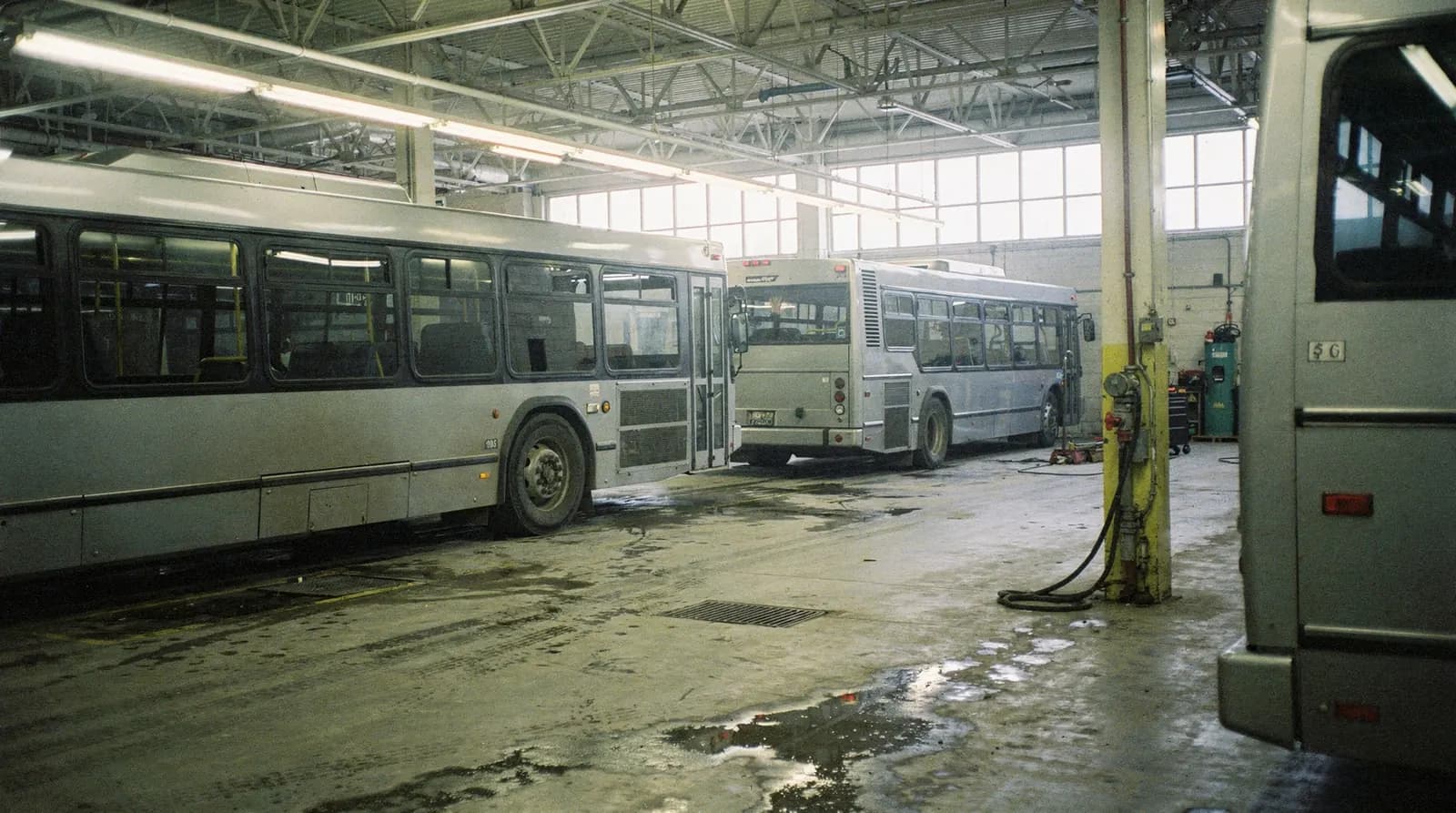
A bus or train depot combines a repair garage (F-2), vehicle storage (F-3) and often offices, and each of those parts has its own occupancy. A depot that charges battery-electric fleets has the parkade's battery question on a larger scale, with many big batteries under one roof.
Stations are usually simpler on the building side and much more complicated on the systems side. A passenger station is a public building with a lot of people, an emergency ventilation plan and a fire alarm that needs to talk to the operator's control centre. If NFPA 130 applies, it comes from the transit owner's fire and life safety criteria, written by their consultants. The contractor's job is to build and test the sprinkler, standpipe and alarm work to those criteria. Alarms in Alberta go in to CAN/ULC-S524:2019 (not NFPA 72), and integrated testing, where the alarm, the ventilation and the door hardware are proved together, follows CAN/ULC-S1001:2011.
Tunnels, bridges and long structures
Road tunnels and limited-access structures sit outside the building code and inside NFPA 502. Fixed suppression, standby water supply and emergency ventilation there are engineered for the owner, usually a transportation authority. We list deluge sprinklers, standpipes, fire pumps and water storage among our services, so the support buildings around a tunnel (pump houses, ventilation buildings, control rooms) are ordinary fire protection work. The tunnel's own system is specialist design, and we'd want the owner's criteria in hand before pricing it.
Standpipes, hydrants and the fire department connection
Alberta's NBC(AE) 2023 names NFPA 14-2013 for standpipes, which is older than the NFPA 14 edition you'll see quoted elsewhere. Private hydrants and the underground mains feeding them fall under NFPA 24-2013. Both are inspected under NFPA 25-2017, the edition the NFC(AE) 2023 references.
A standpipe in an unheated stair tower or parkade has the same freezing problem as a sprinkler pipe, and the designer picks a wet, dry or heated arrangement to suit. A hydrant in a snowbank isn't a hydrant, so plan snow clearing into the maintenance contract. A pump, when a parkade or station needs one, is a separate fire pump design with its own weekly checks, weekly or monthly no-flow runs depending on the driver, and an annual flow test.
Inspection in the cold
The annual visit on a parkade or depot has three cold-weather quirks. Valve rooms and pump rooms need their temperature checked, not assumed. Dry systems need their trip tests scheduled outside deep winter. And the fire department connection and hydrants need to be reachable in snow. Keep every report: none may be destroyed within five years, and they stay on site (NFC(AE) 2023, Division C 2.2.1.2).
What Sterling can do for infrastructure projects
We can design sprinkler, standpipe and alarm systems with hydraulic calculations and BIM coordination, install them as new work or retrofits, add fire pumps and water storage tanks, and run the inspections and flow tests afterwards. Freeze protection reviews, and questions about which standards apply, are fire code consulting work. Call 780.760.0806 or send the drawings through the contact page.
Frequently asked questions
Do parkades need sprinklers in Alberta?
It depends on the building. The code sets sprinkler triggers by height, area, construction and openness, and open-air garages are often treated differently from enclosed ones. Group F-3 is where parking garages sit in the code. Your designer and the AHJ decide, and we wouldn't guess without the drawings.
Will sprinklers put out an electric vehicle fire?
Not a battery in thermal runaway. Research so far says sprinklers control the fire and slow its spread to neighbouring vehicles, and damaged batteries can reignite hours later. That's a reason to plan for fire department access and follow-up, not a reason to skip sprinklers.
Does NFPA 130 apply to Edmonton transit projects?
We couldn't confirm that. NFPA 130 isn't in the NFC(AE) 2023 referenced-documents table, so it applies where the project owner's fire and life safety criteria adopt it. Ask the owner.
Sources
- National Fire Code 2023 Alberta Edition, National Research Council Canada
- Preventing Freeze Damage in Fire Protection Systems, Risk Logic
- Current Protection Standards for Lithium-Ion Batteries, National Fire Sprinkler Association
- Canadian Climate Normals, Edmonton International Airport, Environment and Climate Change Canada