
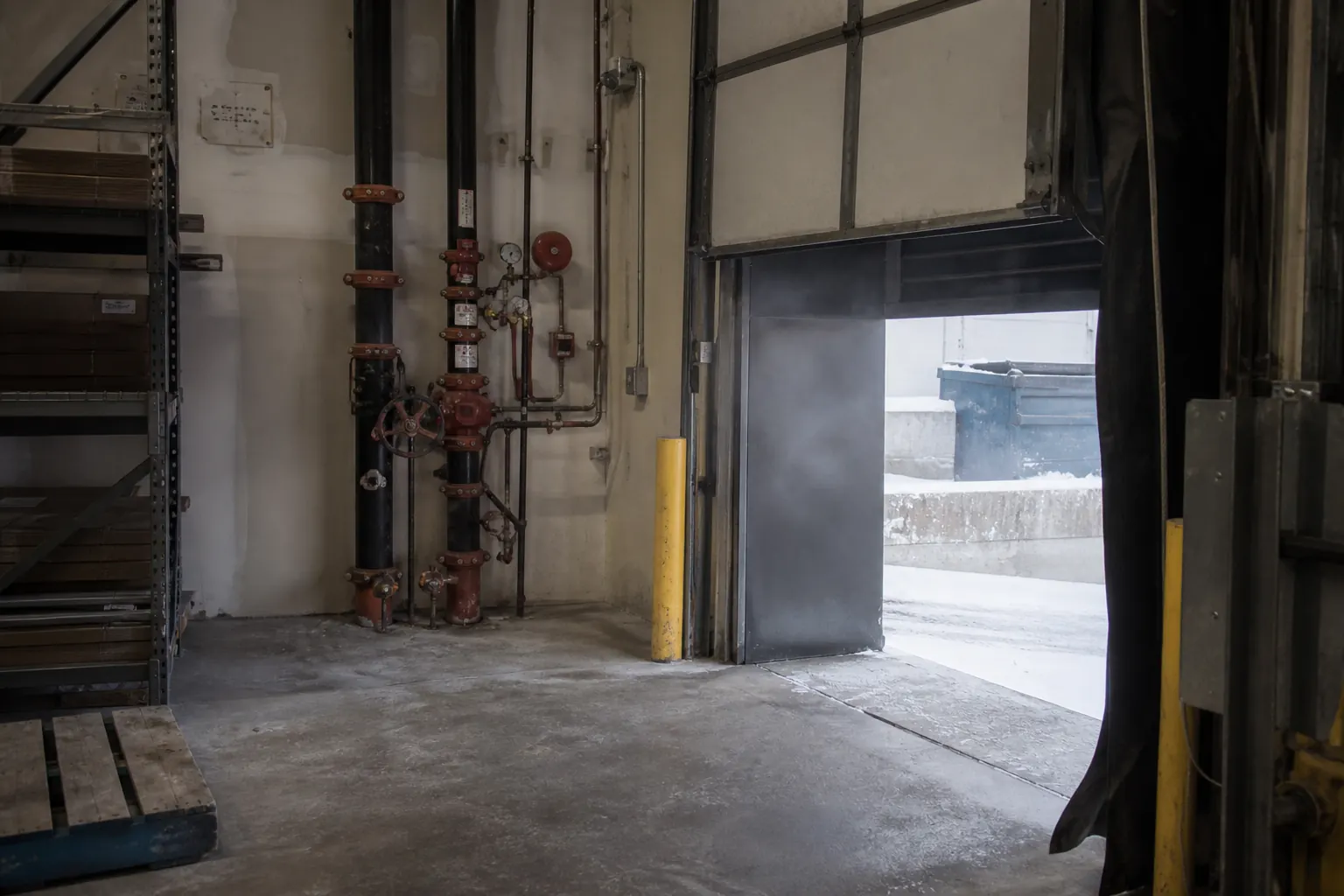
When wet pipe stops working in an Edmonton winter
Use wet pipe wherever the pipe will stay above 4°C (40°F) all winter, and something else wherever it won't. That's the wet vs dry sprinkler decision in one sentence. The rest of this article is about the "something else" and what it costs to keep up.
Wet pipe is the default for good reason. Water already sits at every head, so a fused head flows at once. There's less hardware to fail, and it's usually the cheapest system to design and inspect. A dry pipe system holds air or nitrogen in the pipe and keeps the water back at a dry pipe valve until a head opens. That delay, and the equipment behind it, are the price of a pipe that can't freeze.
The National Building Code 2023 Alberta Edition (NBC(AE) 2023) calls up NFPA 13-2019 for sprinkler design (Division B, 3.2.5.12), and it requires fire protection equipment that could freeze in unheated areas to be protected from freezing (3.2.5.17). Consultants summarizing NFPA 13, Code Red among them, put the line at 40°F: a space subject to freezing that can't constantly hold that temperature needs a dry system or another freeze-protected design. The standard itself sets that line in NFPA 13-2019, 16.4.1.1 (dry pipe or preaction where the temperature can't reliably stay at or above 4°C), and the clauses after it allow alternatives such as antifreeze and listed heat tracing. Your designer's drawings govern.
What Edmonton's cold does to a sprinkler pipe
Edmonton's January design temperatures are -30°C at the 2.5 percent level and -33°C at 1 percent (NBC(AE) 2023, Appendix C, Table C-2). Hourly readings fall below the 2.5 percent value for about 19 hours in an average January, and below the 1 percent value for about 8. St. Albert, Sherwood Park, Leduc and most neighbouring towns are colder at -32°C and -35°C, and Morinville and Gibbons colder again at -33°C and -36°C.
Design values aren't the worst night. Environment Canada's records show -49.4°C for the Edmonton area (in 1886 and again in 1893) and -45.9°C at the airport on January 12, 2024. The airport's 1981 to 2010 normals count about 37 days a year at -20°C or below. It sits south of the city and runs colder than downtown, but a cold snap doesn't read the code.
What matters is the coldest spot the pipe touches, not the room average: the soffit above an overhead door, a dock canopy, a stair vestibule, an attic, a concealed space with thin insulation at the roof line. Failed heat and unnoticed air leaks through penetrations are two of the standard causes of a freeze-up. Neither shows on a drawing.
So walk the building in January, not just the plans.
Heated wet pipe, dry pipe, dry-type heads, preaction or antifreeze
| Approach | Where it fits | The catch |
|---|---|---|
| Wet pipe in a space you can hold above 4°C | Offices, retail, most warehouses, corridors | The heat is now part of the fire protection. If it fails, the pipe goes first |
| Dry pipe | Unheated warehouses, docks, canopies, attics | Slower water delivery, and pipe that can corrode from the inside |
| Dry-type sprinklers on a wet main | A canopy, vestibule or freezer wall where a short section crosses into the cold | A 10-year test-or-replace cycle, and heads listed for their position |
| Preaction | Where an accidental discharge costs more than the delay | Needs detection, and double interlock adds dry-pipe-style delay |
| Listed antifreeze | Small loops, mostly existing ones | Listed fluids only, tested yearly, tight limits |
Our order of preference, for what it's worth: heat the space if the building can hold it, use dry-type heads for a small cold pocket, dry pipe for a whole unheated area, and treat antifreeze as something you inherit rather than choose. That's an opinion, not a code ranking, and a designer with your building in front of them may land elsewhere. Watch the vocabulary. "Dry pipe" is a whole system. "Dry-type" is a single head with a sealed barrel. Mix them up in an RFI and you'll get the wrong quote.
Our fire sprinkler systems page covers the full range of types. Warehouse owners weighing a heated shell against an unheated one should read the ESFR warehouse guide first, since the common ESFR heads are listed for wet pipe only, and that usually settles the heating question.
Keeping wet pipe warm on purpose
If the answer is heat, treat the heat like a fire protection component and give it a backup and an alarm. A single unit heater with no low-temperature alarm is a bet nobody turns it down.
Heat tracing is a legitimate tool, with conditions. It has to be listed for sprinkler piping, with branch lines and underground pipe allowed only where the listing says so. It can't replace a heated enclosure around a dry pipe or preaction valve. Its controller should signal the fire alarm panel so a dead circuit doesn't fail silently. NFPA 25-2017 sets its inspection at whatever the manufacturer requires, per Falcon's chart of the 2017 tables.
GCs, don't charge a wet system in a winter build until permanent or temporary heat is holding, and write the weekend heat plan down. The pipe doesn't care that the building isn't turned over yet.
What a dry sprinkler system in Alberta asks of the owner
More than a wet one. Dry pipe needs an air compressor or nitrogen supply, a dry pipe valve, sometimes a quick-opening device, a heated valve room and pipe pitched to drain. Then it needs a habit of checking all of it.
Timing is the big design issue. Code Red's summary of NFPA 13-2019 says dry systems up to 500 gallons are exempt from the water delivery time rules, systems up to 750 gallons are exempt if they carry a quick-opening device, and anything larger has to meet the times in Table 8.2.3.6.1. That's why big dry systems grow accelerators or exhausters, more parts to test. Because water arrives late, your designer will also size the hydraulic design area larger than the same building would need wet.
Water that doesn't drain eats the pipe from inside. FM Global's Data Sheet 2-1 recommends nitrogen over compressed air for dry and preaction systems, per a nitrogen vendor's summary, so weigh the source.
Alberta sends water-based systems to NFPA 25-2017 through NFC(AE) 2023, Division B, 6.4.1.1. These items come from Siemens' chart of those tables and Falcon's. Confirm them against the standard before you write a contract around them.
| Task on a dry or preaction system | Frequency |
|---|---|
| Valve enclosure temperature | Daily in cold weather (weekly if a low-temperature alarm is supervised) |
| Gauges | Monthly or quarterly, depending on the system |
| Priming water, low-air alarm, quick-opening device | Quarterly |
| Dry pipe valve trip test | Annually |
| Full-flow trip test, and air leakage test | Every 3 years |
A full-flow trip puts water through the whole system, and it all has to drain back out. Book it for fall, not for the week the forecast says -30°C.
Our NFPA 25 frequency guide for Edmonton owners has the rest of the calendar, and the inspections page shows what a visit checks.
Preaction and the second interlock
Preaction is dry pipe with detection in front of it. In a single-interlock system, a detector alone fills the pipe, and the heads still have to fuse before water leaves. A double-interlock system waits for both a detector and an open head, so it behaves like a dry system for delivery time. Where a leak costs more than a slow start, such as records or telecom rooms, that's worth it. But elsewhere it's an expensive way to avoid a wet system.
Antifreeze loops and why owners should check theirs
Antifreeze works only in small, specific cases, and it comes with paperwork. NFPA 25 gave existing antifreeze systems until September 30, 2022 to switch to a listed antifreeze, according to the National Fire Sprinkler Association. Listed means evaluated to ANSI/CAN/UL 2901. In the 2017 edition Alberta cites, that sits in 5.3.3. The concentration is tested every year, sampling at least two points on a loop up to 150 gallons.
The 2023 NFPA 25 edition goes further: a legacy fluid can stay only if it tests at no more than 38 percent glycerine or 30 percent propylene glycol by volume, and it can't be topped up with legacy fluid. Alberta cites 2017, so read that as where the industry is heading. The fallback is converting to dry pipe. For new work, NFPA's fact sheet says the 2022 editions of NFPA 13 always allow listed antifreeze. Alberta cites NFPA 13-2019, so ask your designer which limits apply.
Alberta Municipal Affairs has a joint STANDATA bulletin, 23-FCB-003 and 23-BCB-005, on sprinkler systems that use antifreeze, and the Alberta Fire Safety Association has posted a notice pointing to it. We haven't summarized it here. If your building has an old loop, read the bulletin and ask your AHJ where you stand.
A winter routine for owners and GCs
Put these on the October calendar.
- Check valve rooms and enclosures every day it's cold. A supervised low-temperature alarm can stretch that to weekly.
- Walk the docks, canopies and vestibules after the first hard cold snap and feel for drafts.
- Drain the low points on dry and preaction systems before the first hard freeze, and check air or nitrogen pressure after a cold front.
- Tell tenants that turning the heat down, or propping a dock door, is a fire protection decision.
- Before construction shuts heat off in an area with wet pipe, agree a freeze plan in writing.
Planning a build? Raise heat during fire protection design, when moving a heater is a note on a drawing and not a change order. We design and install wet, dry, preaction, deluge and ESFR systems through fire system installation, and you can send plans through the contact page.
When something freezes anyway
Treat a frozen or burst sprinkler pipe as an impairment. Any interruption counts as a temporary shutdown under the National Fire Code 2023 Alberta Edition (NFC(AE) 2023), Division B, 6.1.1.4, and it needs alternative measures while the system is down. The code note lists emergency hose lines, portable extinguishers, extra fire watch and, where practicable, temporary water connections. A notification procedure has to exist first (6.1.1.3).
NFPA 25, Chapter 15, adds the impairment program. As NFPA's staff describe it, tags go on the control valve and fire department connection, and the fire department, insurer and alarm company are told. Past 10 hours out of service in a 24-hour period you need one or more of these: evacuating the area, an approved fire watch, a temporary water supply, or an approved program to control ignition sources and fuel. Edmonton also expects deficiencies affecting a system's operation or coverage to be reported within 24 hours (EFRS Fire Marshal Bulletin, July 2026).
If piping has already frozen, call 780.760.0806 at any hour. Don't close the main without a plan for who's watching the building while it's off. The 24/7 emergency repair page covers the first few minutes.
Frequently asked questions
Does Alberta require dry pipe sprinklers in unheated buildings?
There's no blanket rule for dry pipe. NBC(AE) 2023, 3.2.5.17, requires fire protection equipment in unheated areas to be protected from freezing, and the designer has several ways to meet it: heat, dry pipe, dry-type heads, preaction or, in limited cases, antifreeze. Your designer picks and your AHJ accepts.
Is antifreeze allowed in Alberta sprinkler systems?
Existing antifreeze systems have to use a listed antifreeze under NFPA 25, and the concentration is tested every year. New systems can use listed antifreeze within limits set by NFPA 13. Alberta also has STANDATA bulletins 23-FCB-003 and 23-BCB-005 on the subject. Confirm details with your AHJ before you fill or top up a loop.
What's the difference between dry pipe and dry-type sprinklers?
Dry pipe is a system type: the pipe holds air or nitrogen and a valve holds the water back. A dry-type sprinkler is a single head with a sealed barrel that hangs into a cold space from a wet, heated pipe. Under NFPA 25-2017, dry-type heads are tested or replaced at 10 years and every 10 years after that.
How often does a dry pipe system get tested in Alberta?
Under NFPA 25-2017, the dry pipe valve gets a trip test every year, plus a full-flow trip and an air leakage test every 3 years. The valve enclosure needs a temperature check daily in cold weather.
Sources
- National Building Code 2023 Alberta Edition, National Research Council Canada
- National Fire Code 2023 Alberta Edition, National Research Council Canada
- Quick-Opening Devices, Dry Pipe Systems, Code Red Consultants
- NFPA 25-2017 inspection frequencies chart, Falcon Fire Sprinkler
- NFPA 25-2017 frequency tables, Siemens
- Listed Antifreeze and the Sunset Date, National Fire Sprinkler Association
- Antifreeze Requirements for Sprinkler Systems, NFPA fact sheet
- Sprinkler Antifreeze Standata, Alberta Fire Safety Association
- FM Data Sheet 2-1 update, ECS Corrosion
- Impairment Procedures for Sprinkler Systems That Are Out of Order, NFPA
- Fire Marshal Bulletin on fire alarm reporting, Edmonton Fire Rescue Services
- Canadian Climate Normals 1981 to 2010, Edmonton Int'l A, Environment and Climate Change Canada
- Long-term climate extremes, Edmonton area, Environment and Climate Change Canada