
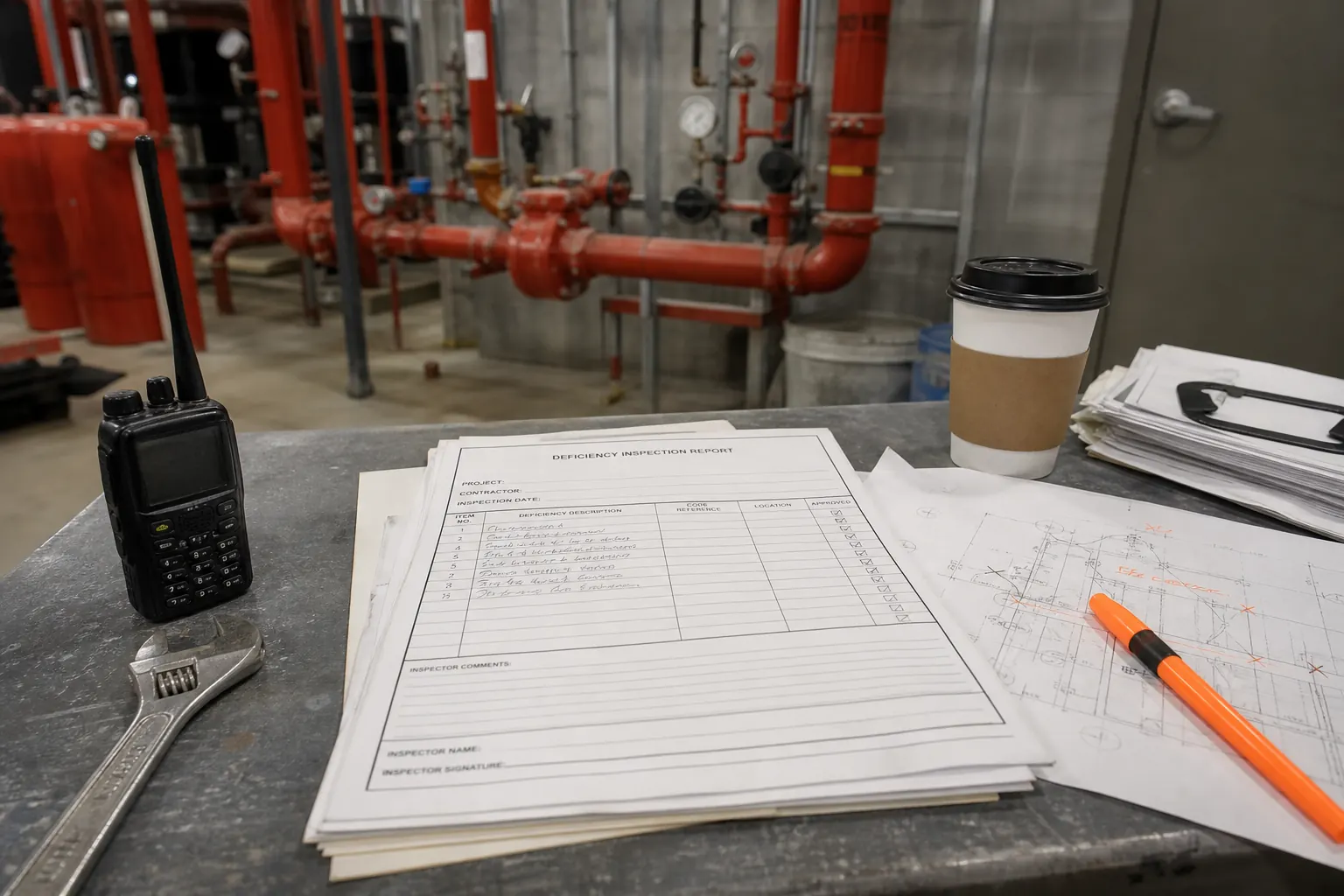
Which document you're holding
Closing out a deficiency in Edmonton comes down to four moves, in this order: stabilize any impaired system, correct the defect with a qualified contractor, retest and document it, and get the proof to Edmonton Fire Rescue Services (EFRS) before the date on the notice. Everything below is detail on those four.
People search for a "fire marshal deficiency", but in Edmonton the paper comes from EFRS Fire Prevention, whose inspectors are Fire Safety Codes Officers. Start by reading the top of the document, because that office issues deficiencies, written notices, orders and variances, and they aren't the same thing. The Safety Codes Act's formal instrument is an order. Edmonton's process for a deficiency reported by a contractor is a notice to the owner with a correction timeline set by the category of deficiency, and if it isn't corrected, a Fire Safety Codes Officer may inspect. We couldn't find the deficiency categories or their timelines published, so the date on your notice is the one that counts.
The review and appeal rights below attach to orders. If you can't tell which you have, ask the officer to confirm in writing.
The deadlines, if it's an order
Under the Safety Codes Act (s. 49), an order has to say what must be done or stopped and give a reasonable time to do it. It can go to the owner, the occupier, a contractor, a designer or a service provider, so your contractor may be holding the same paper.
| What you want | Window | Goes to |
|---|---|---|
| A review of the order | Ask in writing within 14 days of service. The Administrator can revoke or vary within 21 days of service | The Administrator (s. 49) |
| An appeal of the order | Within 35 days of service, whether or not you asked for a review | Safety Codes Council (s. 50) |
| An appeal of a refusal to issue a written variance | Within 30 days | Safety Codes Council (s. 51) |
| An appeal of a Council decision | Within 30 days, on a question of law or jurisdiction only | Court of King's Bench (s. 53) |
The clock runs from service, not from the day someone reads the envelope. And we couldn't verify whether asking for a review or filing an appeal pauses your duty to comply, so don't assume it does. Ask the officer, or a lawyer.
Ignoring an order costs more than the repair. It's an offence to fail to do what an order requires in time, and each day is a separate offence. A first offence can bring a fine of up to $100,000 plus up to $1,000 a day while it continues. A second one goes up to $500,000 and $2,000 a day (ss. 67 and 68).
If the time allowed is unrealistic, say so in writing before the deadline. A part on a 12-week backorder is a reason to ask for more time. It's a bad reason to explain why you missed it.
Stabilize the impaired system first
A defect that leaves a system out of service outranks the paperwork. Under the National Fire Code 2023 Alberta Edition (NFC(AE) 2023), when any part of a fire protection system is temporarily shut down, alternative measures have to keep protection in place (Division B, 6.1.1.4), and the code's own note says any interruption counts, routine testing included.
Two rules to know:
- A fire alarm system, or part of one, out of service for more than 2 hours for any reason means the owner notifies the fire department and, when directed, provides acceptable continuous surveillance until it's restored (Division C, 2.2.7.2).
- For sprinklers, NFPA 25 Chapter 15 covers impairments. As NFPA's staff describe it, a system out of service more than 10 hours in a 24-hour period calls for one or more of an approved fire watch, evacuation of the affected area, a temporary water supply, or an approved program to control ignition sources and fuel.
Edmonton adds its own timing. Deficiencies that affect a system's operation or coverage are to be reported within 24 hours and may require emergency repairs or fire watch until they're fixed. We didn't find a published Edmonton rule on fire watch patrol intervals or who may stand the watch, so settle that with EFRS Fire Prevention.
Correct it, retest it, prove it
- List every item on the notice and mark which are code deficiencies and which are recommendations. A fire alarm report logs them separately, and only the deficiencies have to be fixed.
- Put interim measures on anything that's impaired.
- Have a contractor whose people are qualified for that system make each repair. Fire alarm work has named qualifications (Division C, 2.2.4.3), and so does sprinkler work.
- Retest whatever was touched. If the repair alters an alarm system, ask whether it needs re-verification to CAN/ULC-S537 rather than assuming it doesn't.
- Get a written report saying what was found, what was repaired, what was retested, and the date, naming the device or valve.
- Send the proof through the channel EFRS expects, and to the officer if the notice asks for it, by the date on the notice.
- File the paper at the building. ITM records stay at the premises and can't be destroyed within five years of being prepared (Division C, 2.2.1.2).
On step 6 for alarms, EFRS's July 2026 Fire Marshal Bulletin is blunt. Every section of the CAN/ULC-S536 or S537 report must be completed, with "N/A" where a section doesn't apply, in the standard's tabular format. Partial reports aren't accepted. A rejected report can burn days you don't have.
How the LIV portal changes the closeout
Since September 8, 2026, EFRS has required third-party inspection, testing and maintenance reports to be submitted through the Life Safety Inspection Vault (LIV). It covers fire alarms, fire pumps, range hood cleaning, emergency lights, standpipes, sprinklers and fixed fire suppression. Contractors register, and owners can request view access. EFRS expects reports within 14 days of the initial inspection.
The City's own pages disagree on whether every report has to go in. The safe reading: deficient reports must go through LIV, and EFRS recommends uploading all of them.
What changes for you is timing. The code already says that if the person maintaining a system finds it defective and the owner won't or can't fix it, that person must notify the fire department and the owner in writing (Division C, 2.2.7.2(4)), and Edmonton now expects that through LIV. So the fire department can see the deficiency almost as soon as you do. Book the correction the same week, and ask for owner access so you see the same list they see.
When you disagree with the notice
Two routes exist, and neither is a phone call. You can ask the Provincial Fire Administrator in writing for a code interpretation, which then applies province-wide (Division C, 2.2.2.1). Or you can ask for a variance and back it with a documented code analysis, including any special maintenance or commissioning needs, kept on the premises (Division C, 2.3.1.1 and 2.3.1.2). An officer can issue a project-specific variance. An accredited authority can't waive the code, but it can accept a documented alternative to it. Orders that turn on a real code question are fire code consulting work.
What a closeout looks like
Picture a mid-rise office whose annual alarm report logs three smoke detectors outside their sensitivity range and a battery that failed its capacity test. The technician replaces the detectors and the battery, retests them, and records each fix. The S536 form has a deficiency log with a line for the correction and an owner sign-off, so the finding and its close sit side by side. The contractor uploads the complete report to LIV. The owner files a copy in the building's binder and sends the officer whatever the notice asked for. Nobody had to argue about anything.
The version that goes badly is the one where the report sits in an inbox for a month.
Keeping it from coming back
Repeat deficiencies tend to be dull ones. Picture a sprinkler control valve closed during tenant work and never reopened. A weekly valve check would have caught it (see NFPA 25 inspection frequencies for Edmonton owners). Give one person ownership of the records binder, and review every deficiency the week it appears, not the week before a re-inspection. The Alberta Fire Code annual inspections guide covers what belongs in that binder, and the fire system inspections page shows what a yearly visit covers.
If you'd like a second pair of eyes on a notice, send it through the contact page. For an active impairment, call 780.760.0806.
Frequently asked questions
How long do I have to fix a fire deficiency in Edmonton?
The notice sets the deadline. Edmonton's correction timeline depends on the category of deficiency, and we couldn't find those categories published. An order under the Safety Codes Act has to give a reasonable time to comply (s. 49). Read the date on your document, and ask for more time in writing before it passes if you need it.
Can I appeal a fire order in Alberta?
Yes. You can ask the Administrator for a review within 14 days of service and appeal to the Safety Codes Council within 35 days of service. A Council decision can go to the Court of King's Bench on a question of law or jurisdiction only, within 30 days.
Do deficiency reports have to go through LIV?
Deficient reports must, and EFRS recommends uploading all third-party ITM reports. The City's pages contradict each other on whether compliant reports are required, so follow the recommendation and upload everything.
What if our contractor finds a deficiency and we don't fix it?
The code requires the contractor to notify the fire department and the owner in writing if the owner is unwilling or unable to fix a defective system (Division C, 2.2.7.2(4)). In Edmonton that notice is expected through LIV. Fixing it first is better than explaining it later.
What is the difference between a deficiency and a recommendation?
A deficiency is a failure against the standard and has to be fixed. A recommendation is advice about something that isn't a code failure today, and the decision is yours.
Sources
- Safety Codes Act, RSA 2000, c S-1, Alberta King's Printer
- National Fire Code 2023 Alberta Edition, National Research Council Canada
- Fire Inspection Report Submission, City of Edmonton
- Fire Marshal Bulletin on fire alarm reporting, Edmonton Fire Rescue Services
- Fees and Permits, Edmonton Fire Rescue Services
- Impairment Procedures for Sprinkler Systems That Are Out of Order, NFPA
- CAN/ULC-S536:2019 annual test and inspection record, reproduced by FireTechs