
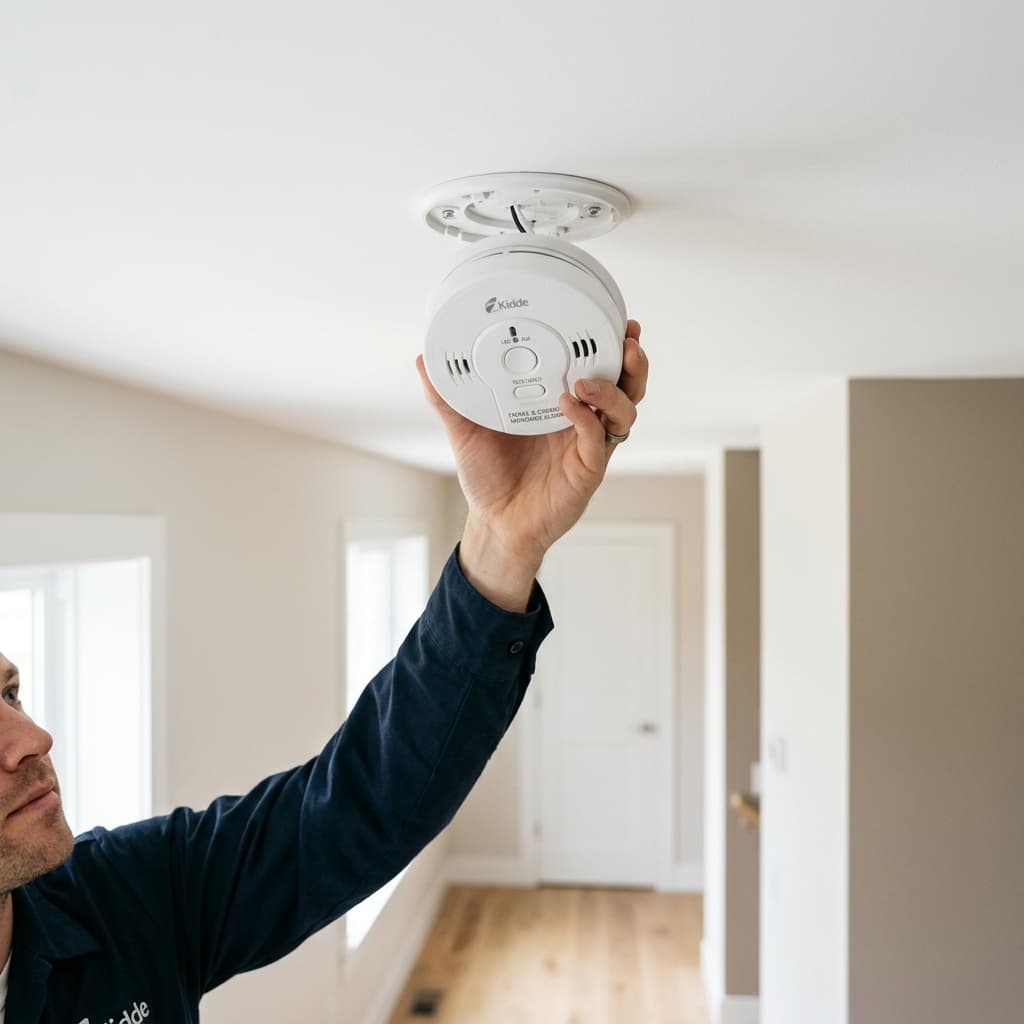
The False Confidence of a Mounted Alarm
A combination smoke and carbon monoxide alarm screwed to the ceiling feels like a solved problem. The device is up, the LED blinks, the test button chirps. Most homeowners stop there. Most contractors do too, unless they know the code well enough to catch the details.
The problem is that a poorly placed or improperly installed combo unit can pass a casual visual check and still fail to detect either hazard when it matters. Carbon monoxide accumulates differently than smoke. The sensor placement rules are different. The code requirements for interconnection, power supply, and proximity to fuel-burning appliances are specific enough that getting two of the three right still leaves a gap.
Mistake 1: Putting It Too Close to the Kitchen or Bathroom
This is the single most common placement error. Installing a combination alarm within 10 feet of a stove, oven, or bathroom door virtually guarantees false alarms from cooking steam or shower moisture. After a few 3 a.m. chirps, the homeowner pulls the battery or disconnects it entirely. The alarm goes from misplaced to non-functional.
Manufacturers specify minimum distances in their installation manuals, typically 10 to 20 feet from cooking appliances and bathrooms. These distances are not suggestions. They are testing parameters that the device was certified under. Outside that range, the sensor may respond to normal household conditions as though they were emergencies.
A disabled alarm is worse than a missing one. At least a missing alarm gets flagged during an inspection. A disconnected unit mounted on the ceiling looks compliant from the ground.
Mistake 2: Mounting in Dead Air Zones
Corners where walls meet ceilings create pockets of stagnant air. Smoke and CO can take significantly longer to reach a sensor mounted in one of these dead zones. The same applies to locations near HVAC supply vents, where forced air can dilute or redirect gas away from the detector before it reaches the alarm threshold.
For ceiling-mounted units, keep the alarm at least 4 inches from any wall. For wall-mounted units, the top edge should sit between 4 and 12 inches below the ceiling line. These clearances exist because of how air stratifies near room boundaries. The physics are simple: warm air rises and creates a thin boundary layer at the ceiling surface. A detector buried in that boundary layer or wedged into a corner where airflow stalls will respond late.
Mistake 3: Believing CO Sinks to the Floor
This is a persistent myth. Carbon monoxide has a molecular weight of 28.01 g/mol. Air averages 28.97 g/mol. The difference is negligible. CO does not sink. It does not rise meaningfully either. It disperses evenly through a room because the density difference is too small to overcome normal air currents from HVAC systems, body heat, and convection.
The U.S. Consumer Product Safety Commission and every major alarm manufacturer confirm that ceiling mounting or high-wall mounting is acceptable for CO detection. The old advice to install CO detectors near the floor was based on a misunderstanding of gas behavior that has been corrected in every credible source for over a decade. If your installer puts a standalone CO detector at baseboard height, ask them to explain the physics.
Mistake 4: Failing to Interconnect
A smoke alarm in the basement that only sounds in the basement does not wake anyone sleeping on the second floor. Interconnection solves this. When one unit triggers, every unit in the network sounds. The Alberta Building Code requires interconnection for new residential construction and secondary suites. Hard-wired systems achieve this through a shared signal wire. Wireless systems use RF communication between compatible units.
The mistake is not always a lack of interconnection. Sometimes it is buying units from different product lines that cannot communicate with each other, or mixing wired and wireless units without a compatible bridge module. Before purchasing, verify that every unit you plan to install is within the same interconnect family. Manufacturer compatibility charts exist for exactly this reason.
If your home has a secondary suite, the Alberta Building Code requires that smoke and CO alarms in both the main dwelling and the suite be hard-wired and interconnected so they operate in unison. Battery-only units do not meet this requirement.
Mistake 5: Ignoring the Power Source Requirements
Hard-wired alarms must connect directly to a dedicated circuit with no disconnect switch between the overcurrent device and the alarm. That means no light switch on the wall that also controls the smoke detector circuit. It also means battery backup is required so the unit continues to function during a power outage.
For battery-only installations, the current best practice (and an emerging code requirement in many jurisdictions) is a 10-year sealed lithium battery. These eliminate the annual battery swap that most homeowners forget or ignore. If the unit uses replaceable batteries and the owner has not changed them in three years, the alarm is decorative.
Mistake 6: Skipping the Post-Installation Test
Press the test button. Every manufacturer requires it after installation. The test confirms that the alarm horn functions, the battery has power, and the sensor responds. It takes five seconds.
Skipping it is surprisingly common, especially during new construction when dozens of units go up in a single day. Defective units out of the box are rare but real. A wiring error on a hard-wired unit is more common than people assume. The test button catches both.
Mistake 7: Leaving the Dust Cover On
During construction, combination alarms ship with plastic dust covers over the sensor openings. These covers prevent drywall dust, paint overspray, and construction debris from fouling the sensor. They are meant to be removed when construction is complete.
They get left on. More often than contractors like to admit. A unit with the dust cover still in place will not detect smoke or CO. It will pass the button test (which only checks the horn circuit) and look perfectly normal on the ceiling. The only way to catch it is a visual inspection of the unit itself.
Mistake 8: Inadequate Coverage
The Alberta Building Code requires CO alarms inside each bedroom, or within 5 meters of each bedroom door, in any dwelling with a fuel-burning appliance or an attached garage. That 5-meter measurement follows the walking path through corridors and doorways, not a straight line through walls.
For smoke alarms, the requirement is every level of the home plus inside and outside sleeping areas. A two-story home with three bedrooms and a basement needs a minimum of five or six units, depending on layout. Many homes have two or three. The gap between code minimum and actual installation is one of the most frequently cited deficiencies in home inspections.
| Location | Smoke Alarm Required | CO Alarm Required |
|---|---|---|
| Inside each bedroom | Yes | Yes, if fuel-burning appliance or attached garage exists |
| Hallway outside bedrooms (within 5m) | Yes | Yes, as an alternative to inside bedrooms |
| Every level of the home | Yes | Recommended |
| Near fuel-burning appliances | Recommended | Yes, in adjacent suites and service rooms |
| Attached garage (adjacent suite) | No | Yes, in the suite sharing a wall/floor/ceiling |
Certification Matters More Than Price
In Canada, smoke alarms must be certified to CAN/ULC-S531. Carbon monoxide alarms must meet CAN/CSA 6.19. Combination units must carry both certifications. Look for the CSA, ULC, or cUL mark on the device. Products sold through major Canadian retailers generally carry these marks. Products purchased from overseas marketplaces often do not.
A non-certified unit is not just a code violation. It is a device that has not been independently tested to respond within the time windows that the standard specifies. The UL 217 standard for smoke alarms and UL 2034 for CO alarms define specific response thresholds, nuisance alarm resistance, and environmental tolerance ranges. An uncertified unit may work under ideal conditions and fail in the conditions where you actually need it.
The 10-Year Expiration Most People Miss
Smoke and CO alarms have a manufacturer-specified lifespan, typically 7 to 10 years. After that, the electrochemical CO sensor degrades and the photoelectric or ionization smoke sensor loses sensitivity. The unit may still chirp when you press the test button. That does not mean it can detect an actual hazard.
Check the manufacture date on the back of every unit in your home. If it is more than 10 years old, replace it regardless of whether it still seems to work. This is not cautious advice. It is the manufacturer instruction, the code expectation, and the recommendation of every fire safety authority in North America.
When the Install Is Beyond DIY
Battery-operated standalone alarms are straightforward for most homeowners. Hard-wired interconnected systems, especially in secondary suites or multi-unit residential buildings, involve electrical work that should be handled by a licensed professional. The interconnection, circuit isolation, and code compliance details matter enough that getting them wrong creates liability.
Sterling provides fire alarm system design, installation, and inspection services across Edmonton and Alberta. If you are building, renovating, or unsure whether your current system meets code, reach out at 780-760-0806 or through rssterling.ca/contact.