
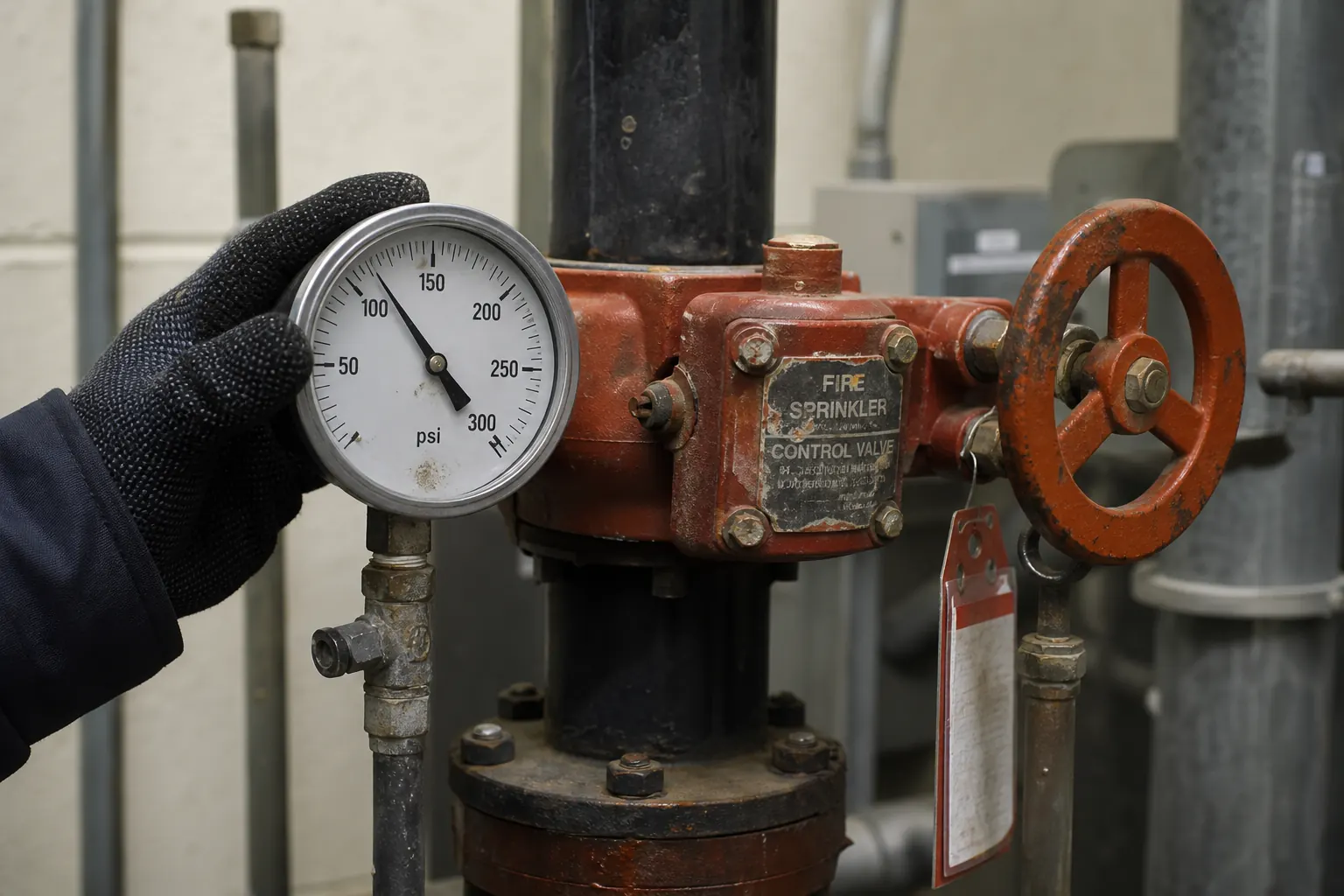
Alberta inspects sprinklers to NFPA 25-2017, not the newest edition
A sprinkler system in Edmonton is inspected on a stack of intervals, from daily valve room checks in a cold snap to a sample test once a sprinkler has been in service for 50 years. The edition that sets them is NFPA 25-2017. The National Fire Code 2023 Alberta Edition (NFC(AE) 2023) sends every water-based system to NFPA 25 (Division B, 6.4.1.1), and its table of referenced documents names the 2017 edition. That covers sprinklers, standpipes, private hydrants, hose systems, water spray, foam-water systems and fire pumps.
A newer NFPA 25 doesn't bind you unless your AHJ or a contract asks for it. Alberta fixes referenced standards at the editions the code names, and the code is where an inspector starts.
NFPA sells the standard, so we can't reproduce it. The table below is compiled from contractor charts of NFPA 25-2017's summary tables (5.1.1.2 and 13.1.1.2) from Falcon and Siemens and the National Fire Sprinkler Association's list of what changed in 2017. Treat it as planning guidance and check any row you'll rely on against the 2017 text. Pumps, standpipes and private hydrants have their own chapters; the inspections page lists the headline pump tasks.
The whole calendar, shortest interval first
| Interval | Task | Note |
|---|---|---|
| Daily or weekly | Temperature of dry, preaction and deluge valve enclosures | Daily in cold weather, weekly if a low-temperature alarm is supervised |
| Weekly | Control valves, sealed | Inspection only |
| Weekly or monthly | RP and RPDA backflow assemblies on the fire line | Inspection |
| Monthly | Control valves, locked | Inspection |
| Monthly or quarterly | Gauges on dry and preaction systems | Depends on the gauge and how it's supervised |
| Quarterly | Gauges on wet and deluge systems | |
| Quarterly | Waterflow alarm and supervisory devices | Visual inspection |
| Quarterly | Mechanical waterflow alarms (water motor gong) | Tested |
| Quarterly | Electrically monitored control valves | Permitted since 2017 (13.3.2.1.2). Charts of the 2017 summary table still show monthly, which meets either reading |
| Quarterly | Fire department connections | Interior inspection can go annual with approved locking caps |
| Quarterly | Main drain test, where the only supply runs through a backflow preventer or pressure-reducing valve | Otherwise annual |
| Quarterly | Priming water and quick-opening devices on dry pipe systems | |
| Semiannually | Vane and pressure-switch waterflow alarms | Tested |
| Annually | Sprinklers, pipe, fittings, hangers and bracing | Visual |
| Annually | Spare sprinklers and the wrench | Stock and condition |
| Annually | Hydraulic design information sign and other information signs | |
| Annually | Antifreeze, in systems that use it | Concentration test |
| Annually | Control valves | Position and operation test |
| Annually | Main drain test | Static and residual pressure |
| Annually | Dry pipe valve trip test | Full-flow trip every 3 years |
| Annually | Backflow assembly forward flow test | |
| Every 3 years | Dry pipe air leakage test | |
| Every 5 years | Internal pipe assessment | Chapter 14 |
| Every 5 years | Interiors of check valves and alarm valves | |
| Every 5 years | Gauges | Replace or calibrate |
| Every 5 years | Strainers, filters and orifices on valves | |
| By age | Sprinkler sample testing or replacement | Standard-response at 50 years, fast-response at 20, dry-type at 10, each then every 10 years. Extra-high temperature solder-type and harsh-environment heads every 5 years. Any head 75 years old, then every 5 years |
| Per manufacturer | Heat tracing |
Tamper switch tests, preaction trip tests and sprinkler pressure-reducing valve checks also carry intervals in NFPA 25. We left them out because we couldn't confirm the 2017 wording. Ask your contractor for the 2017 table.
How late is too late for an annual
Newer editions of NFPA 25 define each frequency as a window, not a date: an annual task falls 9 to 15 months after the last one, a quarterly task 2 to 4 months, a semiannual task 4 to 8 (section 3.7, as summarized by the Florida Health Care Association). We couldn't confirm the same definitions in the 2017 edition Alberta references, so treat them as guidance and ask your AHJ before you count on the slack.
Better not to. Book the annual for the same month every year and the window never comes up. We'd pick September in Edmonton: before the heating season, and long before a January cold snap can find water left in the low points after a trip test.
The quarterly items that get missed
Main drain tests are annual, except where the only supply reaches the system through a backflow preventer or a pressure-reducing valve. Then they go quarterly. The reasoning, as we read it, is that those are the two places a supply can quietly get worse: a fouled strainer, a check valve that isn't opening fully. The test is simple. Open the drain, write down the static pressure, watch the residual drop, close it and watch the recovery. Compare with last time. A lower number is the whole point of the exercise.
Electrically monitored control valves are the item most calendars get wrong. NFSA's summary of the 2017 edition says 13.3.2.1.2 moved them from monthly to quarterly inspection, but contractor charts of the 2017 summary table, Siemens's among them, still list "locked or electrically supervised" valves as monthly. The quarterly wording only permits the longer interval, so a monthly check meets either reading. If you plan on quarterly, confirm it with your AHJ. Sealed valves remain weekly and locked valves monthly.
Fire department connections are quarterly too. The 2017 edition lets the interior inspection drop to annual only where approved locking caps are fitted.
The five-year internal look
Since the 2014 edition NFPA 25 has called it an assessment of internal pipe condition, and it's easy to forget because it only comes round every fifth year. The common method is to open a flushing connection at the end of a main and remove the end fitting, or a section of branch line, and look inside for foreign material. Annex A allows video, ultrasonic testing and lab analysis of water samples in place of cutting pipe, according to PHCP Pros.
Enough material found triggers an obstruction investigation, as do plugged sprinklers, foreign material in drain tests and pinhole leaks. Alarm valves and check valves get an internal inspection on the same 5-year cycle, and gauges are replaced or calibrated. Plan them as one visit, because the system is already open.
When the sprinklers themselves age out
The head-age rows are the ones nobody has on a calendar until a report flags them. Picture a warehouse plumbed in 1975. Its standard-response heads passed 50 years in service in 2025, so sample testing or replacement is due now and then every 10 years. A fast-response head installed in 2006 reaches its 20-year mark this year. Neither is a repair. It's a scheduled line item, and it's cheaper to price before the report asks for it than after.
What Edmonton winters add
The National Building Code 2023 Alberta Edition puts Edmonton's January design temperature at -30 C at the 2.5% level and -33 C at 1% (Appendix C, Table C-2). Those are design values. The -40s that make the news are record lows. Environment Canada's 1981 to 2010 normals for the airport show about 37 days a year at or below -20 C, enough to find any weak spot in a dry system or an unheated dock canopy.
- Dry, preaction and deluge valve enclosures get a temperature check daily in cold weather, or weekly where a low-temperature alarm is supervised.
- Low-point drains on dry and preaction systems sit in the maintenance table. A later edition of NFPA 25 spells out draining them before freezing weather. That isn't Alberta's edition, but it's what a sensible contractor does in September anyway.
- Existing antifreeze systems had to move to listed antifreeze by September 30, 2022, and the mix's concentration is tested every year (see NFSA's note on the sunset date).
- Ice in the pipe has its own place in NFPA 25, under Chapter 14.
The trade-offs between wet and dry pipe are in wet vs dry sprinklers in Alberta winters.
Who does the weekly and monthly checks
Alberta lets owners do certain routine checks themselves: daily and monthly fire alarm checks, monthly extinguisher inspections, weekly and monthly generator checks, each after the right training (Division C, 2.2.4). Sprinkler valve and gauge checks aren't on that list.
So if your maintenance team walks the valves every week, ask your AHJ whether it accepts their log, or have a qualified contractor take those visits. Whichever you choose, keep a dated, initialled record. Weekly readings are the first thing to lapse and the first thing anyone wants after an incident. Where those records live, and for how long, is covered in the Alberta Fire Code annual inspections guide.
Turning the table into a year
Picture a four-storey office building with wet sprinklers, electrically monitored valves and a backflow preventer on the fire service. Its year might look like this:
- January, April, July and October: quarterly visit covering gauges, waterflow alarms, electrically monitored valves (if the AHJ accepts quarterly for them), fire department connections and the main drain test, which runs quarterly because the supply goes through the backflow preventer.
- April and October: the vane and pressure-switch waterflow alarms, on the semiannual cycle.
- September: the annual visit, with the sprinkler, hanger and sign checks, the valve operation test, antifreeze where it's used, and the forward flow test on the assembly.
- Every fifth September: internal assessment, valve interiors and gauge replacement, done together.
- Weekly or monthly in between, by whoever your AHJ accepts.
If you'd rather not build the calendar yourself, send the building address through the contact page or call 780.760.0806. If a report has already raised a deficiency, the next step is in how to close out a fire marshal deficiency in Edmonton. For the rest of the code duties around these tests, start with how Alberta's fire code framework fits together.
Frequently asked questions
How often does a sprinkler system need to be inspected in Edmonton?
There's no single interval. Under NFPA 25-2017, sealed valves are inspected weekly, gauges and waterflow devices quarterly, and the sprinklers, pipe and hangers annually. Internal assessments and valve interiors follow every 5 years. Expect a contractor visit at least once a year, plus quarterly work where your system needs it.
Is NFPA 25 legally required in Alberta?
For water-based systems, yes, through the NFC(AE) 2023 (Division B, 6.4.1.1). The edition Alberta cites is 2017. Your AHJ decides how it applies to your building, and it can accept longer intervals only if it's satisfied reliability isn't reduced (Division C, 2.2.1.3).
Can our own staff do the weekly valve checks?
The code's owner-task carve-outs don't list sprinkler checks. Ask your AHJ whether it accepts a staff log, or hire a qualified contractor. Either way, keep dated, initialled records at the building.
What happens when our sprinklers reach 50 years old?
Standard-response heads in service for 50 years must be tested by sample or replaced, and tested again every 10 years after that. Other head types reach their marks sooner: 20 years for fast-response and 10 for dry-type. Your contractor can price replacement against testing.
How long do we keep sprinkler inspection records?
No inspection record may be destroyed within five years of being prepared, and records stay at the premises (Division C, 2.2.1.2). Initial verification and test reports are kept for the life of the system.
Sources
- National Fire Code 2023 Alberta Edition, National Research Council Canada
- Fire codes and standards, Government of Alberta
- NFPA 25, 2017 Edition Updates and Changes, National Fire Sprinkler Association
- Assessing the Internals, National Fire Sprinkler Association
- Listed Antifreeze and the Sunset Date, National Fire Sprinkler Association
- NFPA 25-2017 inspection frequencies chart, Falcon Fire Sprinkler
- NFPA 25-2017 frequency tables, Siemens
- NFPA 25 Frequencies, Florida Health Care Association
- ITM of Sprinkler Systems: The Five-Year Internal Assessment, PHCP Pros
- National Building Code 2023 Alberta Edition, National Research Council Canada
- Non-technical things everyone should know about NFPA 25, Inspect Point
- Canadian climate normals 1981 to 2010, Edmonton International A, Environment and Climate Change Canada