
Where Alberta's fire code actually requires a fire watch
Alberta has no single "fire watch rule." The National Fire Code 2023 Alberta Edition (NFC(AE) 2023) uses the idea in several places, and four of them matter to most owners and contractors: a shutdown of fire protection, a fire alarm that stays down for more than two hours, hot work, and certain construction or demolition sites. Each has different triggers and a different amount of detail. If you're searching for fire watch requirements in Alberta, the honest answer is that it depends on which of those you're in. (The code also has narrow fire watch rules for large tents and rooftop helicopter landing areas, which we won't cover here.)
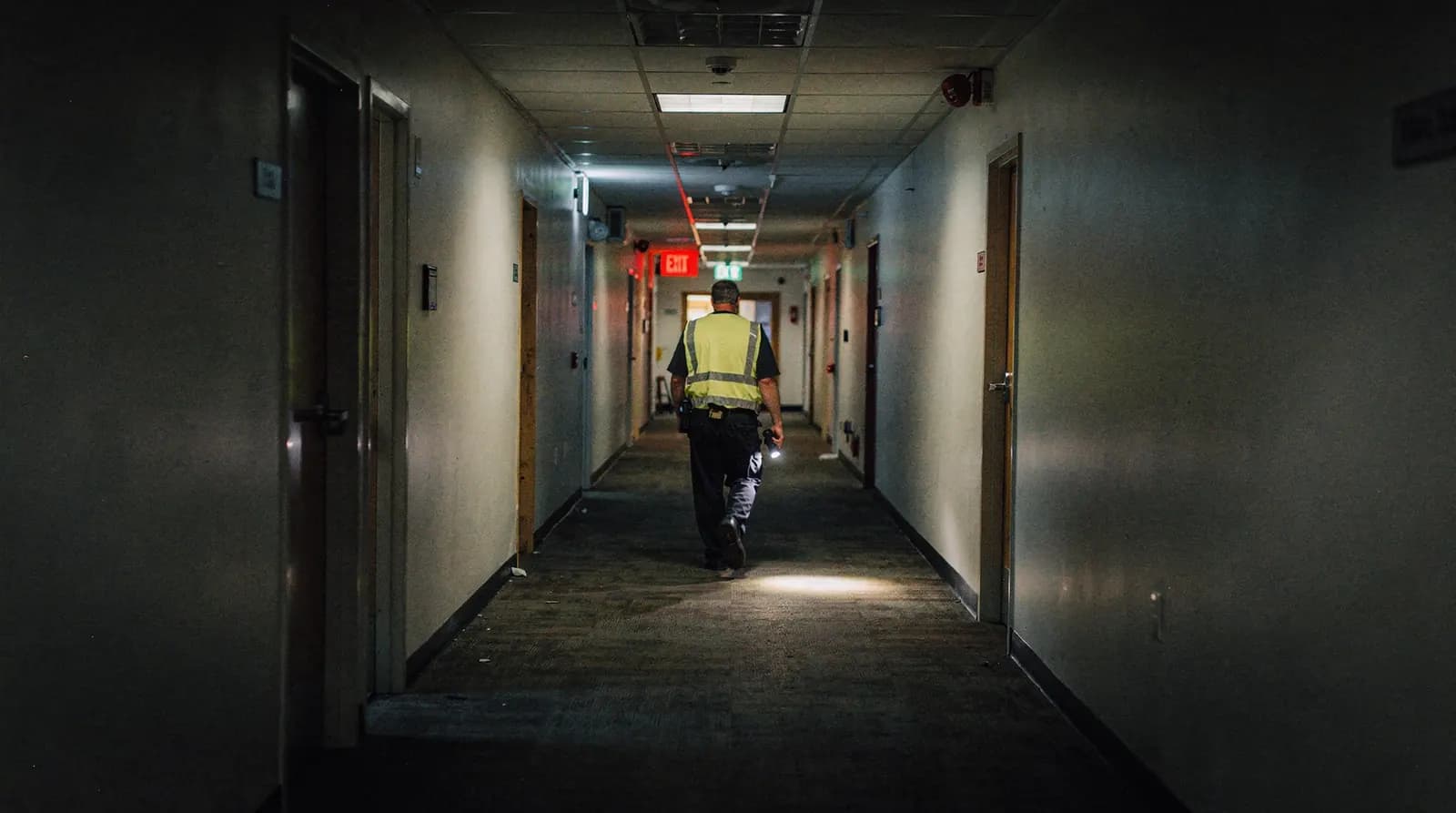
A fire watch is a person, or several, whose only job is to look for fire and raise the alarm while the building's own protection can't be trusted. That's the whole idea. It isn't a guard doing rounds and checking doors, and it isn't someone who also answers the phone.
One thing up front, because a lot of pages get this wrong. We could not find a published City of Edmonton rule for a fire watch patrol interval, a required qualification for the person doing it, or a logbook format. Third-party sites claim to describe "Edmonton fire watch requirements." None of them pointed to a City document we could open. Where the sections below give numbers, they come from the fire code or from NFPA, and they apply to the situation named, not to every fire watch.
Shutting down sprinklers or other fire protection
When any part of a fire protection system is shut down, the owner has to take alternative measures so protection is maintained (NFC(AE) 2023, Division B, 6.1.1.4). The explanatory note is broad: any interruption counts, including routine testing. For sprinkler systems it lists emergency hose lines, portable extinguishers, extra fire watch service and, where practicable, temporary water connections.
So a fire watch is one option on a menu, not the only one. It sits next to the others because a person walking the floor can catch a fire early but can't put out a rack fire with a garden hose.
Two notification duties come with it. A notification procedure has to be in place for tests, repairs and alterations to fire protection installations (6.1.1.3), and before repairs or alterations the fire department has to find that procedure acceptable (Division C, 2.2.7.2(1)). The note behind 6.1.1.3 says the notice should preferably go out in advance, to the fire department, supervisory staff and occupants.
NFPA 25, Chapter 15 is where sprinkler impairments get their detail, and Alberta references NFPA 25-2017 for water-based systems. As described by NFPA's own technical staff, if a system is out of service for more than 10 hours in a 24-hour period, you arrange one or more of these:
- evacuating the affected area
- an approved fire watch
- a temporary water supply
- an approved program to eliminate ignition sources and limit fuel
We're describing NFPA's summary, and we're giving the chapter rather than a clause number on purpose, because clause numbering shifts between editions and Alberta cites the 2017 one. Read the chapter in your copy of NFPA 25-2017 before you write a procedure around it. Our inspection frequencies article covers the routine NFPA 25 tasks that come before an impairment ever happens.
Notice the 10-hour trigger is a threshold for that particular set of measures, not a rule that a fire watch is optional for the first ten hours. Some buildings should have a watch from minute one. A cold storage building with one dry system, or a hospital wing, is a different risk than an empty office floor. That's a judgment your insurer and the fire department will have opinions on.
When the fire alarm is down more than two hours
If a fire alarm and detection system, or part of it, is inoperative for more than two hours for any reason, the owner must notify the fire department. When directed, the owner also has to provide acceptable continuous surveillance in the building until the system is restored (NFC(AE) 2023, Division C, 2.2.7.2(2)). Continuous surveillance is fire watch under a different name.
Two details are easy to miss. The trigger is time, and the code doesn't care why the panel is down: a failed battery, a lightning strike, a contractor's mistake or a planned upgrade all count. And the duty to provide surveillance is "when directed." The fire department decides whether it wants people in the building, and what "acceptable" looks like.
There's also a companion rule: procedures acceptable to the fire department have to exist to warn occupants during the outage (2.2.7.2(3)). The explanatory note says those measures should be written into the fire safety plan, which is a good reason to keep that document current. Our fire safety guides collect the checklists, and the alarm side of a shutdown is covered on our fire alarm systems page.
Hot work
Hot work is the one place where the fire code writes out a fire watch in numbers. Where hot work can't be done in a noncombustible area, NFC(AE) 2023, Division B, 5.2.3 requires:
- A continuous fire watch during the work and for at least 60 minutes after it ends.
- A final inspection 4 hours after completion, or a more thorough inspection right after the fire watch period.
- Protection of combustibles within 15 m of the work.
- A fire watch who is trained and carries extinguishing equipment.
- More than one person if the exposed combustibles can't all be seen by one.
Welding, torch cutting, grinding and soldering fall here. The reasoning is dull and correct: sparks travel, and a smouldering fire in an insulated wall cavity may not show itself for an hour or more. That's why the watch continues after the welder puts the torch down and why there's a second look four hours later.
If you run a facility where contractors do hot work, the practical point is that the watch is a named person with an extinguisher and a line of sight, agreed before the permit is signed. A labourer assigned to "keep an eye out" while also carrying material is not a fire watch.
Construction and demolition sites
On construction and demolition sites, existing fire protection systems have to stay operational where reasonably practical, and any shutdown follows 6.1.1.4 (Division B, 5.6.1.13). Then comes the one place the code gives a patrol interval. A watch with tours at intervals not over 1 hour is required:
- at demolition sites while part of the building is occupied
- during construction in an occupied building that has no fire alarm system
In both cases the watcher has to be able to sound a warning and call the fire department (5.6.1.14).
Please don't stretch that hourly number over other situations. It describes those two site conditions. It is not a general Alberta or Edmonton patrol interval for a sprinkler impairment or an alarm outage, and we haven't found any source that makes it one. Construction fire safety plans in Alberta also have to be accepted in writing by the fire department and the authority having jurisdiction (Division C, 2.2.1.2(14)), and site fire watch is one of the roles the plan covers. Our page on fire system installation covers how that plays out on a project.
What Edmonton says, and what it doesn't
Edmonton Fire Rescue Services (EFRS) Fire Prevention enforces the fire code in the city. Its July 2026 Fire Marshal Bulletin on fire alarm reporting says deficiencies that affect a system's operation or coverage must be reported within 24 hours and "may require emergency repairs or Fire Watch" until they're repaired. That's the verified Edmonton position. It tells you a fire watch can be demanded, and that the clock on reporting is short.
It doesn't tell you the patrol interval, who counts as qualified, how to log it, or how to notify EFRS ahead of a planned sprinkler shutdown. We looked and didn't find those. So do this instead: before a planned shutdown, phone Fire Prevention ([email protected], 780-496-3628 at last check) and ask them what they want. Write down the answer, the date and the name of who gave it. Outside Edmonton, ask your municipality's fire department or its accredited safety codes agency, because accreditation varies and we haven't verified it for each surrounding town.
Once the repair is done, the paperwork matters too. Our article on closing out a fire marshal deficiency in Edmonton walks through that side.
Who can act as a fire watch
The code's requirement is specific only for hot work: trained, and equipped with extinguishing equipment. For the rest, the code leaves it to the fire department to accept or direct the measure. What follows is general practice, not a rule.
A workable fire watch person:
- knows the building, including where the alarm pull stations, extinguishers and exits are
- can raise an alarm and call 911 without leaving to find a phone
- has been shown what the impaired system covers and what it doesn't
- has no other job during the shift, and a relief if the shift is longer than a few hours
Fatigue is the failure point. One person walking a warehouse for twelve hours through the night, alone, isn't a fire watch by hour eight. Plan relief.
A log helps you and your insurer. Again as general guidance, not an Alberta form: record the date, the system out of service, the start and end times, each name on watch, the areas covered, the time of each round, anything found, and who was notified. Keep it with your other fire protection records. Alberta's records rule (Division C, 2.2.1.2) says required records are kept at the premises for the authority having jurisdiction, and that no inspection, testing or maintenance record is destroyed within five years of being prepared.
When a fire watch is the wrong tool
A fire watch buys time in a building that can still be evacuated. It does not replace a system in a building where a fire would outrun a person.
Think about a high-piled storage warehouse with racks to 30 ft, a single sprinkler riser and a shutdown planned for a week. Someone on foot can spot smoke. They can't reach the fire, and the fire department will arrive to a building with no water at the ceiling. That's the situation NFPA's list of alternatives exists for: a temporary water supply, clearing the area, or an approved program to remove ignition sources and limit fuel. In practice, sometimes the better answer is to stage the work so only a small part of the building is ever without sprinklers. Your contractor and insurer can tell you whether that's possible.
Also, a hired security guard is not automatically a fire watch. Guards are trained for theft and access control. If you use a guard company, ask whether the person has fire watch training, whether they'll be doing that job alone, and who is covering the door. It's fine to say no to a candidate who can't answer.
If you're planning a shutdown, call before you drain anything. If you're in one now, our 24/7 emergency repair line is 780.760.0806. Ask us what we can arrange for fire watch in your situation. We won't quote a response time in an article, so ask about that when you call too.
Frequently asked questions
Does the Alberta Fire Code require a fire watch for a sprinkler shutdown?
Not by that name. NFC(AE) 2023, Division B, 6.1.1.4 requires alternative measures so protection is maintained during any shutdown, and its explanatory note lists extra fire watch service among the options for sprinklers. Which measure applies is a decision made with your fire department and, usually, your insurer. NFPA 25, Chapter 15 adds arrangements when a system is out of service for more than 10 hours in 24.
How often does a fire watch have to patrol in Edmonton?
We couldn't find a published Edmonton interval, so we won't give you one. The only patrol interval in the fire code we found is the 1-hour tour for certain demolition and construction sites in an occupied building (Division B, 5.6.1.14). For any other fire watch, ask EFRS Fire Prevention what it wants and keep a written record of the answer.
How long does a hot work fire watch last?
At least 60 minutes after the work ends, with a final inspection 4 hours after completion or a more thorough inspection right after the fire watch (NFC(AE) 2023, Division B, 5.2.3). The watch is continuous during the work. It must be trained, equipped with extinguishing equipment, and more than one person if one can't see all exposed combustibles.
Can a security guard act as my fire watch?
Only if the person is trained and equipped for the job and the fire department accepts it. For hot work the code requires a trained watch with extinguishing equipment. For impairments, the measure has to be acceptable to the fire department. A guard hired to watch doors and cameras usually doesn't meet that on day one.
Who tells the fire department about a fire alarm outage?
The owner. If a fire alarm system, or part of it, is inoperative for more than 2 hours for any reason, the owner has to notify the fire department, and provide continuous surveillance when directed (Division C, 2.2.7.2(2)). A service company that finds a defect the owner won't fix has to notify the fire department and the owner in writing (2.2.7.2(4)).
Sources
- National Fire Code 2023 Alberta Edition, Division B Part 5 and 6, Division C 2.2.7.2, National Research Council Canada
- Fire codes and standards, Government of Alberta
- Impairment Procedures for Sprinkler Systems That Are Out of Order, NFPA
- Fire Marshal Bulletin, Fire Alarm Reporting and Inspection Form Requirements (July 2026), City of Edmonton
- Fire Rescue Services, City of Edmonton