
What a responding crew needs from the street
A crew arriving at a building in Edmonton has five jobs before it can fight anything: find the address, get a truck to the building, find water, connect to the sprinkler system and get inside. Edmonton Fire Rescue Services (EFRS) and the City publish specific expectations for each, and most of them are measured in centimetres and metres that an owner can check with a tape.
Our other articles cover the systems behind the wall. This one is about the parts a crew sees first.
Address numbers, how big and where
The City's address rules depend on how far the building sits from the road. The minimum character height rises with setback, and it's smaller if the numbers are lit from inside.
0 to 15 m, plain numbers
10 cm0 to 15 m, internally lit
7.5 cm15 to 20 m, plain numbers
15 cm15 to 20 m, internally lit
10 cmOver 20 m, plain numbers
20 cmOver 20 m, internally lit
15 cm
Setback is measured from the adjacent curbline. Source: EFRS Building Owners Responsibilities, which points to Addressing Bylaw 9668 for the full rules.
The City's guide to displaying your address adds the rest. The number goes on the front of the building, facing the road so anyone travelling in either direction can see it. It needs a background that contrasts with the numbers, and the City suggests black on white as an example. It can't sit on a tree, a mailbox or a utility pole, and the marker shouldn't carry advertising. The building number is required and the street number is optional. The owner maintains and replaces the sign, and a display that crews struggle to read has to be changed. Not displaying an address properly can lead to a fine under the bylaw.
New construction counts too. The guide says all addresses must be posted during construction of a new building.
Two practical notes. Snow and shrubs hide address signs every year, and the City says to account for large snowfalls, vegetation and poor night visibility when choosing a spot. And Edmonton's quadrants matter on the phone: most of the city is in the NW quadrant, neighbourhoods south of the Anthony Henday are in the SW, and some rural addresses are in the NE, so give the quadrant with the number. That guide is dated 2012, and EFRS's 2025 booklet repeats the same size table, so the numbers are current as far as we can tell. Check Bylaw 9668 for anything unusual.
Fire lanes and the route in
The National Fire Code, Alberta Edition requires every building to be reachable from a street, yard or roadway. For most buildings in Edmonton that means a public road or a parking lot. EFRS says those routes may need fire lanes, and that fire lanes should be clearly identified with signs.
The City's booklet shows what one looks like: a no-parking sign reading "Emergency Access Route" with a Bylaw 5590 reference. For questions about where lanes must go on your site, EFRS Fire Prevention takes calls at 780-496-3628 on weekdays.
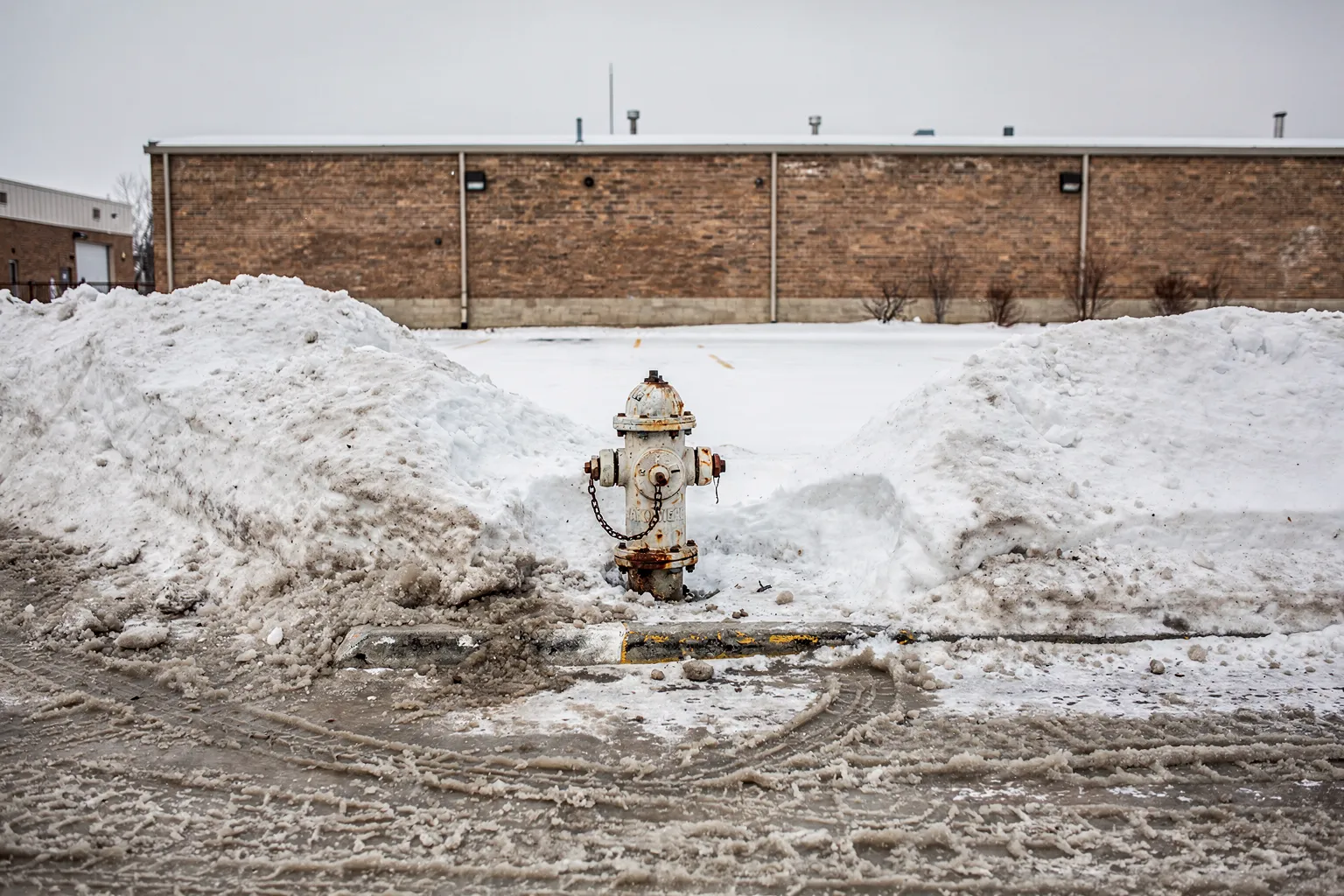
The same booklet says fire hydrants and fire department connections should be kept clear at all times and that may call for more signs. In an Edmonton winter, "clear" has a second meaning, because plowing can bury a hydrant or a connection in a single pass.
Hydrants on your property
A hydrant on private property is the owner's. EPCOR's own safety page says hydrants located on private property are the responsibility of the property owner and should be professionally inspected annually. EPCOR looks after the pipes up to the property line and the water meter. A hydrant beyond that point, fed by your private fire main, is yours.
The City's business checklist gives the clearance number: at least 1 m on all sides of each hydrant on the property, plus a no-parking area. EFRS's maintenance table for private hydrants follows NFPA 25. Inspect them annually and after every use, flow test annually and flow test the piping every 5 years.
Our fire pumps and hydrants page goes through the drain time, impairments and the winter routine. The fire code also says fire protection equipment must be unobstructed and accessible at all times (NFC(AE) 2023, Division C, 2.1.2.7), so a hydrant under a plow pile is a deficiency whatever the flow test said.
Not sure whether a given hydrant is EPCOR's or yours? Ask EPCOR before an emergency, not during one. And if you shut down or repair a private hydrant, the fire department has to be told, and the hydrant marked as out of service (2.2.7.2(5)).
The fire department connection
If your building has sprinklers or a standpipe, there's a fire department connection on the outside, usually a pair of threaded inlets on a plate. Trucks pump into it. The City's checklist asks for at least 1 m of clear space around every sprinkler connection and protective caps in place.
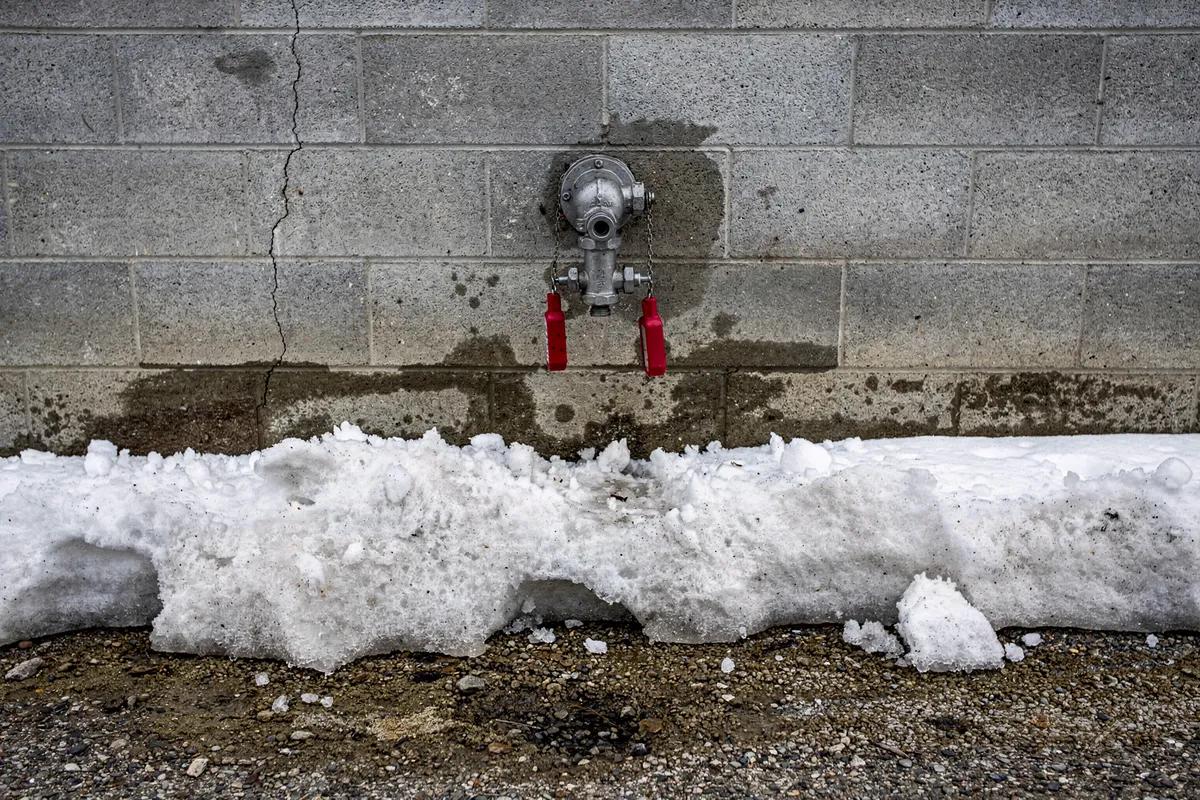
A missing cap lets dirt, ice and debris into the inlet, and it's the kind of defect an inspector can spot from the parking lot. Cap it, clear it and walk the perimeter after each big snowfall. Our fire sprinkler systems page covers how the connection ties into the riser.
The fire department key box
A key box mounted outside lets crews get in without forcing a door. EFRS says buildings with any of the following need one:
- a fire alarm;
- a sprinkler system;
- a standpipe system;
- elevators with firefighter functions;
- stairways with locked doors on the stair side;
- roof areas used for firefighting;
- sleeping or resting facilities for employees.
The box can be opened only by a key EFRS personnel carry. The City says it should hold keys to every system on that list that your building has, plus the main entrance and any locked doors between the entrance and those systems. Not every building needs one.
The wording differs a little between sources. The code clause on key boxes (NFC(AE) 2023, Division C, 2.2.10.1) turns on locked access: alarm controls behind a locked panel, a sprinkler main control valve that is locked open or in a locked room, or standpipe connections in a locked area. It also lets the authority having jurisdiction accept alternatives where someone is on site around the clock. EFRS's list is broader. Ask EFRS Fire Prevention before assuming your building is exempt, and put the box on the closeout checklist for new work, as in our general contractor's closeout guide.
A ten-minute perimeter walk
Do it in October and again in April.
- Stand at the road. Can you read the address from the curb, in daylight and in the dark?
- Walk the fire lane. Is it open, signed and free of parked trucks and snow?
- Measure 1 m around each hydrant and each fire department connection.
- Check that both connection caps are on.
- If a lock has changed, contact EFRS Fire Prevention so the key box holds a working key.
- Photograph what you see and date it. The record helps at your next inspection, and photos sent through our contact page are enough for us to point out problems.
Free PDF
Winter readiness checklist
The October checks for sprinklers, fire alarm, backflow assemblies, pump rooms, tanks and private hydrants before an Edmonton winter.
PDF, 2 pages, NBC(AE) 2023, NFC(AE) 2023, NFPA 25-2017, 120 KB
Annual inspections catch hardware faults. They don't shovel snow or move a dumpster, and that part falls to the owner. For report requirements, see our annual inspections article, and for what happens when a new tenant opens, the business fire inspection guide.
Frequently asked questions
How big do address numbers have to be in Edmonton?
For plain numbers on a building set back 0 to 15 m from the curbline, EFRS lists 10 cm (4 in). It's 15 cm (6 in) at 15 to 20 m and 20 cm (8 in) beyond that. Internally lit numbers can be smaller: 7.5 cm, 10 cm and 15 cm. The City's address guide says the numbers must contrast with their background and face the road.
Who is responsible for a hydrant on my property in Edmonton?
The owner. EPCOR says hydrants on private property are the owner's responsibility and should be professionally inspected annually. EFRS's table calls for annual inspection and flow testing of private hydrants and a 5-year flow test of the piping.
How much clear space do I need around a hydrant or fire department connection?
The City's checklist asks for at least 1 m on all sides of a hydrant on the property, plus a no-parking area. It also asks for at least 1 m around sprinkler connections, with protective caps in place.
Does my Edmonton building need a fire department key box?
EFRS says a key box is required if the building has a fire alarm, sprinklers, a standpipe, elevators with firefighter functions, stairways with locked doors on the stair side, roof areas used for firefighting or employee sleeping facilities. The fire code ties the requirement to locked access and lets the authority having jurisdiction accept alternatives, so confirm with EFRS.
Sources
- Fire Safety Checklist for Businesses (October 2025), Edmonton Fire Rescue Services
- Building Owners Responsibilities, Edmonton Fire Rescue Services
- Guide to clearly displaying your address, City of Edmonton Current Planning (April 2012)
- Water pipes on property, EPCOR
- National Fire Code 2023 Alberta Edition, Division C 2.1.2.7, 2.2.7.2 and 2.2.10.1, National Research Council Canada