
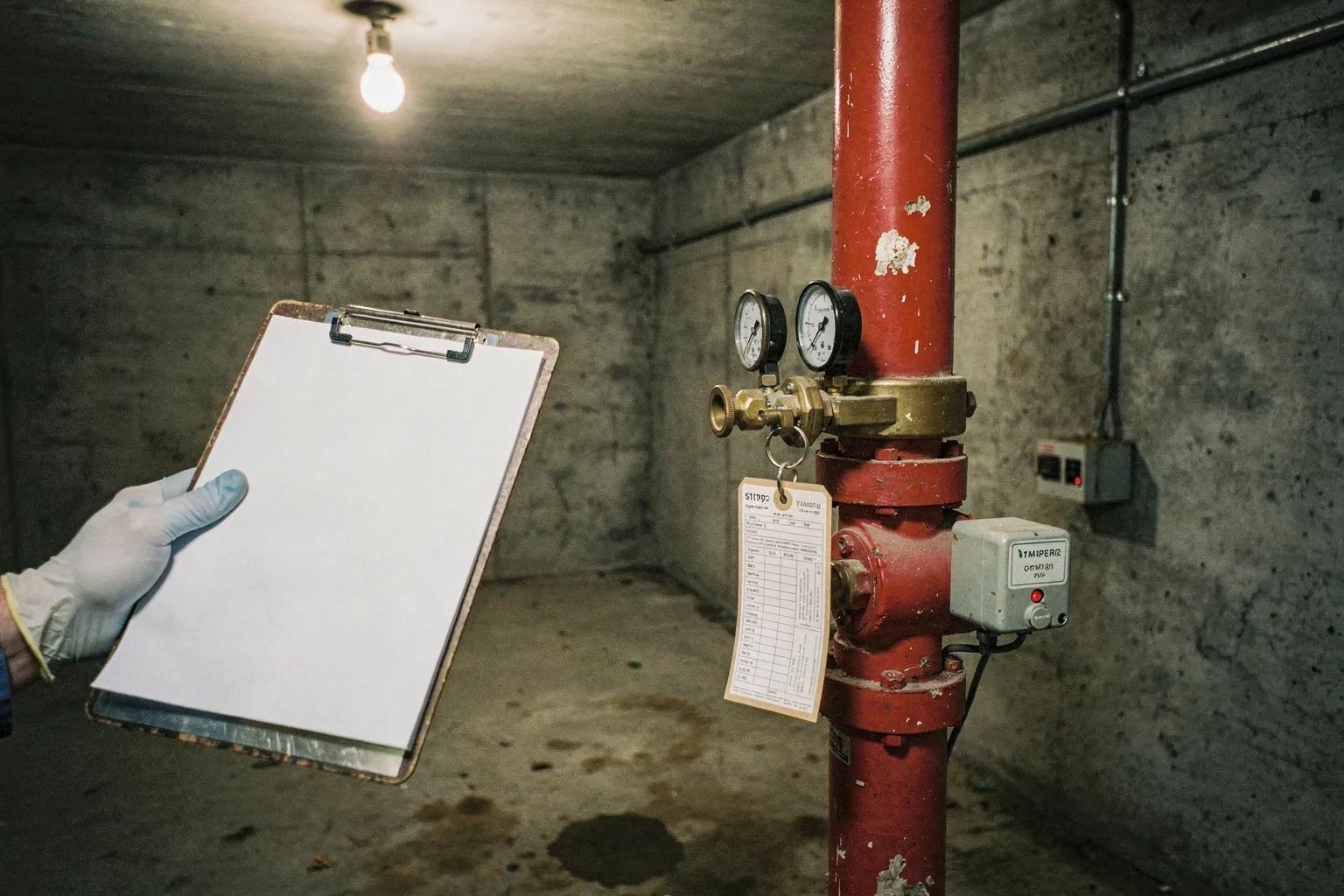
What Edmonton's fire file search tells you
The City of Edmonton will search Fire Prevention's files on a commercial address and tell you what's there. Per its fee page, a property search covers deficiencies, written notices, orders or variances Fire Prevention has issued, and the City's request form describes the property search as the most recent building inspection for the base commercial building. For a building you're about to buy or lease, it's the best first request to make.
It won't tell you the condition of the sprinkler riser today. A file is a history. The tags, reports and dates on site show where things stand now, and a thorough check uses both.
How the request works
The form is online through Fire Prevention. It asks for your contact details, the organization, the address, your own file number and the plan, block and lot. You also choose a search type:
- Property, a search of the most recent building inspection for the base commercial building.
- Environmental, a search of records of potential environmental concerns for the land and buildings on the title lot, or for a specific building named in an approval letter from an inspection.
- Both.
Attach the title owner's authorization with the request. That means a buyer or a tenant needs the seller's or landlord's cooperation, and it's worth asking for it when the offer is accepted and not after the condition period has begun to run.
Collect the title details
Plan, block and lot for each address, plus your own file number.
Get the owner's authorization
The form asks you to attach it.
Choose the search type
Property, environmental or both.
Pay for the research
$185 plus GST ($194.25) per address for the first hour.
Read the result and follow up
Ask Fire Prevention about any open order or variance, at [email protected] or 780-496-3866.
The fee is $185 plus $9.25 GST, or $194.25, per address for the first hour of research. A request can cover up to four searches per title lot, and the City asks for a second request beyond that. The fee page also caps the charge at four addresses for one building or building complex. We found no published turnaround time on the City's pages, so ask when you submit and plan the condition period with some slack.
What the file can't tell you
The file records what Fire Prevention has seen and written. It doesn't tell you whether the alarm contractor has been paid, whether the extinguishers got serviced last month, or whether a tenant propped a stair door open on Friday. A building with a clean file may have deferred maintenance, and a building with an old order may have fixed it and never asked for the closure in writing.
Which is why the on-site half matters.
Questions that surface surprises
Three questions tend to open up a conversation with a seller or landlord. Who holds the service contracts? The sprinkler and alarm contractors named on the riser tags and panel can hand over reports in a day, and a building with no names on its tags is telling you something. Has any system been shut down in the last two years? An alarm out of service for more than 2 hours needs fire department notification (NFC(AE) 2023, Division C, 2.2.7.2), and our impairment checklist shows what the paperwork looks like. And what has been built since the last inspection? A sprinkler system that is altered needs plans submitted first (NBC(AE) 2023, Division C, 2.2.3.2), so a tenant who moved partitions under a sprinkler layout may have changed the protection without telling anyone. Our submittals and permits guide covers that path.
What to read on site
Start with paper, then check the equipment against it. Ask the seller or landlord for each item below, and compare dates on the equipment with what the reports say.
- The most recent annual fire alarm inspection report, and the original verification report if there is one. The fire code keeps initial verification and test reports for the life of the system, and later inspection records at the premises for at least five years (NFC(AE) 2023, Division C, 2.2.1.2).
- The most recent sprinkler inspection and test reports, including the quarterly and annual items.
- The Fire Protective Signalling Certificate, where the alarm is monitored. EFRS says the monitoring certificate must be displayed with the panel or the monitoring device where monitoring is required.
- Extinguisher tags, serviced and tagged within 12 months, per the City's checklist.
- The fire safety plan, if one is required, and the date EFRS accepted it. EFRS says a plan should be reviewed at least every 12 months.
- Any unwanted alarm notices or invoices from the last two years. Our unwanted alarm fees article shows what the City charges and why a pattern matters.
- Any open deficiency reports submitted through the City's portal. Our LIV portal guide explains the reporting clocks.
Then walk the building with the City's own checklist. Our new business fire inspection guide and the fire department access guide cover the exits, clearances, hydrants, connection caps and key box that an inspector will look at.
Monthly
- Extinguisher checks, with a tag or log
- Exit doors and exit signs function tested
- Emergency lights tested for operation
Quarterly
- Sprinkler gauges, supervisory signals and waterflow alarm inspected
- Fire pump fuel tank float switch, where there is a pump
Every year
- Fire alarm inspected and tested by a qualified person
- Sprinkler annual inspection and tests
- Extinguisher maintenance, emergency lights run for 30 minutes
- Private hydrants inspected and flow tested
Every 5 years
- Sprinkler gauges, and sprinklers in high temperature or harsh environments
- Private fire main flow test
- Standpipe flow, hose and hydrostatic tests
Every 6 to 12 years
- Dry chemical extinguishers get an internal examination at 6 years and a hydrostatic test at 12
- Kitchen suppression containers and hoses are hydrostatically tested at 12
Every 10 to 50 years
- Dry sprinklers tested at 10
- Fast response sprinklers tested at 20
- Every sprinkler tested at 50
The intervals above come from EFRS's own maintenance tables, which follow NFPA 25, NFPA 10, NFPA 17A and the CAN/ULC standards. A date that's overdue isn't proof of a failure, but it's a reason to ask. Our NFPA 25 frequency guide goes further, and the five-year internal inspection explainer covers a five-year item that's easy to lose track of.
A tank on the property
If the building has a fuel tank, put it on the list. The City requires permits for installing, altering or removing flammable and combustible liquid storage tanks, and its booklet puts the permit threshold at 230 L, with every underground tank included. Aboveground tanks of 2,500 L or more, and all underground tanks, need annual registration, and a tank divided into compartments is registered compartment by compartment.
For a buyer, one detail stands out. The City says a registration certificate expires on December 31 every year, is valid only while the tank stays at the location on the certificate, and is not transferable. Ask the seller for the permit, the Permit Service Report that the City issues after final inspection, and the current registration. Plan to re-register in your own name. The City lists fines of up to $100,000 for a first offence for tank work without a permit or with a non-certified contractor, so a missing permit matters.
When the file or the walk-through turns something up
Open orders and failed items can be closed, but not by the buyer in a hurry. Our guide to closing out a fire marshal deficiency in Edmonton walks through the sequence, and our fire system inspections page lists what a service visit covers. For a bigger question about a building's code position, fire code consulting is the better door, and the contact page or 780.760.0806 gets you to a person.
What goes into the purchase agreement or the lease is a legal matter. A lawyer should read any clause about who pays to cure a deficiency or who keeps the inspection records, and this article isn't legal advice.
Free PDF
Fire due diligence checklist for a commercial building in Edmonton
What to ask the City for, what to ask the seller or landlord for, and what to read on site before you buy or lease a commercial building.
PDF, 2 pages, NFC(AE) 2023, EFRS Building Owners Responsibilities, City pages read 2026-11-11, 144 KB
Frequently asked questions
How do I find out if a commercial property has fire orders in Edmonton?
Ask Edmonton Fire Rescue Services for a file search. The City says a property search covers deficiencies, written notices, orders or variances issued by Fire Prevention. Submit the online request with the plan, block and lot, a search type and the title owner's authorization.
How much does an Edmonton fire file search cost?
The City charges $185 plus GST, or $194.25, per address for the first hour of research. A request covers up to four searches per title lot, and the fee page caps the charge at four addresses per building or building complex.
Who can request a fire file search?
The form asks for the title owner's authorization to be attached, so a buyer or tenant works through the owner. Ask for the authorization early in the process.
Does a clean fire file mean the building's systems are in good shape?
No. The file is a history of what Fire Prevention has issued and inspected. It says nothing about whether last month's extinguisher checks happened or whether the sprinkler tests are current, so check the reports and the equipment dates on site.
Does a fuel tank registration transfer to a new owner?
No. The City says registration certificates are valid only at the location named and are not transferable. A new owner registers the tank in their own name.
Sources
- Fire Rescue File Search Request, City of Edmonton
- Fire Rescue Services Fees and Permits, City of Edmonton
- Flammable and Combustible Liquid Storage Tanks, City of Edmonton
- Building Owners Responsibilities, Edmonton Fire Rescue Services
- Fire Safety Checklist for Businesses (October 2025), Edmonton Fire Rescue Services
- National Fire Code 2023 Alberta Edition, Division C 2.2.1.2, National Research Council Canada