
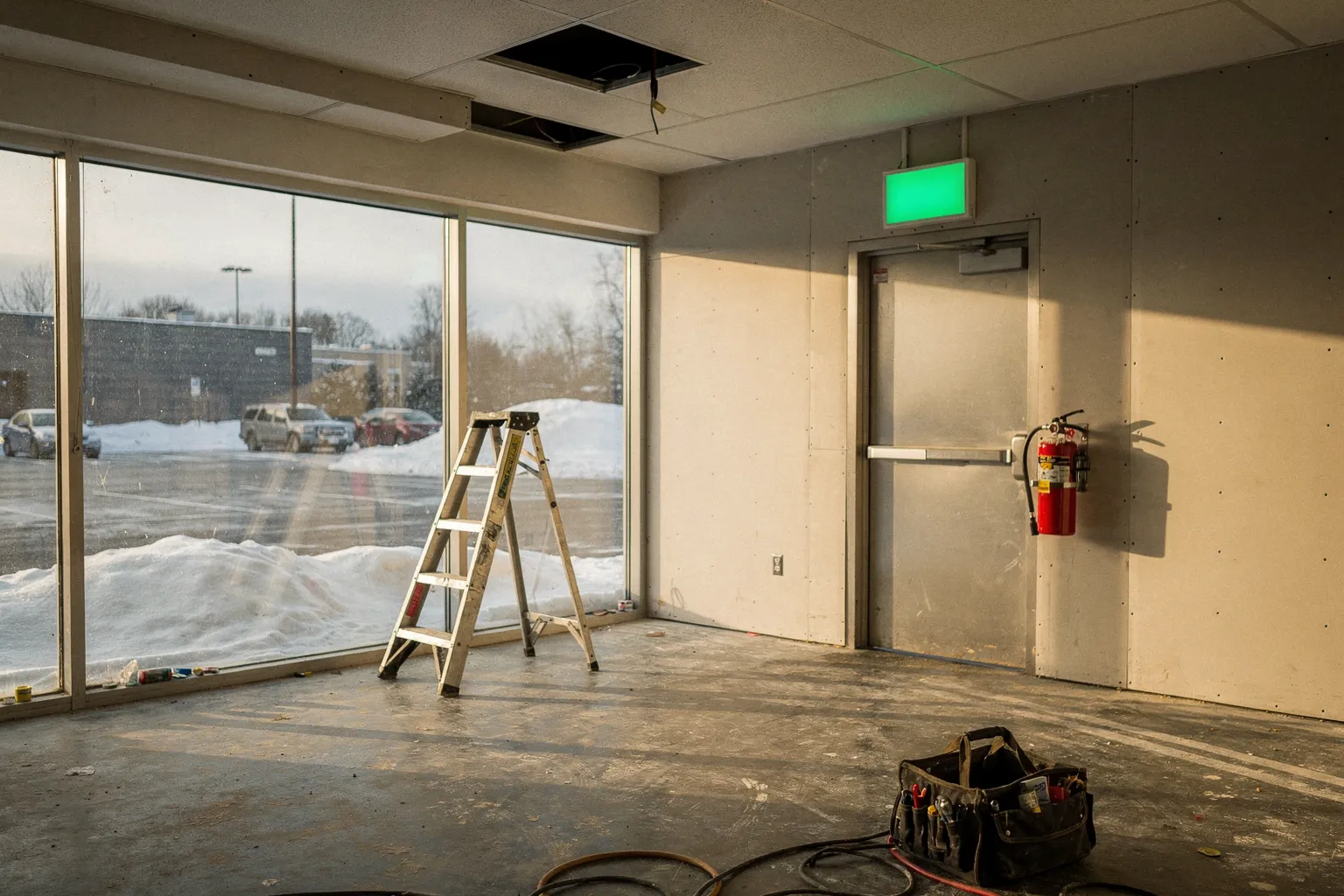
When the fire inspection happens
In Edmonton, the fire safety inspection for a new business takes place after the business licence is issued. The City's licensing page says the inspection does not have to be completed first. Edmonton Fire Rescue Services (EFRS) learns about your application once the licence fee has been paid and then contacts you to book a time.
Your licence categories decide if you get an inspection at all.
- For categories the City deems high risk, EFRS typically inspects within 10 business days after the licence is issued.
- For low-risk categories, EFRS decides whether an inspection is needed. If it is, the City says to expect it within about 30 business days after the licence is issued.
The City's category pages show, category by category, whether a high-risk fire safety inspection applies to you, so read the entry for your own business type before you plan an opening date around it.
Apply and describe the business
The City assigns licence categories from your description of activities. A detailed description saves follow-up questions.
Permit clearance and categories
Staff check zoning and the provincial building code, and may require development or building permits first.
Pay the licence fee
EFRS is notified once the fee has been paid.
Licence is issued
The inspection does not have to be finished first.
EFRS contacts you to book
Typically within 10 business days for high risk, or about 30 for low risk when an inspection is needed.
None of this means you can ignore the checklist until the inspector calls. The checklist says items should be addressed "prior to an inspection or opening your business," and a fit-out that leaves an exit door blocked is out of compliance on day one whether or not anyone has visited yet.
What the City's checklist covers
EFRS publishes a Fire Safety Checklist for Businesses (the edition we read is from October 2025) so owners can assess their own space against the National Fire Code, Alberta Edition. The City addresses it to "the owner or the owner's agent." Edmonton's second document, the Building Owners Responsibilities booklet, explains the same requirements at more length. Both are linked at the end of this article.
Here is the checklist grouped by where you'd stand when you check it.
Exterior
Outside and at the door
- Address visible from the road, in lettering that contrasts with the background
- Access lanes for fire trucks kept open
- At least 1 m clear on all sides of any hydrant on the property, and a no-parking area beside it
- At least 1 m clear around sprinkler connections, with protective caps in place
- Exit doors easy to identify and not hidden by curtains or hangings
Egress
Ways out and lighting
- Exit doors tested monthly, with one latch or lock and no key or special knowledge needed to open
- Aisles and stairs free of obstructions
- Exit signs lit and emergency lighting working
- Emergency lights tested monthly for operation and for 30 minutes once a year
Housekeeping
Inside the space
- Storage at least 45 cm below sprinklers, or at least 1 m below the ceiling where there are none
- Combustibles at least 1.2 m from gas furnaces and water heaters
- Oily rags in a metal container with a tight lid
- Every ceiling tile in place, nothing blocking fire department access panels
- 1 m clear around electrical panels, no extension cords standing in for wiring
Systems
Equipment and records
- Extinguishers serviced and tagged in the last 12 months, within 23 m of travel, checked monthly
- Fire alarm inspected and tested yearly by a qualified alarm company
- Records of the initial verification and the current and preceding inspections for each system
- A fire safety plan if the use requires one, with staff trained
Some items depend on the business. A kitchen that produces grease-laden vapours adds its own list: approval of the cooking equipment by an HVAC inspector, hood and exhaust cleaning by a certified company at least every six months or as often as needed, a suppression system inspected every six months, posted manual-operation instructions and a Class K extinguisher where there are deep fryers. Compressed gas cylinders must be secured, kept out of exits and corridors, and kept at least 1 m from any exit. Flammable gases such as propane and acetylene belong outside the building.
The deficiencies EFRS says it finds most
The Building Owners Responsibilities booklet describes itself as covering the "most frequent deficiencies." Its list of common fire hazards identified by inspectors reads like a walk through an ordinary retail strip:
- exit door latches or hardware that don't work;
- materials blocking an exit or access aisle;
- extra or non-compliant locks on exit doors;
- storage inside an exit stairwell;
- combustibles piling up in elevator shafts, ventilation shafts, rooftops and service rooms;
- crawl spaces and ceiling spaces used for storage;
- dumpsters or sheds parked too close to the building;
- hot ashes or smoking materials disposed of improperly;
- electrical work, construction or renovation done without a permit or qualified people;
- extension cords used as permanent wiring.
Most of those can be spotted on a walk-through, and many cost little to fix. If you only have time for one pass before opening, do the exits and the storage.
Free PDF
Emergency lighting and exit sign test log
The monthly and yearly tests Alberta requires for emergency lights and exit signs, with a log to fill in and keep at the building.
PDF, 2 pages, NFC(AE) 2023 (Division B, 6.5.1.6 to 6.5.1.8), 129 KB
The paper EFRS expects to see
The checklist asks that records be "present and available" for the initial verification and for the current and immediately preceding maintenance and inspections of extinguishers, the fire alarm, a sprinkler system, any special suppression system and any commercial cooking suppression system. A new tenant usually doesn't hold those records. The landlord does, or the previous tenant's contractors do, so ask for them before the lease is signed and again before the inspector books.
Keep more than the checklist's minimum. The fire code's records rule runs longer: later inspection and test records stay at the premises and aren't destroyed within five years, and initial verification and test reports stay for the life of the system (NFC(AE) 2023, Division C, 2.2.1.2). Our LIV portal explainer covers how annual reports reach the City.
A fire safety plan is the other document. The checklist says one is required for licensed beverage establishments and licensed restaurants, assembly occupancies with more than 30 people, buildings with a fire alarm, sprinkler, commercial cooking suppression or special suppression system, and buildings with storage, flammable liquids or hazardous processes, among others. Our fire safety plan guide covers contents and drills.
What the City charges
The City's Fire Rescue fee schedule has a section titled "New Business Licence Approval or Requested Inspections." It lists new business licence approval at $96.50 for low risk and $290 for high risk, both plus GST. A requested inspection is $184 plus GST. A second re-inspection is also listed at $184 plus GST, and occupancy load calculation or approval is $186.50 plus GST.
The licensing page adds that when your business needs a fire safety inspection, a separate fire inspection fee applies and EFRS collects it. It doesn't say which line on the schedule that is, so ask when EFRS calls. The listing of a second re-inspection fee does tell you that a failed item can cost another visit, so fix what you find before the first one.
Tenant or landlord
The City's checklist puts the compliance duty on the owner or the owner's agent. In practice a lease divides the work: the landlord usually controls base-building systems like the sprinkler riser, fire alarm panel and hydrants, and the tenant controls what's inside the unit. Who pays for an extinguisher service or a failed emergency light is a lease question, and your lawyer should settle it before opening day.
Buying or leasing an existing building? The City will also search its files for past orders and inspection history, covered in our guide to fire due diligence on a commercial property. Alarms that trigger because of your fit-out can cost you, too, so read about unwanted alarm fees before the drywall sander arrives.
To book a check, use the contact page or call 780.760.0806. For extinguishers, our types of fire extinguishers guide and extinguisher service page cover ratings, tags and monthly checks. The Alberta code's emergency lighting tests are explained in the emergency lighting article, and the emergency lighting and exit signs page shows what we service.
Free PDF
Extinguisher classes and monthly check
What the fire classes mean, the monthly inspection list and the service schedule for portable extinguishers under NFC(AE) 2023.
PDF, 2 pages, NFC(AE) 2023, NFPA 10-2013, 140 KB
Frequently asked questions
Does Edmonton inspect a new business before the licence is issued?
No. The City's licensing page says the fire safety inspection does not have to be completed before the licence is issued. EFRS is notified after the licence fee is paid and contacts you to schedule the inspection where one applies.
How long after getting my licence will the fire inspection happen?
For categories the City deems high risk, inspections are typically completed within 10 business days after the licence is issued. For low-risk categories, EFRS decides whether an inspection is needed, and if so it is typically completed within 30 business days.
What does Edmonton Fire Rescue check in a new business?
The City publishes a Fire Safety Checklist for Businesses covering exits, emergency lighting, extinguishers, storage clearances, fire alarm and sprinkler upkeep, electrical housekeeping, and any kitchen, gas or special suppression systems. It also asks for inspection records and a fire safety plan where one is required.
How far below the sprinklers can I store things?
The City's checklist asks for at least 45 cm of clearance between the top of storage and the sprinklers. Where a business has no sprinkler system, it asks for at least 1 m between the top of storage and the ceiling.
What does the fire inspection cost?
The City's fee schedule lists new business licence approval at $96.50 (low risk) and $290 (high risk), a requested inspection at $184 and a second re-inspection at $184, all plus GST. The licensing page says a separate fire inspection fee is collected by EFRS when an inspection is required, so confirm the amount with EFRS.
Sources
- Apply for a Business Licence, City of Edmonton
- Business Licence Categories, City of Edmonton
- Fire Safety Checklist for Businesses (October 2025), Edmonton Fire Rescue Services
- Building Owners Responsibilities, Edmonton Fire Rescue Services
- Fire Rescue Services Fees and Permits, City of Edmonton
- National Fire Code 2023 Alberta Edition, Division C 2.2.1.2, National Research Council Canada