
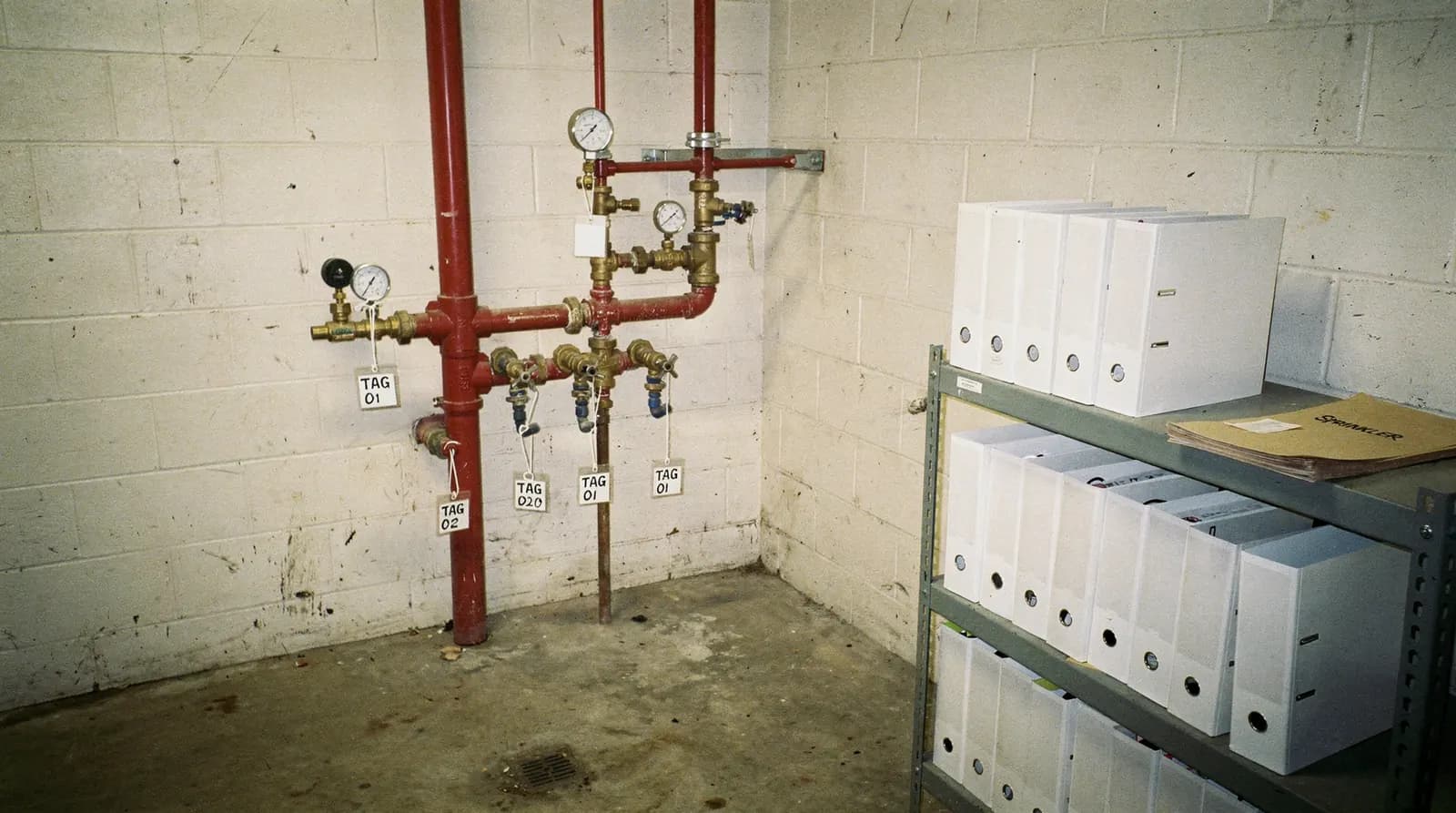
What a general contractor needs in hand before occupancy
A fire protection closeout package for an Alberta commercial building has five parts: passed acceptance tests, the professional sign-offs (Schedule C-1 and its companions), the City's letters of confirmation where they apply, the documents the owner has to keep, and a clean list of what's still open. If one part is missing, occupancy can wait, because the authority having jurisdiction (AHJ) must receive Schedule C-1 before it issues an occupancy permit or permission to occupy (National Building Code 2023 Alberta Edition (NBC(AE) 2023), Division C, 2.4.2.2 to 2.4.2.5).
Our fire system installation page describes the sequence at a high level. This guide goes deeper on the paper. It's written for the person who has to walk into the last owner meeting with a binder and answer the question "is the fire protection done?"
The acceptance tests, and who witnesses them
Acceptance tests are where the sprinkler and alarm systems prove they do what the drawings said. They usually run in this order.
- Underground and aboveground pressure tests. NFPA 13-2019 (25.2.1.1) calls for an aboveground hydrostatic test at 200 psi held without loss for two hours (or 50 psi above the working pressure where that exceeds 150 psi), and it's best done with the ceiling still open. A leak found then costs a coupling. After the ceiling closes it costs a ceiling.
- Sprinkler system tests. Main drain test, waterflow alarm test through the inspector's test connection, and valve supervision checks, with signals confirmed at the panel.
- Fire alarm verification. The alarm system is verified to CAN/ULC-S537:2019, device by device, against the design.
- Integrated systems testing, where the building's systems interact, to CAN/ULC-S1001:2011 (elevator recall, fan shutdown, door releases, sprinkler flow signals).
- Monitoring. Where the alarm must notify the fire department, the monitoring account has to be live and tested.
Who watches? Not the City, as far as the code goes. Where professional involvement applies, the owner's registered professional witnesses the suppression tests and the alarm verification (NBC(AE) 2023 Division C, 2.4.1.3 and 2.4.1.4), and the City collects letters of confirmation afterward. We didn't find evidence that City or fire department staff attend sprinkler or alarm acceptance tests, so don't schedule the ceiling close around a City visit that may not come. Confirm with your AHJ.
The integrated testing coordinator must be a registered engineering professional (NFC(AE) 2023 Division C, 2.2.4.8). That person's calendar is a common schedule pinch, so book it when you book the alarm verification, not after.
Schedule C-1 and the occupancy dependency
Schedule C-1 is the coordinating registered professional's assurance of compliance. Schedules C-2 (field review) and C-3 (delegated design) come from the registered professionals of record and any delegated designers, and all of them follow substantial completion. The AHJ must have C-1 before an occupancy permit or permission to occupy (2.4.2.2 to 2.4.2.5).
The City of Edmonton adds a wrinkle. It may ask for the C-schedules to come from the same code cycle and the same firm as the A and B schedules that went in at permit. If the engineering firm changed midway, ask the City what it will accept before the last week.
Early occupancy is possible but conditional. Occupying before completion needs the AHJ's written permission, possibly with conditions, and the owner must make sure no unsafe condition comes from unfinished work (NBC(AE) 2023 Division C, 2.2.11.1). If your tenant wants the keys on Friday and the alarm verification is on Monday, that clause is the conversation.
The City of Edmonton letters
Edmonton uses letters of confirmation to record that the tests happened. According to the City's Commercial Inspections page, it may require the following before final inspection or occupancy:
| Letter | Form | Covers |
|---|---|---|
| Fire Alarm Verification Letter of Confirmation | COE-SCPI-FORM-0014 | Alarm verification to CAN/ULC-S537 |
| Fire Suppression System Test Letter of Confirmation | COE-SCPI-FORM-0015 | Sprinklers and kitchen hood suppression |
| Integrated Systems Testing letter | COE-SCPI-FORM-0013 | CAN/ULC-S1001 testing |
On the current version of Form 0014 (v2.0, dated 2026-05-28), the verifier confirms they meet the qualified-person expectation in CAN/ULC-S536, that testing followed CAN/ULC-S537, that the S537 report is attached, and that the system complies with the NBC(AE) and CAN/ULC-S524-19. On Form 0015 (v3, dated 2026-07-23), the verifier confirms they meet the qualification rule in NFC(AE) Division C, 2.2.4.4, and names one standard from a list that includes NFPA 13-2019, NFPA 13R-2019 and NFPA 17A-2017. Both are signed by the owner or design professional and by the person who did the work.
Forms get revised, so download the current version from the City's site at the time. And a later modification to the system voids the letter. The ceiling contractor who nudges a head after testing can cost you a retest.
The City books final inspections through SelfServe or 311. Safety Codes Officers don't call ahead, so the site must be open and accessible on the day.
Where the alarm must signal the fire department, the owner also gives the AHJ a Fire Protective Signalling Certificate from a certified listing agency, showing the address, the listed installation company and the listed monitoring company (Division C, 2.2.3.4). That's a separate document from the letters, and getting the monitoring contract set up takes calls.
What the owner has to keep, and for how long
Handover is where a lot of good projects quietly fail. The owner inherits a legal duty to keep records, and the Alberta rule isn't what many people think it is. Under NFC(AE) 2023 Division C, 2.2.1.2:
- initial verification reports, integrated systems testing reports and test reports for each system are kept for the life of the system;
- later inspection and test records are kept at the premises, and no record may be destroyed within five years of being prepared;
- records go on forms acceptable to the AHJ, which include those in CAN/ULC-S536, S537 and S1001.
So the acceptance test reports you collect at closeout are the ones that live as long as the building's systems. Copy them to the owner, confirm where they'll be stored, and get a signature on the transmittal.
The O&M binder, item by item
The code doesn't specify an O&M binder, so this is what we'd expect to see in one, based on what the annual inspector will ask for later.
- As-built sprinkler drawings and the hydraulic calculation.
- Product data and operating instructions for valves, heads and devices.
- Alarm as-builts: device plans, riser diagram, zone descriptions, the sequence of operations, and reset and silence instructions. The annual alarm inspection under CAN/ULC-S536 includes a documentation check for exactly these, plus a copy of the site-specific software and the previous verification reports, so the first inspector will look for them.
- The acceptance test reports, letters and schedules listed above.
- The spare sprinkler cabinet with the right wrench. NFPA 25's annual checks include spare sprinklers and the wrench.
- The hydraulic design information sign on the riser, which NFPA 25-2017 also lists as an annual check.
- Benchmark main drain and waterflow test results where the fire safety plan needs them (NFC(AE) 2023 Division B, 2.8.2.4 asks for them for indoor storage).
- Names and phone numbers for the sprinkler contractor, the alarm contractor and the monitoring company.
Also on the closeout walk, look at the fire department key box. The code requires one when, among other things, fire alarm controls are behind a locked panel, a sprinkler main control valve is locked open or in a locked room, or standpipe or fire department connections are in a locked area (NFC(AE) 2023 Division C, 2.2.10.1). Where a fire alarm or sprinkler system is required to signal the fire department, it goes on the exterior wall near the principal entrance. The explanatory note lets the AHJ accept alternatives where there's 24-hour entry, such as on-site security or staff. It's an easy item to forget and an embarrassing one to fail on.
Deficiencies at closeout
Every project ends with a punch list, and the fire protection portion should be short and specific. Separate what blocks occupancy (a failed test, a missing signature, a system that isn't monitored) from what doesn't (a missing escutcheon, a touch-up paint). If a test fails, expect to retest after the correction. Get the failed and the passed report both into the binder, because an inspector reading only the pass will wonder what changed.
If a deficiency will survive into occupancy, the AHJ's written permission and any conditions (NBC(AE) 2023 Division C, 2.2.11.1) are the paper to have, and the owner should know that some of its duties start the day people move in. The deficiency closeout guide shows how notices are handled once a building is running.
Warranty, generally
Warranty terms belong to your contract and to the manufacturers, and we won't invent them. Read three things: the date the warranty starts (acceptance is a better trigger than shipping), what voids it (unapproved alterations to the system, missed service), and who calls whom when something fails. Check whether coverage is conditional on documented annual service. If the fire protection contract is silent on this, it's cheaper to ask now than after the first year.
What to demand from the fire protection contractor
- Test reports signed by the qualified person, with dates, and the letters of confirmation in current form versions.
- The as-builts, calculation and product data in one delivery, digital and paper.
- Names of who tested and who witnessed, and their qualifications. Alberta requires journeyperson sprinkler system installers for installing and altering sprinklers (Division C, 2.2.4.4) and specific qualifications for fire alarm work (2.2.4.3).
- A written list of the annual inspection tasks the owner's contractor will take over, and the dates they're due.
- Confirmation that the monitoring account is live.
- A note on who to call at 2 a.m. That's ours, at 780.760.0806, if we did the work. If someone else did, you should have their number.
The fire alarm and fire sprinkler pages describe the systems being tested, and the owner's yearly duties are laid out in our note on Alberta Fire Code annual inspections. The first annual inspection begins the maintenance cycle, and fire system inspections explains how that runs, including Edmonton's LIV reporting portal. If you'd like a second pair of eyes on a closeout list before the owner meeting, send us the details.
Frequently asked questions
What documents does a sprinkler system need before occupancy in Alberta?
That depends on the AHJ and the building. Commonly the registered professional's Schedule C-1, C-2 and C-3, test reports for the sprinkler system and, in Edmonton, the Fire Suppression System Test Letter of Confirmation (COE-SCPI-FORM-0015). Alarm systems add a verification report and letter, and monitored systems need a Fire Protective Signalling Certificate.
Does the City of Edmonton witness sprinkler acceptance tests?
We couldn't find evidence that it does. The code puts witnessing on the owner's registered professional, and the City collects letters of confirmation. Confirm with the AHJ if the schedule depends on it.
How long must the owner keep acceptance test reports?
For the life of the system. Initial verification reports, integrated systems testing reports and test reports for each system are kept that long under NFC(AE) 2023 Division C, 2.2.1.2. Later inspection records are kept on site and none is destroyed within five years of being prepared.
Can a building be occupied before the fire protection is finished?
Only with the AHJ's written permission, which may carry conditions, and the owner must make sure the unfinished work creates no unsafe condition (NBC(AE) 2023 Division C, 2.2.11.1). Schedule C-1 must be received before an occupancy permit or permission to occupy is issued.
Who signs the fire alarm verification letter in Edmonton?
Form 0014 is signed by the owner or design professional and by the person who did the verification. The explanatory note to the NFC(AE) says alarm verifications are generally the responsibility of a licensed engineering professional and, in Alberta, the registered professional completing the Schedule C.
Sources
- National Fire Code 2023 Alberta Edition, National Research Council Canada
- National Building Code 2023 Alberta Edition, National Research Council Canada
- Commercial Inspections, City of Edmonton
- Building codes and standards, Government of Alberta
- Fire codes and standards, Government of Alberta
- CAN/ULC-S536:2019 annual test and inspection record, reproduced by firetechs.net
- NFPA 25 2017 inspection frequency chart, Falcon Fire Sprinkler