
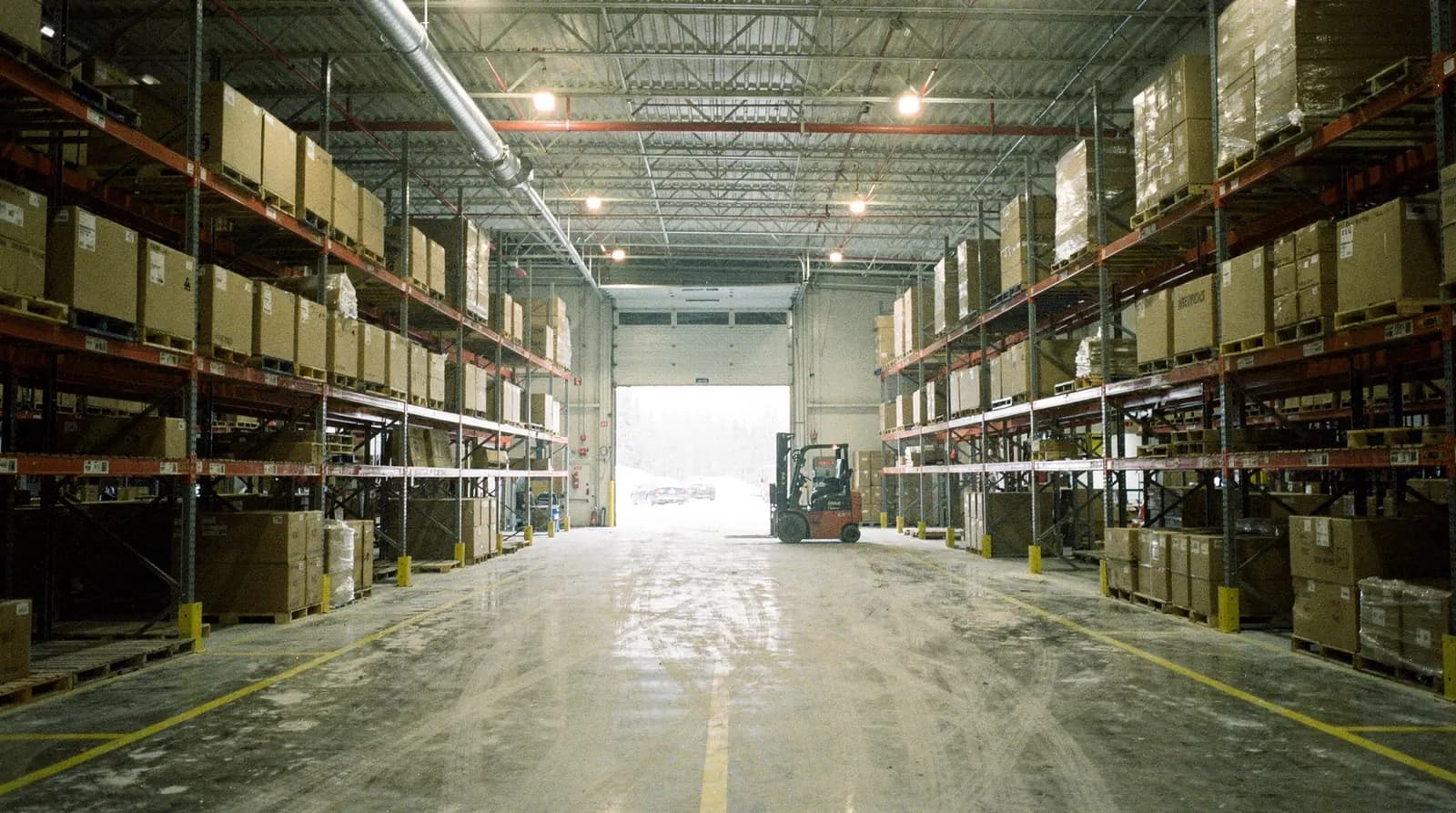
What a warehouse sprinkler system is designed around
Warehouse fire protection in Edmonton starts with two questions: what's on the racks, and how high does it go? The building matters less than people expect. The same 100,000 sq ft box can need very different sprinklers depending on whether it holds canned goods or foam-packed furniture.
NFPA 13-2019, the edition Alberta's codes reference, sorts stock into Class I to IV commodities and Group A, B and C plastics. The National Fire Sprinkler Association's example of Class I is noncombustible product in ordinary cartons: stoves, refrigerators, gypsum board, water-based paint. As packaging and contents get more combustible, the water the design has to deliver generally climbs. Group A plastics, which take in foams and many plastic-packed goods, sit at the hard end.
Occupancy is a separate call. The National Building Code's appendix notes list warehouses as examples of both Group F-2 (medium hazard) and F-3 (low hazard), so which applies turns on what's stored. Settle it early. It's fire code consulting work, and it changes what the rest of the design has to do.
Height limits, aisles and the number on the wall
NFC(AE) 2023, Section 3.2, covers storage in warehouses, factories, shipping and receiving areas and sales floors. Table 3.2.3.2 caps storage height by commodity: in a sprinklered building, 9.0 m for Class I to IV and 6.1 m for Group A plastics. Racks are treated separately, so read the table for your arrangement before quoting it to a tenant. Main aisles have minimum widths. The maximum storage height has to be posted.
Post it where the lift driver looks, on the end of the rack or the nearest column. A number in a binder in the office isn't posted.
Rack storage above 13 m has no prescriptive route at all. It goes through an alternative solution, which means an engineered case the AHJ has to accept.
ESFR, CMSA or in-rack sprinklers
Three approaches cover most high-piled storage, and each gives something up.
| Approach | How it works | The catch |
|---|---|---|
| Standard ceiling sprinklers (density and area) | Control a fire in lower or lighter storage | Runs out of capacity as height and plastic content climb |
| CMSA (control mode specific application) | Larger-orifice control heads matched to a specific storage arrangement | High pressure demand, and the design is only valid for the arrangement it was built around |
| ESFR (early suppression, fast response) | Fast-response, large-orifice heads that aim to suppress the fire from the ceiling, with no pipe in the racks | Fussy about commodity, ceiling height and obstructions, and thirsty |
| In-rack | Sprinklers inside the racking at set levels | Racking gets rearranged, lift trucks hit heads and pipe, and someone has to coordinate every rack change |
Where the stock suits it, we'd lean toward ceiling-only ESFR in a new building, because there's no pipe inside the racks to work around when the next tenant reconfigures. You pay for that in the water supply. Flow and pressure at the tallest, worst-case storage arrangement size the pump and tank, and that number can be unpleasant. In-rack is sometimes the only workable answer when the stock is too hazardous or too tall for the ceiling alone. Our piece on ESFR sprinklers in Edmonton warehouses goes further into the ESFR side.
When the tenant changes, the design has to be re-checked
Picture a 60,000 sq ft warehouse in Nisku, sprinklered years ago for cartoned Class II goods. The next tenant brings plastic totes and foam-packed product, or racks the old goods three levels higher. Same building, same sprinklers, different fire. (That's a made-up example, not a job.)
The fire code sees this coming. NFC(AE) 2023, 2.1.3.1(2), expects the protection to be upgraded when the hazard outgrows what it was designed for, and Division C, 2.2.1.1, puts responsibility on the owner. A landlord who never asks what's in the racks is carrying risk they can't see. The usual ways a design gets outgrown:
- a taller stack or an extra rack level
- wood pallets swapped for plastic
- flue spaces closed up, or racking pushed together
- a mezzanine or partition built under the sprinklers
- a new product class, especially plastics
Keep the sprinkler drawings and hydraulic calculations in the lease file, and ask for a stock list and rack plan before any move-in. A short review then costs far less than a redesign after somebody's insurer walks the building. Our guide to sprinkler submittals and permits shows what a design submittal contains.
Lithium-ion batteries and other stock the design may not cover
Standard warehouse sprinkler design doesn't cover lithium-ion battery storage. The National Fire Sprinkler Association's April 2024 review says NFPA 13 doesn't address it, so design criteria are limited, and the only prescriptive criteria for bulk storage come from FM Global Data Sheet 8-1, which limits state of charge in its scenarios. Fire Safety Research Institute tests found fully charged modules went into a faster, more volatile thermal runaway than modules at 30 percent charge.
NFPA 855 doesn't fill the gap. It's about stationary energy storage systems, not batteries sitting on a pallet in a distribution centre.
So a logistics operator taking in e-bikes, power tools or battery packs may be holding a hazard the original design never considered. Talk to your insurer and a fire protection engineer before that stock arrives. Storage limits, separation and a purpose-built design may be the answer, and more sprinkler heads on their own may not. Battery charging for electric lift trucks has separate rules in NFC(AE) 2023, 3.1.3.3.
Water supply, tanks and pumps
If the street main can't deliver what the stock demands, the site needs a fire pump, usually with a water storage tank. Alberta's building code references NFPA 20-2016 for pumps, which is older than the NFPA 13 edition, and out-of-province pages often quote something newer. One insurer's water-demand guidance (AXA XL) tells engineers to plan for a residual pressure of at least 50 to 75 psi for CMSA designs. Many municipal mains won't give you that at the flow you need.
Get a hydrant flow test done before the racking layout is drawn, not after the building's roofed. Large sites also lean on private hydrants, which the building code ties to NFPA 24-2013. Details on both are on our fire pumps and hydrants page.
Unheated docks in an Edmonton winter
The building code requires fire protection equipment in unheated areas to be protected from freezing (NBC(AE) 2023, 3.2.5.17). Loading docks are where that bites. Edmonton's January design temperatures are -30 C at the 2.5 percent level and -33 C at 1 percent (NBC(AE) 2023, Appendix C, Table C-2). The 2.5 percent figure means readings fall below it about 19 hours in an average January. Leduc's entries are colder, at -32 C and -35 C. The October winterization checklist covers checking unheated spaces before the first cold snap.
A dock door standing open at -30 C will freeze a wet branch line nearby faster than anyone expects. The fixes are heated enclosures around the pipe, or a dry pipe system in the unheated zone, which trades freeze risk for slower water delivery and more maintenance. Our wet vs dry sprinklers in Alberta winters piece lays out that trade.
Inspection in a building that never stops moving
Sprinklers in Alberta are inspected, tested and maintained to NFPA 25-2017, from weekly valve checks to the annual pump flow test. In a warehouse the inspection also has to look at what changed on the floor: stock stacked up against the ceiling, heads knocked by lift trucks, a rack moved over a riser. Building the inspection schedule around the shift pattern, with the loading bays and racks in mind, keeps it from becoming the thing nobody lets in the door. The intervals are in our NFPA 25 frequency guide.
What we can design, install and service for a warehouse
Everything above sits inside the services Sterling lists:
- design, with hydraulic calculations and permit drawings for high-piled and ESFR storage
- installation of wet, dry, preaction and ESFR sprinkler systems, fire pumps and water storage tanks
- fire alarm and emergency lighting to go with them
- inspection and maintenance to NFPA 25-2017, with deficiency reports
- code consulting on occupancy classification and alternative solutions
We don't supply racking, and we won't guess at a lithium-ion design that no standard covers. That takes a fire protection engineer, your insurer and the battery maker's data. Start with the sprinkler systems page, or send your stock list through the contact page.
Frequently asked questions
What commodity class is my warehouse stock?
It depends on the product and its packaging together, not the product category alone. A noncombustible item in an ordinary carton is Class I. Add wood pallets, combustible packaging or plastic content and it moves up through Class II to IV, and Group A plastics are the top of the scale. The sprinkler designer classifies it, and your insurer may hold its own view, so agree the class before move-in.
Do I need ESFR sprinklers?
Not automatically. ESFR is one way to protect tall storage from the ceiling, and it suits some stock and building heights better than others. The answer comes from the commodity, storage height, ceiling height and water supply together. Sometimes CMSA or in-rack sprinklers are the better fit.
Can a tenant stack higher than the original design?
Only if the sprinkler design and the fire code's height limits allow it. The maximum storage height has to be posted, and NFC(AE) 2023, 2.1.3.1(2), expects protection to be upgraded when the hazard outgrows the design. Get the drawings and hydraulic calculations reviewed before the racking goes in.
Does my sprinkler system cover lithium-ion batteries?
Probably not to the level the hazard needs. NFPA 13 doesn't address lithium-ion battery storage, and the only prescriptive criteria come from FM Global Data Sheet 8-1. Speak to your insurer and a fire protection engineer before bulk battery stock arrives.
Sources
- National Fire Code 2023 Alberta Edition, National Research Council Canada
- Fire codes and standards, Government of Alberta
- The Importance of Commodity Classification for High-Piled Storage Occupancies, National Fire Sprinkler Association
- Current Protection Standards for Lithium-Ion Batteries, National Fire Sprinkler Association
- Estimating Fire Protection Water Demands (PRC.14.1.1.0), AXA XL