Flour, sugar and starch dust are the fire load nobody counts
In a food plant the hazard people underestimate is fine powder, not the fryer. Flour, sugar, starch and spice dust settle on ledges, ducts and the tops of equipment, and a cloud of it meeting an ignition source can explode. NFPA 61, which the Alberta fire code lists among its referenced documents (the 2017 edition), covers facilities handling dry agricultural materials such as grain, sugar, flour, spices and feed, along with starch manufacture.
The Alberta rule that applies everywhere is NFC(AE) 2023, Section 5.3, wherever combustible dust is produced in quantities that create a fire or explosion hazard. In plain terms it asks for:
- cleaning with non-sparking, conductive, grounded vacuum equipment
- compressed-air blow-down only with ignition sources removed and equipment de-energized or rated for it
- dust collectors of noncombustible, non-sparking construction, bonded and grounded
- collectors over 2.36 m3/s (about 5,000 cfm) placed outside, explosion-vented, protected by explosion prevention, or set in a one-hour room with venting
The blow-down rule exists for a reason. An air hose puts settled dust into suspension, which is exactly what you don't want. The code also lists NFPA 68-2013 (venting) and NFPA 69-2014 (explosion prevention).
Sprinklers are not an explosion protection system. They handle the fire. Housekeeping, venting and isolation are process safety work for a qualified engineer. Newer NFPA dust documents exist, and they bind Alberta only where your AHJ, insurer or contract invokes them. Ask your insurer whether it expects a dust hazard analysis, because many plants find out what they have that way.
Which occupancy is a food plant?
The building code's appendix examples list cereal, feed and flour mills under Group F-1 (high hazard), factories under F-2 and creameries under F-3. So a plant that mills flour and one that assembles packaged meals may not share a group, and the group affects sprinklers and separations. What you process decides it. This is fire code consulting territory, and it's better settled before the layout is frozen than after.
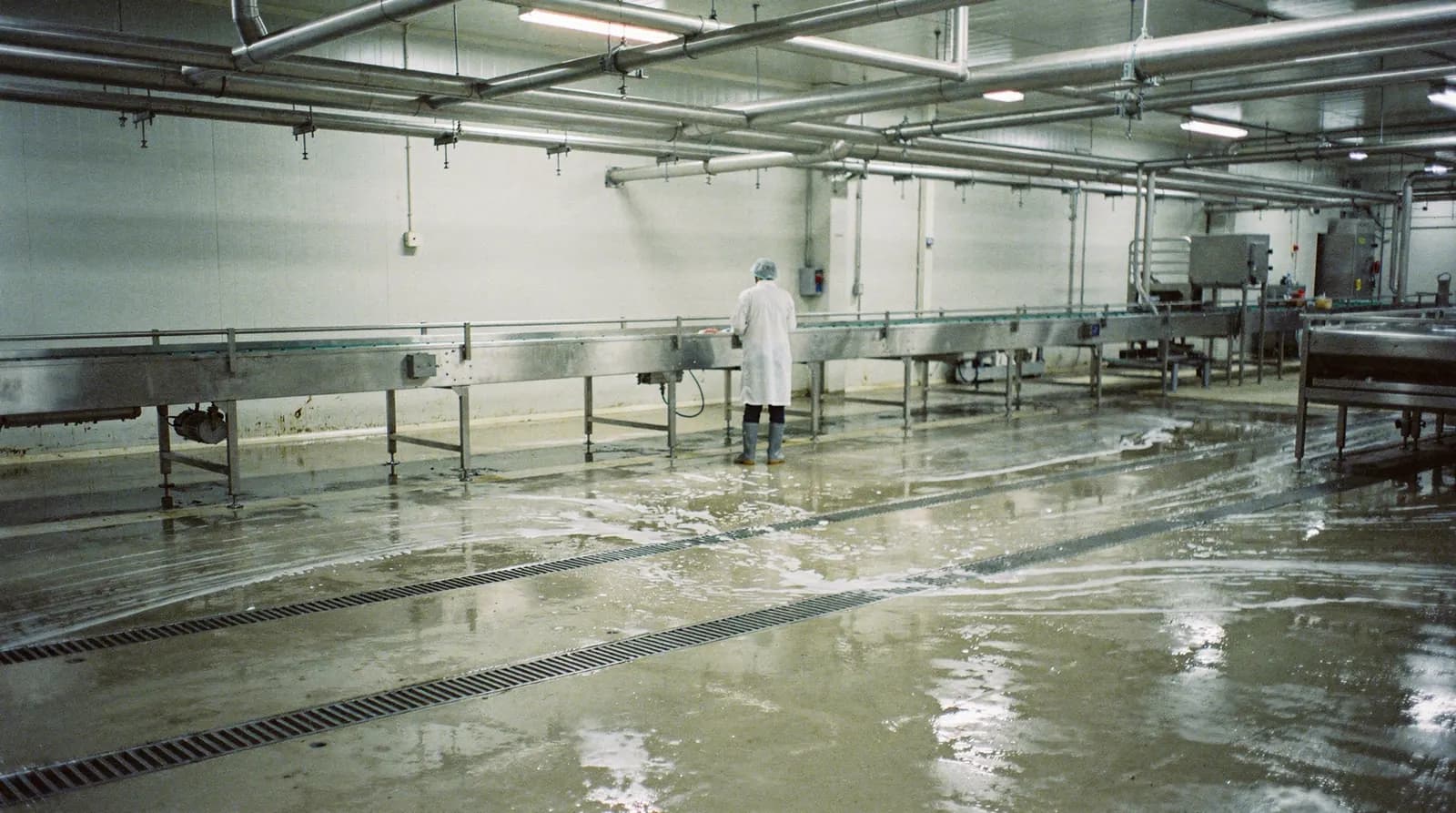
Sprinklers in a room that gets hosed down every shift
Washdown shortens the life of ordinary sprinklers. NFPA 13 expects listed corrosion-resistant sprinklers wherever chemicals, moisture or other corrosive vapours could attack them. That means either a corrosion-resistant coating, such as wax or lead, or stainless steel heads, and only the manufacturer may apply the coating. Pipe follows the same logic. Where cleaning agents are aggressive, stainless steel pipe is common.
Never paint sprinklers. A plant that repaints ceilings each spring should tell the painter to keep off the heads, and any head that gets painted is replaced, not scraped.
Food safety and fire protection also want different things. Auditors want smooth surfaces, few ledges and no dead legs. The sprinkler designer wants coverage, drainage and access. Get both parties talking during design, not at commissioning. Pressure washers aimed at heads and detectors damage them, so detection in wet rooms needs housings rated for the environment. Chilled and frozen areas of the same plant take dry pipe or preaction, which we cover on the cold storage page.
Ovens, fryers, thermal oil and the staff kitchen
These aren't all the same problem.
Where baking or drying gives off flammable vapours, NFC(AE) 2023 (5.4.1) sends the design, operation and maintenance of the process to NFPA 86-2019, the ovens and furnaces standard. A staff cafeteria is commercial cooking, and the fire code sends it to NFPA 96-2017 (2.6.1.9). That means a hood, an exhaust duct that gets cleaned, and a wet chemical suppression system. We work with Amerex kitchen suppression systems; see special hazard suppression.
Production fryers are murkier. We can't point to an Alberta code clause that says whether a line fryer counts as commercial cooking for NFPA 96, or should be protected to the equipment maker's and your insurer's requirements. Get those parties, and the AHJ, to agree in writing before anyone specifies fixed suppression.
Thermal fluid heaters have a different failure pattern. The heater manufacturer Sigma Thermal notes that fires usually trace to the equipment carrying the oil (a poor insulation choice, loss of flow, cracked heater tubes, uncontained leaks) rather than the oil itself.
Inspections while the line is running
Fire system inspections in a food plant get planned around sanitation, not just the calendar. Sprinklers are inspected, tested and maintained to NFPA 25-2017 and fire alarms to CAN/ULC-S536:2019. The waterflow test opens the inspector's test connection and the main drain test discharges hard, so both need a drain that leads somewhere sensible and not across open product. Some rooms need gowning or product covered first, and tools may have to be swabbed or logged.
Any shutdown, routine testing included, counts as a temporary shutdown that needs alternative measures (NFC(AE) 2023, 6.1.1.4). A plant that can't stop needs a plan for the hours a zone is off. The inspection page covers the routine, and digital reports help when your food safety audit asks for the records. Our impairment checklist and fire watch requirements in Alberta cover what to arrange for the hours a zone is off.
What we can design, install and service in a food plant
- sprinkler design and installation, including corrosion-resistant heads where the room calls for them, and dry or preaction systems in chilled areas
- fire alarm and emergency lighting, with monitoring integration
- work with Amerex kitchen suppression systems, and clean agent for electrical or control rooms
- portable extinguishers
- inspection and maintenance to NFPA 25-2017, and code consulting on occupancy
We don't design dust collection, explosion venting or isolation, and we don't run dust hazard analyses. That's a process safety engineer's work, and we'd coordinate our part with theirs. Where the plant has a warehouse attached, warehouse and logistics covers the storage side, and industrial manufacturing covers plant-wide hazards such as flammable liquids and hot work. To go through your own plant, use the contact page.
Frequently asked questions
Does NFPA 61 apply to my food plant in Alberta?
The NFC(AE) 2023 lists NFPA 61-2017 among its referenced documents. Whether it applies to a given plant depends on the materials handled and how the code text reaches them, so ask your AHJ. Section 5.3 of the fire code applies regardless, wherever combustible dust builds up to a fire or explosion hazard.
Do sprinklers protect against a flour dust explosion?
No. Sprinklers control a fire. Dust explosions are prevented by housekeeping and by ignition control, and limited by venting and isolation, all of which a process safety engineer designs. Sprinklers still matter for the fire that follows.
Can sprinklers go in washdown rooms?
Yes, with listed corrosion-resistant sprinklers and pipe suited to the cleaning chemicals. Heads are coated or made of stainless steel at the factory, never painted on site. Sprayed water damages heads and detectors, so plan their placement and housings with the sanitation team.
Does a plant have to shut down production for a fire inspection?
Not usually the whole plant, but zones may need to be taken out of service and some tests discharge water. Any shutdown of a system is a temporary shutdown under the fire code and needs alternative measures. Agree a schedule with the inspector well ahead.
Sources
- National Fire Code 2023 Alberta Edition, National Research Council Canada
- Understanding Combustible Dust Standards For Food Manufacturing, Food Manufacturing
- A Guide to Listed Corrosion-Resistant Sprinkler Heads, Quick Response Fire Supply
- Fire Safety and Thermal Fluid Heating Systems, Sigma Thermal