
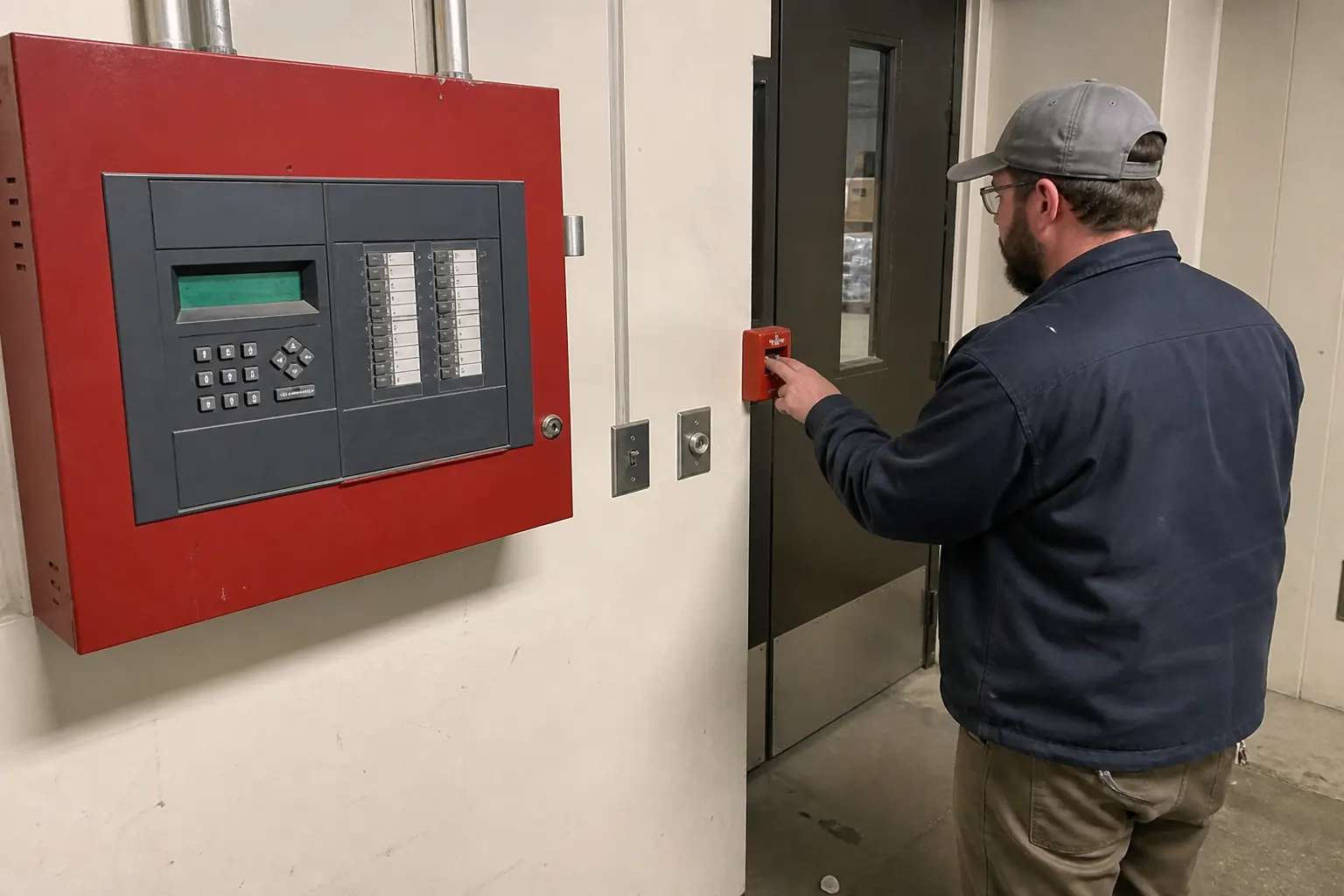
Verification, annual testing and monitoring are three different jobs
Fire alarm verification proves that a new or altered system works as designed. The annual test proves it still does. Monitoring carries the alarm's signals off the property to someone who can send a truck. Alberta puts each in a different document, and owners mix them up until an inspector asks for a report that doesn't exist.
| Job | Standard | When it happens | What you keep |
|---|---|---|---|
| Installation | CAN/ULC-S524:2019 | New or altered system | Design and as-built drawings |
| Verification | CAN/ULC-S537:2019 | After a new installation or an alteration | Verification report, kept while the system exists |
| Inspection and testing | CAN/ULC-S536:2019 | Daily and monthly checks, then a full annual test | Annual report, on site, at least 5 years |
| Monitoring | CAN/ULC-S561-13 in the code, S561:2020 in ULC listings | Continuous | Signal results in the annual report, plus the Fire Protective Signalling Certificate where fire department notification is required |
| Integrated testing | CAN/ULC-S1001-11 | Where the alarm drives elevators, HVAC, door holders or sprinkler flow switches | Integrated test report, kept while the system exists |
The National Fire Code 2023 Alberta Edition (NFC(AE) 2023) calls up S536 for inspection and testing (Division B, 6.3.1.2), S561 for central stations (6.3.1.3) and S1001 for interconnected systems (6.8.1.1). Installation and verification come from the National Building Code 2023 Alberta Edition. Notice what's missing. Alberta doesn't use NFPA 72 for this, so a spec that quotes it is the wrong document for an Alberta inspection. The code names the August 2019 edition of S536, by exception, because it better meets the intent even though it postdates the code's reference cutoff. If a contractor mentions a newer edition, the code still says 2019.
Our fire alarm systems page covers the hardware. This article covers the paper.
What S537 verification is and why its report outlives every other record
Verification is the first full test of a finished installation, checked against the design. Every later annual test gets compared with it. That's why the code keeps initial verification and integrated systems reports for the life of the system (NFC(AE) 2023, Division C, 2.2.1.2), while ordinary inspection records only have to stay five years.
Where the alarm talks to other building systems, S1001 integrated testing follows, and its coordinator must be a registered engineering professional (Division C, 2.2.4.8). Witnessing sits with the registered professional the owner retains. The City doesn't send someone to every test. It collects letters of confirmation.
Old buildings with a missing binder are where this bites. If an existing system never had an initial verification, the AHJ may require an audit to S536 unless it's satisfied the system has been maintained and works (Division C, 2.2.9.2). The fix isn't a reconstructed report. It's a proper audit.
What the annual S536 test covers
The annual test touches every part of the system, and the report gives every device its own line. The S536:2019 annual record form, as reproduced by FireTechs, asks for:
- a summary page saying whether the system is connected to a fire signal receiving centre, is fully functional, and has deficiencies or recommendations;
- a deficiency log with a correction sign-off and an owner compliance statement, and a log of who attended;
- a documentation check covering reset and silence instructions, zone descriptions, sequence of operation, as-built device plans and previous verification reports;
- control unit function tests, including trouble signals, ground faults on both sides, alarm transfer and the firmware version;
- a voice communication test where the building has one;
- power supply and emergency power, with a battery capacity test (the battery must still hold at least 85 percent of its rating afterward);
- an individual record for each field device, from smoke detector sensitivity and cleaning dates to duct detector pressure differential and CO detectors on the system.
Between annual tests, the daily and monthly checks can be done by the owner or the owner's representative once the manufacturer or service provider has trained them (Division C, 2.2.4.3). Those checks don't replace the annual.
A sticker on the panel isn't a report. The report goes to the owner and stays on the premises for the fire inspector (Division C, 2.2.1.2).
Who may install, verify and test fire alarms in Alberta
Alberta names the qualifications in the fire code (NFC(AE) 2023, Division C, 2.2.4.3), and they're specific.
- Installation: an Alberta journeyperson electrician (certificate dated September 1, 1991 or later), or an earlier Alberta or Red Seal electrician who has also taken a fire alarm course the Provincial Fire Administrator recognizes.
- Making the system operational, inspecting, testing, maintaining and signing the documents: an approved post-secondary certificate (the electrician routes count) or a current CFAA Fire Alarm Technician certification.
- CFAA students work under on-site supervision of a CFAA technician, and apprentices under a journeyperson.
- Anyone assisting at the panel during verification or an annual test meets the same qualifications.
Older course-based credentials stopped being recognized after December 31, 2025. Ask to see the CFAA certificate or the electrician credentials before you sign a service contract. And if the "tested OK" email you got last year has no S536 report attached, you don't have a report.
What Edmonton expects to see on the report
In Edmonton the report format isn't up for negotiation. The EFRS Fire Marshal Bulletin of July 2026 says the S536:2019 reporting format became mandatory with NFC(AE) 2023, all sections of S536 and S537 reports must be completed (with "N/A" where a section doesn't apply), and partial reports aren't accepted. Results go in the standard's tabular format. Smoke detector sensitivity and battery testing are mandatory, and the STANDATA that had allowed sensitivity testing to be deferred wasn't renewed.
Since September 8, 2026, EFRS also expects third-party ITM reports to be submitted through the Life Safety Inspection Vault (LIV). Fire alarms are on the list. Contractors register, owners can request view access, reports are expected within 14 days of the initial inspection, and deficiencies affecting a system's operation or coverage are expected within 24 hours. A deficient report triggers a notice to the owner with a correction timeline, and a Fire Safety Codes Officer may inspect if it isn't corrected.
The City's own pages disagree on whether every report must go through LIV. The safe reading: deficient reports must go through LIV, and EFRS recommends uploading all ITM reports. Outside Edmonton, ask your municipality's fire department or its accredited agency what it wants before the test visit. Our fire system inspections page covers the rest of the inspection picture, and the deficiency closeout guide covers what happens after a notice.
ULC monitoring, S561 and the monitoring certificate
Monitoring is the link between your panel and a fire signal receiving centre, and it's tested as part of the annual. CAN/ULC-S561 covers the receiving centre and the transmitting unit and its inputs at your premises. NFC(AE) 2023 cites the 2013 edition for maintaining central stations (Division B, 6.3.1.3). ULC's listing program has moved on to S561:2020, per ULC's certification bulletin, which added hosted and clearing-house centre types, a 1-hour separation for operations areas in sprinklered buildings and a redundant-centre requirement for existing listees from January 1, 2025. That's mostly your monitoring company's homework. It explains why their paperwork says 2020 and the code says 2013.
Whether your alarm has to signal the fire department is a building code question. The National Building Code 2023 Alberta Edition decides it (Division B, 3.2.4.7): notification to the fire department in conformance with CAN/ULC-S561 is required for single-stage systems in assembly occupancies with an occupant load over 300, for systems with waterflow devices, and for two-stage systems. Your permit drawings show which side of the line the building sits on. Where the NBC(AE) requires signalling, monitoring isn't optional. Where the alarm doesn't transmit, the fire code wants a sign at each manual station asking people to call the fire department and giving the number (Division B, 2.8.2.14(4)).
The certificate is a separate thing, and for required monitoring it's a code requirement. When the NBC(AE) requires the alarm to notify the fire department, the owner must give the AHJ a Fire Protective Signalling Certificate from a certified listing agency, showing the address, the listed installation company and the listed monitoring company (NBC(AE) 2023, Division C, 2.2.3.4). UL Canada lists its ULC fire alarm certificate programs. One covers verification, testing and inspection to S536:2019 and S537:2019. Another, Protective Signaling Systems, covers fire alarm and sprinkler monitoring to S561:2020 and S559:2020. Only ULC-listed companies issue them, certificated systems have to stay under the issuing company's care and inspection service, and UL audits that company's service records. Keep a copy of the current certificate in the binder.
Ask your tester to trigger alarm, supervisory and trouble signals on the day and confirm each one reaches the station. The same goes for sprinkler flow and valve switches that ride on the alarm panel.
Records to keep in the building
Alarm records live at the premises, not in a contractor's cloud folder. Division C, 2.2.1.2 asks for the original or a copy of every required test and inspection record on site. You keep the current record and the one before it, but nothing is destroyed within five years of being prepared. The verification, integrated systems and initial test reports are the exception, and they stay as long as the system does. The forms the AHJ accepts include those in S536, S537 and S1001.
Binders in older buildings tend to hold warranty cards and quotes and no test sheets. Sort yours once. Verification reports up front, then annual reports by year, then the deficiency log, then the monitoring certificate and the monitoring company's contact sheet. The Alberta Fire Code annual inspections guide has the code-reading side of record-keeping.
When the alarm system is out of service
If a fire alarm system, or part of it, is inoperative for more than 2 hours for any reason, the owner has to notify the fire department and, when directed, provide acceptable continuous surveillance until it's restored (NFC(AE) 2023, Division C, 2.2.7.2). Procedures to warn occupants during the outage need the fire department's acceptance, and the agreed measures belong in the fire safety plan.
Any interruption counts as a temporary shutdown under Division B, 6.1.1.4, routine testing included, and the note says alternative measures for an alarm shutdown should be worked out with the fire department. We'd treat a lost link to the monitoring station the same way. The code doesn't single monitoring out by name in the parts we reviewed, so your AHJ has the final say.
Contractors have a duty too. If the person maintaining a system finds a device or system defective and the owner won't or can't fix it, they must notify the fire department and the owner in writing (Division C, 2.2.7.2(4)). Edmonton now expects that report through LIV. Edmonton also expects deficiencies affecting operation or coverage within 24 hours and says they may require emergency repairs or fire watch. We couldn't find a published Edmonton rule on fire watch intervals, so settle that with EFRS Fire Prevention before a planned shutdown.
Trouble signals that won't clear, or an alarm that's gone dark, can't wait for the next visit. Call 780.760.0806 at any hour. The 24/7 emergency repair page covers the first few minutes. To book annual testing, or to have someone review what's in your binder, send the panel details through the contact page. We install fire alarm systems as part of fire system installation, handle annual inspection and testing, and coordinate with your monitoring company.
Frequently asked questions
Is fire alarm verification the same as the annual test?
No. Verification to CAN/ULC-S537:2019 is done on a new installation or an alteration, and its report stays with the building as long as the system does. The annual inspection and test to CAN/ULC-S536:2019 repeats every year after that. They use different forms, and inspectors ask for both.
How often does a fire alarm system need testing in Alberta?
Daily and monthly checks under CAN/ULC-S536:2019, which trained owner staff may do, plus a full annual test by a qualified person. Edmonton expects the annual report in the standard's full tabular format, every section completed. Only the annual test needs a contractor. The daily and monthly checks live in your own logbook.
Does my building need ULC monitoring?
It depends on what the National Building Code 2023 Alberta Edition required when the building was permitted. Article 3.2.4.7 requires fire department notification for single-stage systems in assembly occupancies over 300 people, systems with waterflow devices and two-stage systems. If the alarm has to signal the fire department, monitoring is not optional, and the owner files a Fire Protective Signalling Certificate from a certified listing agency with the AHJ (Division C, 2.2.3.4). Your permit drawings or your AHJ can tell you which applies.
Who can test a fire alarm system in Alberta?
A person with an approved post-secondary certificate, including the electrician routes, or a current CFAA Fire Alarm Technician certification (NFC(AE) 2023, Division C, 2.2.4.3). Students and apprentices work under supervision. Older credentials stopped being recognized after December 31, 2025.
What if our fire alarm system was never verified?
The AHJ may require an audit to CAN/ULC-S536 unless it's satisfied the system has been maintained and works (Division C, 2.2.9.2). Start by looking for the original acceptance paperwork with the building's drawings and permit file. If it can't be found, expect the audit conversation.
Sources
- National Building Code 2023 Alberta Edition, National Research Council Canada
- National Fire Code 2023 Alberta Edition, National Research Council Canada
- Fire codes and standards, Government of Alberta
- Fire Marshal Bulletin on fire alarm reporting, Edmonton Fire Rescue Services
- Fire Inspection Report Submission, City of Edmonton
- CAN/ULC-S536:2019 annual test and inspection record, reproduced by FireTechs
- Certification Bulletin 2020-09 on CAN/ULC-S561:2020, UL Canada
- Fire and Security Alarm Certificate Programs, UL Canada