
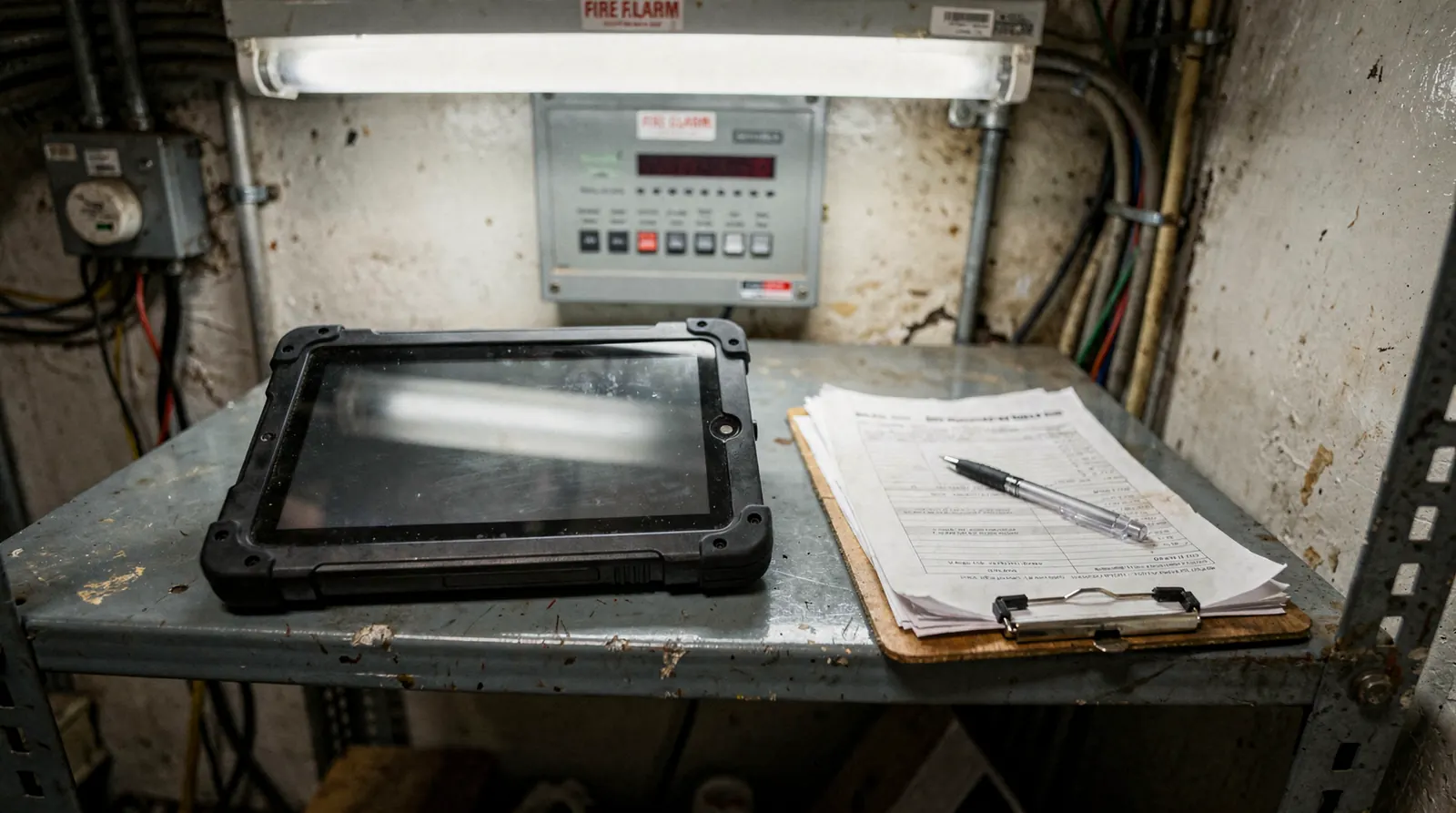
What the LIV requirement is
Edmonton Fire Rescue Services (EFRS) now requires third-party fire system inspection, testing and maintenance reports (at minimum the deficient ones, as explained below) to be submitted electronically through the Life Safety Inspection Vault, known as LIV, starting September 8, 2026. It's a web platform at app.livsafe.com. This article is based on the City of Edmonton's own Fire Inspection Report Submission page and EFRS's July 2026 Fire Marshal Bulletin. The rules are new and the City may change them, so check the City page before you act.
If you own or manage a commercial building in Edmonton, the short version is that your fire protection contractor now has a reporting job on top of the inspection, and you should know whether they're doing it.
Which systems and which reports
The City lists these systems as covered:
- fire alarm systems
- fire pumps
- range hood cleaning
- emergency lights
- standpipe systems
- sprinkler systems
- fixed fire suppression systems
Portable extinguishers, exit signs, backflow assemblies and alarm monitoring weren't on the list we read. (The City's FAQ also mentions emergency generators, which aren't on that list, so ask if you have one.) Test reports for premises-isolation backflow assemblies go to EPCOR under its own cross connection program, which our backflow prevention page explains.
Now the part where the City is inconsistent, and we'd rather say so than pick a side. One place on the City's page says the requirement applies to non-compliant reports. Its FAQ says both compliant and non-compliant reports. The bulletin says the fire code itself only requires deficient reports, but EFRS recommends uploading all of them.
So here's how to read it. Deficient reports must go through LIV. EFRS recommends uploading all ITM reports. Ask your contractor to upload everything and you'll be covered whichever reading turns out to be the firmer one.
Who registers and who sees what
Contractors must register with LIV. The reports are theirs to submit, so the burden of setting up sits with them, not with you. Owners can request view access, which lets you see what's been filed against your building. Ask for it. Otherwise, the only way you'll know a report went in is if your contractor tells you.
Two things this doesn't change. First, the fire code still puts the responsibility for carrying out the National Fire Code 2023 Alberta Edition (NFC(AE) 2023) on the owner or the owner's authorized agent (Division C, 2.2.1.1). A contractor's failure to upload isn't a defence. Second, the on-site records rule still stands. Records of required tests, inspections and maintenance are kept at the premises for the authority having jurisdiction, no record is destroyed within five years of being prepared, and initial verification and test reports for each system are kept for the life of the system (Division C, 2.2.1.2). Nothing we read says LIV replaces your binder or your digital copy on site. Keep both.
The two clocks, 14 days and 24 hours
EFRS expects reports within 14 days of the initial inspection. Deficiencies that affect a system's operation or coverage are to be reported within 24 hours. Those are EFRS's figures, as published in the July 2026 bulletin, and we haven't seen a definition beyond that.
Think about what the 14 days does to scheduling. If a contractor starts a large building's alarm test on the 1st and finishes on the 6th, the clock is running from the initial inspection. It's fair to ask your contractor how they treat that and when you'll see the report.
The 24-hour rule is the one with teeth. A closed sprinkler valve, a fire alarm zone that won't report, a pump that fails to start: those are deficiencies affecting operation or coverage, and your contractor is now expected to report them to EFRS within a day. The bulletin adds that such deficiencies "may require emergency repairs or Fire Watch" until repaired. If you've never had a call from your contractor at 4 p.m. about a valve, you might get one now. That's the system working.
For a deficiency, the bulletin describes a notice to the owner with a correction timeline based on the category of deficiency, and if it isn't corrected, a Fire Safety Codes Officer may inspect. The categories and their timelines weren't published in anything we read. Ask EFRS or your contractor what category a given item falls into. Our article on closing out a fire marshal deficiency covers the closeout paperwork.
If it goes further and you receive a formal order under the Safety Codes Act, the clocks change and they're short. You can ask the Administrator in writing to review the order within 14 days of service, and you can appeal to the Safety Codes Council within 35 days of service (Safety Codes Act, ss. 49 and 50). Get advice early. Our fire code consulting page describes how we help with that.
What EFRS expects in a fire alarm report
The July 2026 bulletin also sets out format expectations for fire alarm reports, and they're stricter than many owners realize. As the bulletin describes it:
- Reporting in the CAN/ULC-S536-19 format became mandatory with NFC(AE) 2023.
- All sections of S536 and S537 reports must be completed, marked "N/A" where they don't apply. Partial reports aren't accepted.
- Results must use the standard's tabular format.
- Smoke detector sensitivity and battery testing are mandatory. The STANDATA that allowed delayed sensitivity testing was not renewed.
That last point matters if your last alarm contractor skipped sensitivity readings or ran a "visual only" check. It also explains why a good annual alarm report is long. S536 forms cover the control unit, power supplies and batteries, the voice system, ancillary circuits, the link to the monitoring centre and a record for every field device. A short summary sheet won't meet that.
Our fire alarm verification and ULC monitoring article covers what verification is and why monitoring matters, and the fire alarm systems page covers the standards Alberta cites.
What owners should ask their contractor
Bring this list to your next annual visit or the call to schedule it.
- Are you registered with LIV, and will you upload every report or only deficient ones?
- When will the report be uploaded relative to the visit, and how do I get view access to it?
- If you find a deficiency that affects operation or coverage, how quickly will I hear from you, and by what route?
- Is the alarm report in full CAN/ULC-S536 format, with every section completed and sensitivity and battery testing included?
- Will I receive a copy for the on-site record, and how long do you hold your own?
- Which of my systems fall under the City's list, and which report elsewhere?
If a contractor doesn't know the answers, you have your answer.
Where the rest of your inspection duties sit
LIV governs how reports reach the City. It doesn't change how often the systems get inspected. Alberta references NFPA 25-2017 for water-based systems, and our inspection frequencies article lays out the schedule, while the fire system inspections page covers what a visit involves. The Alberta-wide picture, including annual inspection duties, is in our annual inspection article.
If you have a report in hand and aren't sure it meets the format or timeline above, send it to us through the contact page or call 780.760.0806.
Frequently asked questions
What is the LIV portal in Edmonton?
The Life Safety Inspection Vault (app.livsafe.com) is the platform EFRS requires for electronic submission of third-party fire system inspection, testing and maintenance reports, starting September 8, 2026. Contractors register and upload reports. Owners can request view access. It covers fire alarms, fire pumps, range hood cleaning, emergency lights, standpipe, sprinkler and fixed fire suppression systems.
Do compliant reports have to be uploaded to LIV?
The City's own pages are inconsistent, so we won't say definitively. The bulletin says the code requires deficient reports only, while EFRS recommends uploading all ITM reports. Deficient reports must go through LIV. The simplest approach is to have your contractor upload every report and confirm the arrangement in writing.
Who is responsible for LIV submission, the owner or the contractor?
The contractor registers and submits the third-party report. The owner keeps the code responsibility for maintaining the systems and the on-site records (NFC(AE) 2023, Division C, 2.2.1.1 and 2.2.1.2). Ask for view access so you can confirm what's been filed for your building.
How fast does a deficiency have to be reported?
EFRS expects deficiencies affecting a system's operation or coverage within 24 hours, and full reports within 14 days of the initial inspection. The City's bulletin says such deficiencies may require emergency repairs or fire watch until fixed. Confirm the details with the City, because the process is new.
Does LIV replace keeping my inspection records on site?
Nothing we read says so. Alberta's fire code requires records to be kept at the premises for the authority having jurisdiction, with a five-year minimum before destruction and life-of-system retention for initial verification and test reports (NFC(AE) 2023, Division C, 2.2.1.2). Keep the on-site copy unless EFRS tells you otherwise in writing.
Sources
- Fire Inspection Report Submission, City of Edmonton
- Fire Marshal Bulletin, Fire Alarm Reporting and Inspection Form Requirements (July 2026), City of Edmonton
- National Fire Code 2023 Alberta Edition, Division C 2.2.1.1 and 2.2.1.2, National Research Council Canada
- Safety Codes Act, RSA 2000, c S-1, Alberta King's Printer
- Fire codes and standards, Government of Alberta