
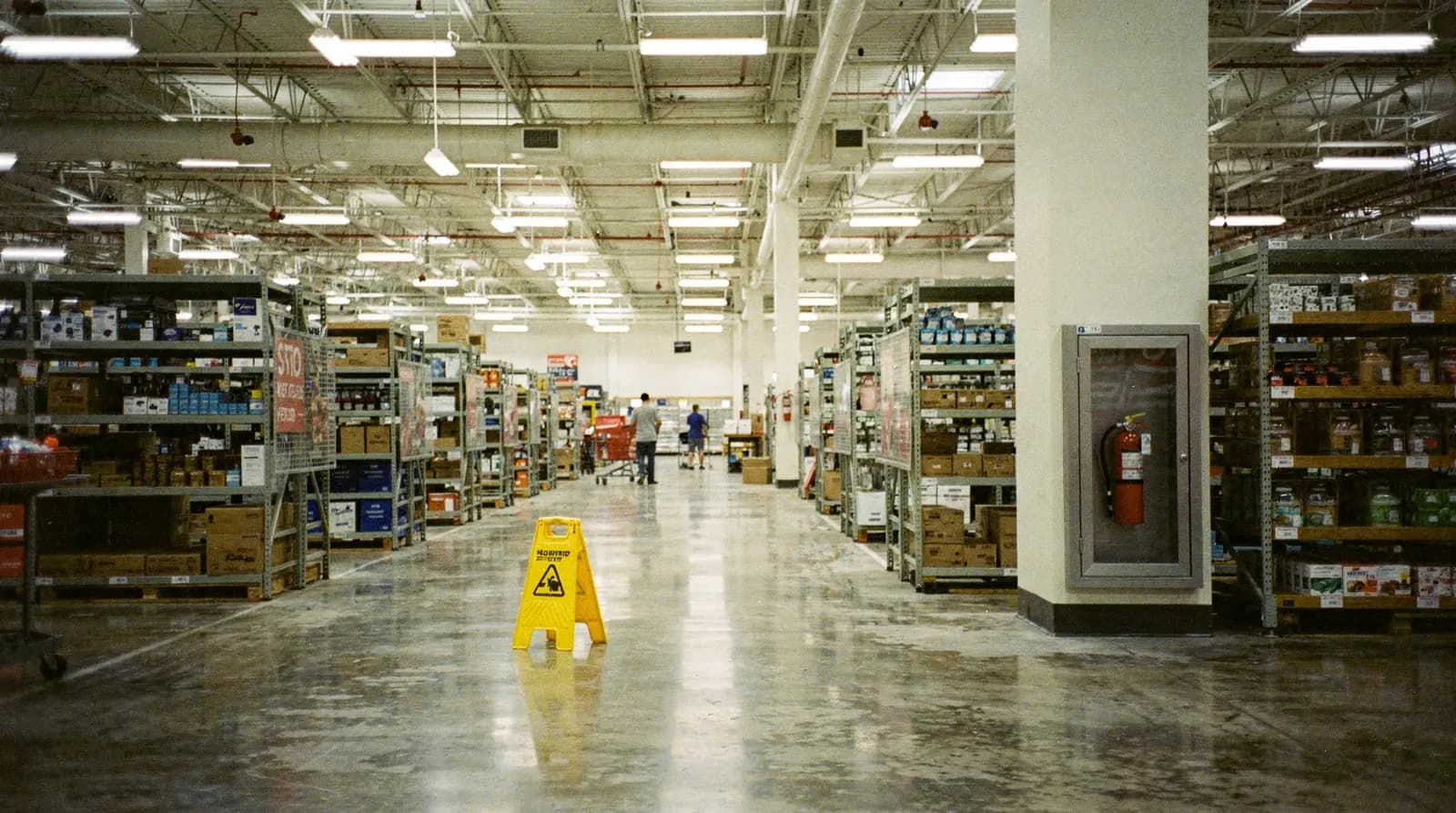
Storage is what makes a big box a hazard
The stock decides how hard a store's sprinklers have to work, and stock changes every season. Alberta's storage rules aren't limited to warehouses. The National Fire Code 2023 Alberta Edition (NFC(AE) 2023), Section 3.2, covers sales areas along with stockrooms and shipping and receiving.
Table 3.2.3.2 caps each storage area by commodity. The commodity classes come from NFPA 13: Class I is essentially noncombustible product in ordinary cartons, Class III is wood, paper, cloth and Group C plastics, and Group A plastics (polyethylene, polypropylene, polystyrene, ABS) sit at the bad end. Most plastic storage totes are polyethylene or polypropylene. So is a lot of a housewares aisle.
| Commodity | Unsprinklered limit | Sprinklered limit |
|---|---|---|
| Class I and II | 500 m² and 6.5 m high | 1,500 m² and 9.0 m |
| Class III and Group C plastics | 250 m² and 4.5 m | 1,000 m² and 9.0 m |
| Class IV and Group B plastics | 250 m² and 3.6 m | 1,000 m² and 9.0 m |
| Group A plastics | 250 m² and 1.5 m | 500 m² and 6.1 m |
Where sprinklers are required, they're designed to NFPA 13-2019. Rack storage in a sprinklered building can go higher than the table, which is where the design criteria start to matter. Storage areas over 100 m² also need a main aisle at least 2.4 m wide (3.6 m where storage is over 6 m high, unless it's in racks in a sprinklered building), and the code wants the maximum storage height posted in the storage area (3.2.2.2 and 3.2.2.5).
The catch is what happens after handover. If a change of use raises the hazard past what the system was designed for, the system has to be upgraded (NFC(AE) 2023, 2.1.3.1(2)). Ceiling-only sprinklers sized for cartons of clothing won't cope with stacked plastic. For rack-heavy formats, see ESFR sprinklers for warehouses and warehousing and logistics. Our fire protection closeout guide lists what to collect at handover.
Aerosols and oxidizers are the other retail-specific items. Aerosols on display are a lower hazard if they're out of cartons or the cartons are display-cut, and packaged aerosol storage follows Article 3.2.5, which sorts them into Levels 1 to 3 by NFPA 30B. Oxidizer storage in mercantile occupancies has its own article, 3.2.7.18. If your merchandising mix changes, ask before the shelves are set.
The tenant improvement permit, in practice
In Edmonton, interior alterations, tenant space improvements and changes of business use in non-residential buildings need a building permit, as the City's changes to existing buildings page explains. Retail is Group E in the building code, offices are Group D. The sprinkler and alarm changes that come with a fit-out normally travel through that same permit process, and the City decides what your scope triggers, including how much professional involvement it needs. Our guide to construction site fire safety plans in Alberta covers whether a fit-out needs one, and sprinkler submittals and permits covers the design paperwork.
The order that works:
- Get the landlord's base-building sprinkler and alarm drawings, and the most recent water flow test if there is one.
- Have the sprinkler designer review the new layout against them before the architect locks the reflected ceiling plan.
- Submit permit drawings, with the hydraulic calculations if the design changes.
- Install under the permit. Sprinkler alterations must be done by a journeyperson sprinkler systems installer, and alarm work by qualified alarm technicians (Division C, 2.2.4.4 and 2.2.4.3).
- Test, verify the alarm changes, and close out with the reports the AHJ asks for.
Step 2 is the one skipped. Sprinkler drawings arrive after the ceiling is framed, the heads land between light fixtures, and somebody eats a change order.
The changes that quietly break sprinkler coverage
Most of these look like decoration or merchandising, and none of them is.
| Change | What it does | Who to ask first |
|---|---|---|
| Full-height partition or demising wall | Blocks spray patterns and leaves unprotected space on the far side | Sprinkler designer |
| New or lowered ceiling | Puts heads at the wrong distance from the ceiling, or leaves them above it | Sprinkler designer |
| Mezzanine or raised platform | Solid decks wider than about 1.2 m (4 ft) generally need heads underneath (NFPA 13 obstruction rules), and area and egress change | Designer and code consultant |
| Taller or denser stock | May exceed the design basis, so the system needs upgrading (2.1.3.1(2)) | Sprinkler designer |
| Moved or added alarm devices | An alteration that needs verifying to CAN/ULC-S537:2019 | Alarm contractor |
| Hanging signs, banners, ductwork | Obstructions have distance rules of their own | Sprinkler designer |
The 4 ft rule is a rule of thumb from NFPA 13's obstruction requirements. Edition-specific wording matters, so have the designer confirm it against NFPA 13-2019. A mezzanine also changes area and exit calculations under the building code. That's the architect's and code consultant's job, and it can move a project's schedule more than the sprinkler piping does.
Food courts and restaurant tenants
Cooking is the one activity in a shopping centre that has its own fuel, its own ignition source and its own ductwork. NFC(AE) 2023 sends commercial cooking to NFPA 96-2017 for the exhaust system and to NFPA 17A-2017 for wet chemical suppression, and the system is normally a listed UL 300 wet chemical type. Licensed restaurants, and any assembly occupancy over 30 people, also need a fire safety plan (NFC(AE) 2023, 2.8.1.1), and food preparation areas in commercial kitchens need emergency lighting (NBC 2020, 3.2.7.3(1)(k)).
Two schedules run separately. NFPA 96's exhaust cleaning frequency depends on the cooking: monthly for solid-fuel cooking, quarterly for high-volume cooking such as charbroiling and wok work, semiannually for moderate volume and annually for low volume. And the suppression system needs a full examination by qualified personnel at intervals not over six months, per NFPA 17A. Edmonton's fire department expects range hood cleaning and fixed suppression reports through its inspection report portal too.
Sterling works with Amerex kitchen suppression systems as part of its special hazard work. Exhaust cleaning is a different trade and isn't in Sterling's list. Extinguishers for grease fires are on the portable fire extinguishers page.
Exit routes and alarms after a fit-out
Exit signs are required over or beside every exit door if a building has more than 2 storeys or an occupant load over 150 (NBC 2020, 3.4.5.1), and signs also have to point the way where no exit is visible from a corridor or an open floor over 150 people. Racking, a new counter or a display wall in front of an exit sign is a fire inspector's easy catch. Battery emergency lighting units and battery-backed exit signs get a monthly check and a yearly full-duration test, and other emergency lights and exit signs a yearly inspection (NFC(AE) 2023, 6.5.1.6 to 6.5.1.8); see emergency lighting and exit signs. Emergency lighting testing in Alberta explains how to keep the records.
Alarm changes work the same way. A mall usually has one alarm system, so a tenant's device changes touch the whole building, and the fire alarm systems page has the verification and annual testing details.
Landlord or tenant
The fire code puts responsibility on the owner (Division C, 2.2.1.1), and a lease can hand routine work to the tenant. The paperwork doesn't move with it. Inspection records stay at the premises for at least five years, and verification reports stay for the life of the system (Division C, 2.2.1.2). Put in writing who books the annual visit, who pays for deficiencies inside the tenant's space, and who holds the reports. Our inspection page lists what gets tested and how often.
What Sterling can do for retail owners, tenants and contractors
Sterling can prepare sprinkler design and permit drawings for a fit-out (fire protection design), install and alter sprinklers and alarms (fire system installation), work with Amerex kitchen suppression systems, and inspect and maintain them afterwards. It also offers code consulting for occupancy and change-of-use questions. For a leak, a trouble signal or an impairment on a Saturday, 780.760.0806 is answered around the clock.
Sources
- National Fire Code 2023 Alberta Edition, National Research Council Canada
- National Building Code 2020 Part 3 extracts, reproduced with NRC permission by Aimlite
- Changes to Existing Buildings and Sites, City of Edmonton
- Fire Inspection Report Submission, City of Edmonton
- NFPA 96 Cleaning Frequency Summary, Total Fire Protection
- NFPA 17A: Wet Chemical Fire Suppression Standard, US Made Supply