
Why nobody can quote a sprinkler inspection from the address alone
Fire sprinkler inspection cost in Edmonton depends on the building, not the city, and any number quoted without seeing the system is a guess. This article gives no dollar figures for that reason. It shows what moves the price so you can read a quote and tell whether it covers your system.
Two buildings of the same floor area can sit far apart. One is a single wet system with one riser, a clear mechanical room and a tenant who lets the inspector in at 8 a.m. The other is a dry system serving a loading dock and a parkade, with a locked riser room behind a leased suite. Same square footage. Different day of work.
If you own or manage the building, the duty is yours. Alberta's National Fire Code 2023 Alberta Edition (NFC(AE) 2023) puts the responsibility for carrying out the code on the owner (Division C, 2.2.1.1), and it sends sprinkler inspection, testing and maintenance to NFPA 25-2017 (Division B, 6.4.1.1). Our fire system inspections page shows the whole schedule. This article is about what you pay for it.
What a base annual visit usually covers, and what it doesn't
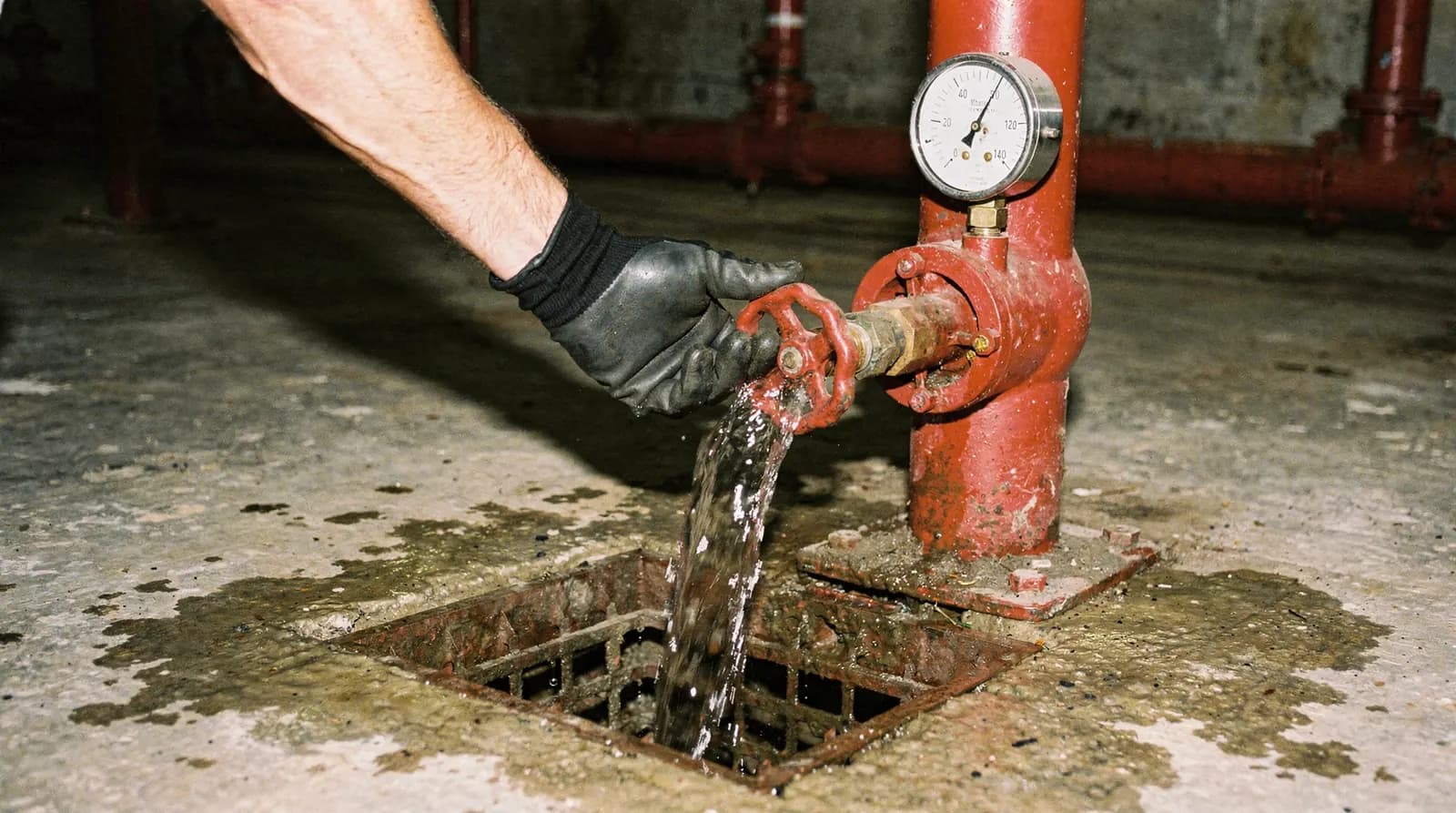
A base annual inspection is the yearly walk through the system: control valves, gauges, alarm devices, visible heads, pipe and hangers, the main drain and the inspector's test. It's the visit most quotes describe. It isn't everything NFPA 25-2017 asks for over a five-year stretch, and that gap is where quotes get misread.
Read the scope line by line and look for these:
- whether the quote covers only the annual tasks or also the quarterly and semiannual ones that fall due through the year;
- the number of risers, systems and floors the price assumes;
- whether the monitoring account is put on test and restored by the inspector;
- the report format, and whether the inspector uploads it to Edmonton's reporting platform for you;
- what happens to a deficiency. Is it listed, priced separately, or repaired on the spot under a stated approval limit?
The last one matters most. An inspection finds things. It doesn't fix them, and (as covered further down) the person allowed to inspect isn't always the person allowed to repair.
The building and system factors that set the price
Time on site is the main driver, and time follows a handful of physical facts.
System type. A wet system is mostly valves, gauges and a walk. Dry and preaction systems add air pressure checks, priming water, low-point drains, a trip test each year and, at longer intervals, a full-flow trip. Deluge systems add their own trip tests. More parts means more hours. Our sprinkler systems page explains how the types differ.
Size and count. More risers, more floors and more heads to look at, plus more waterflow devices to test. A campus of six buildings isn't six times one building, but it's a long way from one.
Height and access. Heads at a 12 ft ceiling are seen from a step ladder. Heads at 40 ft over racking need a lift, a spotter and often a shutdown of forklift traffic. Locked riser rooms, mechanical rooms above tenant ceilings and roof-mounted equipment all eat time before any test starts.
Occupancy. Inspecting inside a hospital ward or a hotel means working around the people in it. Night and weekend work is normal in some buildings, and it prices differently from a Tuesday morning.
Condition and paperwork. A tidy system with last year's report to compare against goes faster than one where nobody can find the gauge history or the drawings. Painted heads, corroded piping and missing signs each add a finding to write up.
Location and season. Travel time counts. So does winter, when a dry valve room has to be checked and a frozen dock door can hold up a walk-through.
Tests that aren't in the annual visit
Some NFPA 25-2017 tasks come round every three or five years. They're separate events, and a low annual price can quietly leave them out. The intervals below come from published charts of the 2017 tables (for example Falcon's summary) and NFSA's write-up of the internal assessment (Assessing the Internals).
| Task | Interval | Why it changes the price |
|---|---|---|
| Internal pipe assessment | Every 5 years | Opens a flushing connection and looks inside pipe. Usually needs isolation, water handling and follow-up if debris turns up |
| Alarm valve and check valve interior inspection | Every 5 years | Valves are opened, so the system is out of service while it's done |
| Dry pipe full-flow trip test | Every 3 years | Floods the dry system and leaves water to drain from every low point |
| Dry pipe air leakage test | Every 3 years | Time to pressurize and measure, on top of the annual trip test |
| Gauge replacement or calibration | Every 5 years | Parts plus the shutdown to swap them |
| Strainers, filters and orifices | Every 5 years | Cleaned or inspected inside the valve trim |
| Sample testing or replacement of aged heads | Set by head type and age | Lab testing is a separate cost, and replacement means parts |
None of these applies to every building every year. A five-year task isn't an emergency when it comes due. But ask the contractor to show you which ones your system will hit in the next five years, so the budget doesn't spike without warning. We'd rather hand an owner a five-year calendar than a surprise. Our NFPA 25 frequency guide lists the long-interval items in full.
Fire-line backflow assemblies are their own item. In Edmonton, EPCOR requires an annual test by a registered certified tester, so it's normally priced apart from the sprinkler inspection. See backflow prevention.
Deficiencies and repairs are where budgets slip
A clean inspection is a cheap year. A report with findings isn't a bigger inspection bill so much as a second bill for the repairs, and it's a different kind of work.
Alberta's fire code splits the qualifications (NFC(AE) 2023, Division C, 2.2.4.4). A journeyperson sprinkler systems installer may inspect, test, maintain and repair NFPA 13 and 13R systems. A person holding an approved NFPA 25 certificate of training may inspect, test and maintain, but not repair. So a quote from an inspection-only company may end at the report, and the repair needs a second contractor, a second mobilization and a second quote.
Think about the common findings. A painted sprinkler head has to be replaced, not cleaned. A control valve found partly closed needs the cause found and the valve secured. A dry system that keeps losing air needs the leak traced. A failed gauge needs replacing. Each has a parts cost and a labour cost, and the second one grows if the fix needs a lift or an isolated floor.
In Edmonton, Fire Rescue expects a deficiency that affects how a system operates or what it covers to be reported within 24 hours, and third-party inspection reports go to the City through its Life Safety Inspection Vault (LIV) platform. Deficient reports must go through it, and Edmonton Fire Rescue recommends uploading all of them (per the City's report submission page). If your contractor handles the upload, say so in the quote. If it's left to you, it's your time.
For a fixed budget, ask for a not-to-exceed approval limit on minor repairs found during the visit, so the inspector can fix a head or a gauge without a return trip. Larger findings get their own quote.
How to compare two quotes that don't match
Start by making them describe the same job. Ask each contractor the same seven questions.
- Which NFPA 25-2017 tasks does the price cover this year, and which are excluded?
- How many systems, risers and floors did you assume?
- Who tests and who repairs? Is the technician a journeyperson sprinkler systems installer, or an NFPA 25 certificate holder who can't repair?
- How is the 5-year and 3-year schedule handled, and will you list what falls due in the next five years?
- What's the after-hours or access requirement, and is any lift or second visit included?
- What's the approval limit for repairs found on the day?
- What does the report look like, and who submits it?
Then compare the answers, not the totals. A quote that's lower because it omits the quarterly checks isn't cheaper. It's a different, smaller job. And a quote that seems high may simply include the report upload and a repair allowance the other one leaves for later.
Be a little suspicious of a quote that arrives with no questions asked. A contractor who doesn't ask about the ceiling height, the dry systems or the tenant access hasn't priced the building.
Scheduling and bundling
Inspection dates are a cost lever, but a smaller one than people hope. Booking early in the year and picking a date that suits the building (not just the contractor) reduces the chance of an after-hours premium or a wasted visit when the riser room is locked.
Bundling is real, though we won't invent a savings figure for it. When one contractor visits once to look at the sprinklers, the fire alarm, the emergency lighting and the extinguishers, there's one mobilization instead of four, one set of building access arrangements and one point of contact. Whether that shows up as a lower total depends on the contractor and the building. Ask for the bundled quote and the itemized one and compare. Our fire alarm systems and emergency lighting pages describe those visits.
Dry and preaction owners have one scheduling trap. A full-flow trip test leaves water in the low points, and doing it in September is safer than doing it in a January cold snap. Plan the three-year test for the warm months. Our article on wet vs dry sprinklers in Alberta winters explains why.
What we need to quote your building
Sterling quotes inspections by site, not by a rate card, because the drivers above change from building to building. To price a visit, we need:
- the building address and how many buildings are involved;
- the system types (wet, dry, preaction, deluge) and the number of risers if you know it;
- ceiling heights in the areas with storage or high bays;
- your last inspection report, so we can see the findings and the long-interval items;
- access notes, such as locked rooms, after-hours needs or tenant contacts.
Send it through the contact page or call 780.760.0806. If you're weighing several contractors, our inspections page sets out what a visit covers so you can hold every quote against it.
Frequently asked questions
How much does a fire sprinkler inspection cost in Edmonton?
It depends on the system type, the number of risers and floors, ceiling heights, access and what's in scope. We don't publish a figure because a number without a site visit misleads more than it helps. Send the address and your last report and a contractor can quote the visit and list what's excluded, including the 5-year and 3-year tests.
Why is one inspection quote so much lower than another?
Usually because the scope differs. One may cover only the annual tasks, exclude the long-interval tests, leave out repairs, or assume fewer risers than you have. Compare the scope line by line before comparing totals. A lower price that leaves the quarterly checks or the report upload to you isn't a like-for-like saving.
Is the 5-year internal inspection included in the annual price?
Normally not. NFPA 25-2017 has the internal pipe assessment every 5 years, and it needs isolation, water handling and sometimes follow-up work. Ask the contractor whether it's in this year's quote and when it next comes due for your system.
Does the inspection price include repairs?
Usually not. An inspection finds deficiencies. Repairs are separate work, and under NFC(AE) 2023, Division C, 2.2.4.4, the person qualified to repair NFPA 13 and 13R systems is a journeyperson sprinkler systems installer (or an apprentice under a journeyperson's direct supervision). Ask whether the contractor can repair, and whether small repairs found on the day can be done under an approval limit.
Can I lower the cost of sprinkler inspections?
You can remove avoidable time. Keep riser rooms accessible or staffed, keep past reports and drawings in one place, clear access to valves and gauges, and schedule dry-system tests for warm months. Bundling sprinkler, alarm, lighting and extinguisher visits with one contractor may also reduce repeat mobilizations. It won't change what the code requires.
Sources
- National Fire Code 2023 Alberta Edition, National Research Council Canada
- NFPA 25-2017 inspection frequencies chart, Falcon Fire Sprinkler
- Assessing the Internals, National Fire Sprinkler Association
- Fire Inspection Report Submission, City of Edmonton
- Cross Connection Control, EPCOR Water Services