
What the 5-year internal inspection is
The 5-year internal sprinkler inspection is a look inside your sprinkler pipe, done every five years, to find out whether rust, scale, sediment or other foreign material has built up enough to block water. NFPA 25 calls it an internal assessment. It sits in Chapter 14 (Section 14.2 in the editions since 2014), and in Alberta the edition that counts is NFPA 25-2017, because the National Fire Code 2023 Alberta Edition (NFC(AE) 2023, Division B, 6.4.1.1) sends water-based systems to that standard and its reference table names the 2017 year. NFPA 25 for 2023 and 2026 exist. They aren't what an Alberta inspector works to, unless the AHJ or a contract says otherwise.
The requirement isn't new. The National Fire Sprinkler Association (NFSA) notes it's been in NFPA 25 since the standard's first edition in 1992. What changed in 2014 was the vocabulary: the chapter became "Internal Piping Condition and Obstruction Investigations", and the five-year job became an "assessment", meaning the technician is judging whether there's foreign organic or inorganic material in the pipe and whether there's enough to block sprinklers or piping.
Most items on a sprinkler inspection are about valves, gauges and heads. This one is about the pipe itself.
How the assessment is done
The classic method is invasive in a small, controlled way. The inspector opens a flushing connection at the end of one main and removes a fitting or a section of branch line toward the end of one branch (as NFSA describes it), then looks inside. Anything found is photographed and sampled. The system is drained first, so the work is planned as a shutdown.
Where the inspector looks depends on the system. As one industry training article puts it, wet systems tend to trap air at high points on branch lines and mains, while dry systems collect water at low points on branch lines and mains. Both spots are where corrosion and debris tend to gather.
NFPA 25's annex recognizes methods that don't involve cutting pipe:
- Video inspection with a camera on a flexible snake, which shows the inside of the pipe as it goes.
- Water sampling, with lab analysis for corrosion products, foreign material and microbial activity.
- Ultrasonic testing, which measures wall thickness from outside without draining. It's fast, and it has limits. NFSA discourages relying on it because it measures thickness and doesn't reveal what's inside the pipe, and the training article says it can miss obstructions and microbiologically influenced corrosion (MIC).
We'd usually treat camera and sampling work as supplements to opening the pipe and not a replacement, and we'd ask the AHJ before swapping methods on a system that's been a problem. The code doesn't spell out which method the Edmonton inspector must accept, so ask.
What it finds
Three families of problem show up.
Foreign material comes first. Rocks, sand and grit from the water main or the install, slime and other organic growth, and debris left in the pipe during construction. It rides the water to the smallest openings, which are the sprinkler orifices.
Corrosion is the second. Rust and scale flaking off the pipe wall, and pitting. NFSA's article points to the nine forms of corrosion in NFPA 25's annex. Microbiologically influenced corrosion (MIC) draws the most attention, and NFSA also notes that it's "an issue but not as big as we once thought it to be", with trapped water at roll-grooved pipe joints cited as another cause of pipe damage. Oxygen matters too. FM Global's data sheet for corrosion (2-1, revised in 2016) moved emphasis from MIC to oxygen and recommends nitrogen inerting for dry and preaction systems, according to a vendor of nitrogen equipment, so treat that account as one view and not as a code requirement.
Trapped water in dry pipe is the third. In a dry or preaction system, pipe that doesn't drain fully is a corrosion factory and a freeze risk in Edmonton. That's why the low points get the attention. See wet vs dry sprinklers in Alberta winters for why dry systems get drainage rules.
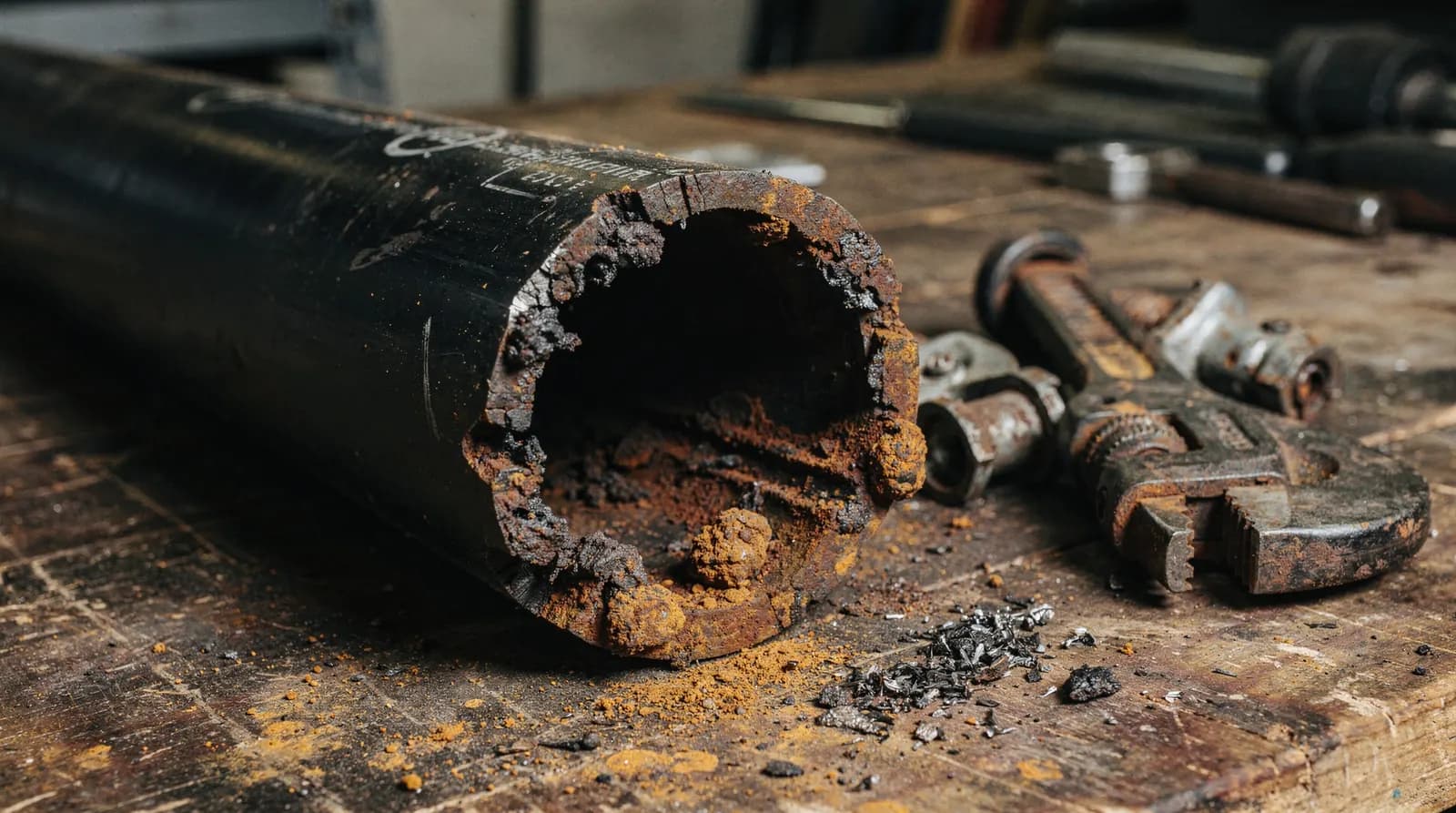
What comes out on the shop floor is rarely a surprise to a technician: a coupon of pipe with a rind of rust, a handful of grit, a sprinkler that won't flow. The point of the assessment is that the owner sees it before a fire does.
Sampling logic, and when it becomes an investigation
NFSA's 2025 summary of the chapter says the five-year assessment applies to every system, with one relaxation. On wet systems only, the assessment may be done on every other system in a facility. If material is found in one, all systems get assessed. Dry, preaction, standpipe and fire pump systems get assessed without that sampling allowance. NFSA also says non-metallic pipe such as CPVC is exempt, while copper is not.
We couldn't open the 2017 text of Section 14.2 to check that wording line by line. NFSA says Section 14.2 hasn't changed since 2014, so the summary should describe the edition Alberta references, but ask your inspector to confirm the sampling allowance before you rely on it for a multi-riser building.
If enough foreign material is found to obstruct pipe or sprinklers, an obstruction investigation follows (Section 14.3). It's a deeper look at the whole system that decides how far the contamination runs and whether the answer is flushing or pipe replacement. NFSA's summary lists five investigation points: the system or water control valve, the most remote end of a cross main, a branch line near the most remote cross main connection, a branch line at the end of the most remote branch, and a branch line connected to the most remote low point drain.
Investigations can start without waiting for the 5-year date. Section 14.3.1 lists the triggering conditions (NFSA counts 16, and the count varies a little between editions and summaries), among them plugged sprinklers, foreign material in valves or in drain test water, pinhole leaks, abnormally frequent tripping of a dry pipe valve, and a 50% increase in the time it takes water to reach the inspector's test connection during a dry pipe trip test. A system out of service for over a year is on that list too. Section 14.4 covers ice obstruction in dry pipe and preaction systems serving freezers and cold storage.
The other 5-year items on the same visit
The pipe isn't the only thing on a five-year clock. Published NFPA 25 frequency charts show these five-year items. The tank line comes from a chart of the 2014 edition and the rest from charts of the 2017 edition, and chart layouts differ between publishers, so have your inspector confirm the ones that matter to you:
| Item | Interval |
|---|---|
| Internal pipe assessment | Every 5 years (Chapter 14) |
| Alarm valve and check valve interiors | Every 5 years |
| Strainers, filters and orifices on valves | Every 5 years |
| Gauges, replace or calibrate | Every 5 years |
| Sprinkler system pressure reducing valves, full-flow test | Every 5 years |
| Extra-high temperature solder-type sprinklers, and sprinklers in harsh environments | Test every 5 years |
| Hose connection pressure reducing valves, full-flow test | Every 5 years |
| Water storage tank interior | Every 5 years (3 years for tanks without corrosion protection) |
Bundling them is efficient. The valves are already open and the system is already drained, so the same shutdown can cover the alarm valve internals, the strainers and the gauge swap. The NFPA 25 inspection frequency guide has the weekly to annual items around it.
What drives the cost
We don't publish prices, because a quote depends on the building. The variables that move it are predictable:
- How many systems and risers, and whether the wet-system sampling allowance applies.
- Dry or wet. Draining and refilling a dry system, and the air and trip testing afterward, take longer.
- Access. Sprinkler heads and pipe in a finished ceiling, in a mezzanine, over racking or in a freezer need lifts and time.
- The method: opening pipe, camera or water sampling.
- What's found. A clean assessment closes quickly. An obstruction investigation adds work, and repairs are quoted apart.
- Working hours. Occupied buildings often push the work to nights or weekends.
- Water disposal from flushing.
Ask for a quote that separates the assessment from any obstruction investigation, so you can see what you're buying.
Planning it around an occupied building
An internal assessment is a planned impairment. Draining a riser takes a system out of service, so the shutdown rules apply the way they do to any other work:
- A notification procedure for tests, repairs and alterations (NFC(AE) 2023 Division B, 6.1.1.3), acceptable to the fire department (Division C, 2.2.7.2(1)).
- Alternative measures while any part is shut down (6.1.1.4), which the explanatory note says can include emergency hose lines, portable extinguishers, extra fire watch and, where practicable, temporary water connections.
- NFPA 25 Chapter 15's impairment program: a coordinator, tags at the control valve and the fire department connection, and notice to the fire department, insurer and alarm company. NFPA's staff describe arrangements for outages longer than 10 hours in a 24-hour period.
A few practical points. Work zone by zone so the building is never entirely dry. Do it in shoulder season, not in a January cold snap, because a dry system that's been opened and refilled has water in it for the first time in a while. Put the monitoring company on test before you start and off test when you finish. And tell the tenants, all of them. Ask early who is doing the work, since Alberta's fire code treats repair of sprinkler systems as journeyperson sprinkler installer work while inspection, testing and maintenance can be done by holders of an approved NFPA 25 certificate (Division C, 2.2.4.4). Opening and reassembling piping sits close to that line, so confirm who will do it.
The Edmonton inspection reporting system matters here too. Since September 8, 2026, EFRS has asked for third-party inspection reports through the Life Safety Inspection Vault (LIV). Deficient reports must go through it, and EFRS recommends uploading all of them, so an assessment that finds an obstruction should reach LIV.
Keep the report. The code doesn't allow an inspection record to be destroyed within five years of being prepared, and records stay on site (NFC(AE) 2023 Division C, 2.2.1.2), so the report from one assessment is still on file when the next one is due. If your assessment is coming due, send the building details through the contact page. Our fire system inspections service handles the paper along with the pipe, and the fire sprinkler systems page describes what's behind those valves.
Frequently asked questions
Is the 5-year internal sprinkler inspection required in Alberta?
Yes for water-based systems. NFC(AE) 2023 Division B, 6.4.1.1 requires inspection, testing and maintenance to NFPA 25, and the edition Alberta references is NFPA 25-2017, which includes the five-year internal assessment in Chapter 14. Ask the AHJ if you believe an exception applies.
How long does a 5-year internal sprinkler inspection take?
It depends on the number of systems, access and the method. One accessible wet system can be quick, and a large dry system with obstruction findings isn't. We won't give a number without seeing the building. Ask your contractor for a schedule by zone.
Does every sprinkler system need an internal assessment?
According to NFSA, dry, preaction, standpipe and fire pump systems are assessed every time, while wet systems may be sampled, with every other wet system in a facility assessed, unless a problem turns up. NFSA also says CPVC is exempt. Confirm the sampling rule with your inspector for the 2017 edition.
What happens if debris is found in the pipe?
If enough foreign material is found to obstruct pipe or sprinklers, NFPA 25 requires an obstruction investigation under Section 14.3. It looks at how far the problem extends and decides between flushing, repair and replacement. The findings go in the inspection report, and deficient reports go through LIV in Edmonton.
Can the internal inspection be done without cutting the pipe?
Sometimes. NFPA 25's annex recognizes video inspection and water sampling as alternatives. Ultrasonic testing measures wall thickness and can miss obstructions. Talk to the AHJ before you rely on a non-invasive method for a system with a history.
Sources
- Assessing the Internals, NFPA 25 Internal Assessments, National Fire Sprinkler Association
- Internal Assessments and Fire Sprinkler Obstructions, National Fire Sprinkler Association
- ITM of Sprinkler Systems, The Five-Year Internal Assessment, Plumbing and HVAC industry publication (phcppros)
- National Fire Code 2023 Alberta Edition, National Research Council Canada
- NFPA 25 2017 inspection frequency chart, Falcon Fire Sprinkler
- NFPA 25 2017 edition chart, Siemens
- Impairment Procedures for Sprinkler Systems That Are Out of Order, NFPA
- Fire Inspection Report Submission, City of Edmonton
- FM Global Data Sheet 2-1 update, ECS, a nitrogen equipment vendor